
PM Modi and UK PM Keir Starmer met in Mumbai to strengthen trade, defence, and technology partnerships
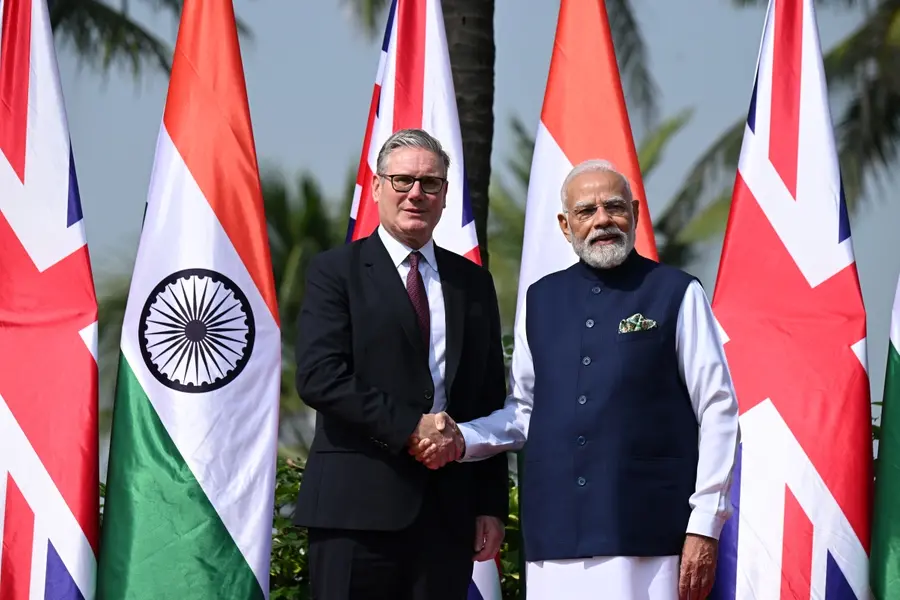
Mumbai: Prime Minister Narendra Modi met UK Prime Minister Keir Starmer in Mumbai on Thursday, marking Starmer’s first visit to India since taking office. The leaders discussed ways to strengthen bilateral ties, focusing on trade and defence, and are expected to announce further investment initiatives.
The meeting comes soon after the India-UK Comprehensive Economic and Trade Agreement (CETA) was finalised. Both leaders highlighted the growing partnership between the two countries and the importance of technology security and economic collaboration.
Starmer arrived in India on Wednesday for a two-day visit, accompanied by the largest-ever UK trade delegation to India, with over 100 companies and organisations in tow. The UK Prime Minister’s office had previously announced that 64 Indian companies would invest a total of 1.3 billion pounds ($1.75 billion) in the United Kingdom.
What did PM Modi and Keir Starmer discuss?
The two leaders focused on enhancing cooperation in trade and defence. Discussions are expected to include operationalising the recently signed trade agreement and strengthening technology partnerships.
How is India working to expand trade with the UK?
Commerce and Industry Minister Piyush Goyal said his meeting with Prime Minister Starmer further strengthened economic ties and trade cooperation between India and the UK.
“Delighted to call on UK Prime Minister Keir Starmer. Discussed avenues to further deepen India-UK trade and economic partnership for mutual prosperity,” Goyal wrote on X.
Earlier, Goyal met Peter Kyle, the UK Secretary of State for Business and Trade, to discuss steps to implement the India-UK CETA and the goal of doubling bilateral trade by 2030.
“The meeting marked a significant step towards operationalising the India-UK CETA, with both Ministers agreeing to reposition the Joint Economic and Trade Committee (JETCO) to oversee its implementation and delivery,” said a statement from the Commerce Ministry.
Both sides underlined their commitment to a swift, coordinated, and results-driven execution of the agreement to ensure maximum benefits for businesses and consumers in both nations.
What are the key priorities under CETA?
The ministers emphasised their shared ambition to double bilateral trade by 2030, focusing on sectors such as advanced manufacturing, digital trade, clean energy, and services. They discussed ways to maximise the agreement’s impact through regulatory cooperation, reducing non-tariff barriers, and integrating supply chains.
Ahead of the ministerial talks, sectoral roundtables were held in priority areas including Advanced Manufacturing, Consumer Goods, Food and Drink, Science, Technology and Innovation, Construction, Infrastructure, and Clean Energy. Financial, Professional and Business Services, including IT/ITeS, education, and engineering, were also covered. These discussions brought together industry leaders from both countries to guide the implementation of the trade agreement.
What role did business leaders play?
The India–UK CEO Forum convened business leaders from both nations to explore new trade, investment, and innovation opportunities. Co-chaired by prominent representatives from India and the UK, the forum served as a key platform to strengthen economic cooperation and foster long-term partnerships. The discussions highlighted a shared commitment to building a modern, mutually beneficial, and sustainable economic relationship between India and the UK, underpinned by the CETA agreement.
(with agency inputs)
Published: 09 Oct 2025, 10:49 am IST
Related Topics
Disclaimer: Kindly avoid objectionable, derogatory, unlawful and lewd comments, while responding to reports. Such comments are punishable under cyber laws. Please keep away from personal attacks. The opinions expressed here are the personal opinions of readers and not that of Mathrubhumi.
