
The Winter Session concluded with the Lok Sabha adjourned sine die on Day 15, as key Bills were tabled even while opposition parties mounted united protests over the replacement of MGNREGA with the VB-G RAM G law.
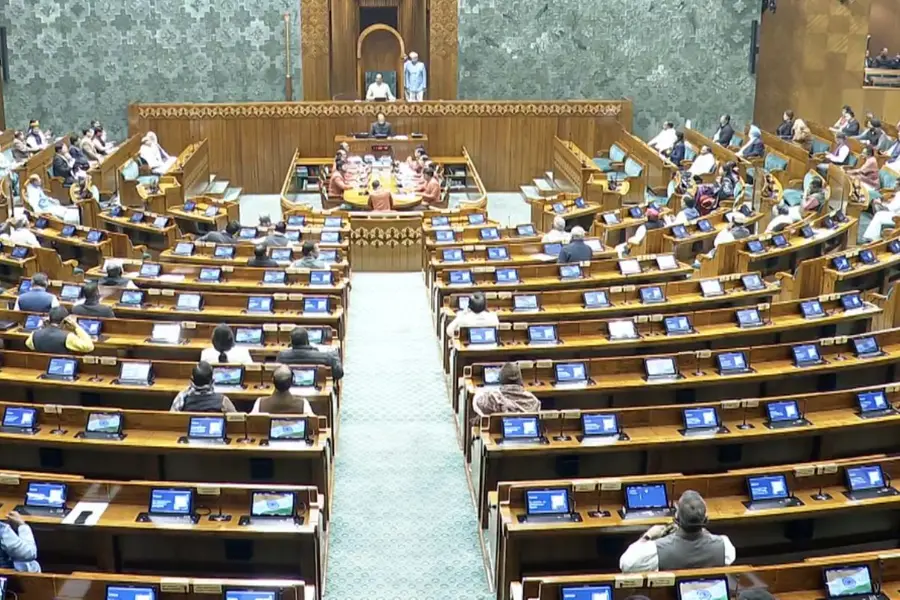
The Lok Sabha was adjourned sine die on Friday, bringing the Winter Session of Parliament to a close, even as the final sitting unfolded amid intense political confrontation over the Viksit Bharat Guarantee for Rozgar and Ajeevika Mission (Gramin) (VB-G RAM G) Bill, which replaces the Mahatma Gandhi National Rural Employment Guarantee Act (MGNREGA).
The House was earlier adjourned following repeated disruptions after the passage of the VB-G RAM G Bill, which was cleared by both Houses amid sloganeering, walkouts, and protests by opposition members. With only one sitting left in the Winter Session, the government has lined up several legislative items, along with the tabling of multiple parliamentary committee reports.
As per the day’s agenda, several Union Ministers are scheduled to lay papers on the Table of the House. These include ministers from key portfolios such as Culture, Law and Justice, Health, Education, Agriculture, Environment, Labour, Rural Development, Civil Aviation, Commerce and Industry, and Social Justice, reflecting a packed final-day schedule despite the political turbulence.
Several Bills are also listed for introduction. DMK MP D Ravikumar is set to seek leave to introduce two Constitutional Amendment Bills, 2024—one proposing the insertion of a new Article 21B, and another seeking to substitute a new provision for Article 129.
Congress MP Adv Dean Kuriakose will move to introduce the Mahatma Gandhi National Rural Employment Guarantee (Amendment) Bill, 2024, aimed at amending Section 22 and related provisions.
Congress MP Hibi Eden’s colleague HRI Shafi Parambil is scheduled to introduce the Digital Personal Data Protection (Amendment) Bill, 2024, along with the National Commission for Fair Labour Practices Bill, 2024. BJP MP Rajesh Verma is also set to introduce the Air (Prevention and Control of Pollution) Amendment Bill, 2024, which proposes changes to Section 2A and other provisions of the Act.
The legislative push, however, has been overshadowed by widespread opposition outrage over the passage of the VB-G RAM G Bill, which formally replaces MGNREGA. Opposition parties have accused the BJP-led government of rushing the legislation through Parliament without adequate consultation and weakening a landmark rights-based welfare scheme.
Congress MP Randeep Surjewala termed the passage of the Bill “the saddest day for labourers in the history of independent India,” alleging that nearly 12 crore rural workers would be adversely affected.
Senior Congress leader Abhishek Manu Singhvi said the Bill symbolised the government’s “arrogance” and criticised the Centre for refusing to send it to a Select Committee despite repeated demands.
Trinamool Congress leaders mounted one of the sharpest attacks, staging a 12-hour dharna outside Samvidhan Sadan. TMC MP Dola Sen said it was the opposition’s responsibility to raise the voice of the people, while Rajya Sabha MP Sagarika Ghose accused the government of using “bulldozer tactics” to push through the Bill.
She controversially claimed that renaming MGNREGA amounted to a “second assassination of Mahatma Gandhi.”
Congress MP Manickam Tagore announced that Congress Lok Sabha MPs would meet at the CPP office, alleging that Gandhi’s name was deliberately removed from the legislation. CPI MP P Sandosh Kumar described the Bill as “dropping a bomb on the poor,” warning that protests would intensify on the streets.
Defending the legislation, Union Agriculture Minister Shivraj Singh Chouhan said the VB-G RAM G Bill would play a crucial role in improving rural welfare.
He accused the Congress of disrespecting Mahatma Gandhi’s ideals and misleading the public. The government has highlighted that the new scheme guarantees 125 days of wage employment per rural household, up from 100 days under MGNREGA.
Under Section 22 of the Bill, the Centre-State fund-sharing ratio will be 60:40, while for Northeastern states, Himalayan states, and Union Territories such as Uttarakhand, Himachal Pradesh and Jammu and Kashmir, it will be 90:10. Section 6 allows states to notify up to 60 days in a financial year during peak agricultural seasons.
As the Lok Sabha was adjourned sine die, the Winter Session ended on a note of sharp political polarisation, with the government pushing through key legislation and the opposition vowing to take the battle over MGNREGA’s replacement to the streets.
Published: 19 Dec 2025, 11:18 am IST
Disclaimer: Kindly avoid objectionable, derogatory, unlawful and lewd comments, while responding to reports. Such comments are punishable under cyber laws. Please keep away from personal attacks. The opinions expressed here are the personal opinions of readers and not that of Mathrubhumi.
