
New Delhi: Minister of Parliamentary Affairs & Minority Affairs Kiren Rijiju, on Sunday, expressed gratitude at the Modi government’s decision to officially classify the ancient language Pali as a Classical Language.
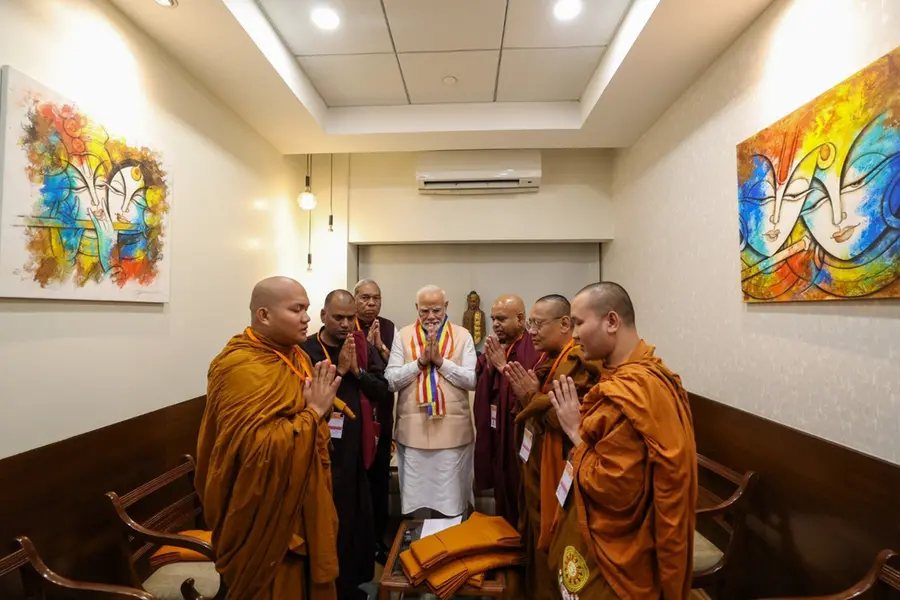
Taking to X, the Member of Parliament from Arunachal Pradesh shared a video clip of Prime Minister Narendra Modi with Buddhist Monks, in prayer amid chants.
“Ven Members of the Bhikkhu Sangh, Mumbai with @narendramodi Ji and expressed gratitude on the Cabinet decision to confer the much-needed status of Classical Language on Pali and Marathi,” he wrote on X.
Members of the Bhikku Sangh in Mumbai met the Prime Minister on Saturday and expressed joy at the government’s decision to classify Pali and Marathi as Classical Languages.
In a post on X, PM Modi acknowledged the Bhikkhu Sangh’s happiness at the decision of his Cabinet.
He went on to share about the monks: “They recalled the strong connection of Pali with Buddhism and expressed confidence that more youngsters will learn about Pali in the coming times.”
About Pali Language:
The Pali language is sacred language for Buddhists as it is the language of the Theravada Buddhist scriptures, known as the Pali Canon, which contains the core teachings of the Buddha. It connects practitioners with the historical roots of Buddhism, enriching their understanding of key concepts like impermanence, suffering, and non-self.
The Buddha used Pali to deliver his sermons and his followers used it to spread his teachings throughout the world.
Newly recognised Classical Language:
The Union Cabinet on Thursday approved to confer the status of classical language to Marathi, Pali, Prakrit, Assamese, and Bengali languages.
History of Classical languages:
The Government of India introduced the "classical language" category on October 12, 2004, first declaring Tamil as a classical language.
The government set criteria for the status, requiring that the language must have high antiquity with early texts or recorded history over a thousand years old, a body of ancient literature or texts considered a valuable heritage, and an original literary tradition not borrowed from another speech community.
A Linguistic Experts Committee (LEC) was established by the Ministry of Culture under Sahitya Akademi in November 2004 to examine proposed languages for classical status.
The criteria were revised in November 2005, and Sanskrit was subsequently declared a classical language.
The Government of India has conferred classical language status to Tamil (2004), Sanskrit (2005), Telugu (2008), Kannada (2008), Malayalam (2013), and Odia (2014).
(with agency inputs)
Published: 06 Oct 2024, 12:43 pm IST
Related Topics
Disclaimer: Kindly avoid objectionable, derogatory, unlawful and lewd comments, while responding to reports. Such comments are punishable under cyber laws. Please keep away from personal attacks. The opinions expressed here are the personal opinions of readers and not that of Mathrubhumi.
