
As rescue efforts continue, Chief Minister Mamata Banerjee blames the Centre for “man-made” floods, while the Union government refutes the charge, citing active cooperation with Bhutan and ongoing river projects.
Darjeeling: Even as floodwaters began to recede in parts of North Bengal on Monday, the devastation left behind was stark — submerged villages, collapsed bridges, and scarred hillsides from over 40 landslides.
At least 30 people have died, six remain missing, and thousands have been displaced across Darjeeling, Jalpaiguri, Alipurduar, Kalimpong, and Cooch Behar.
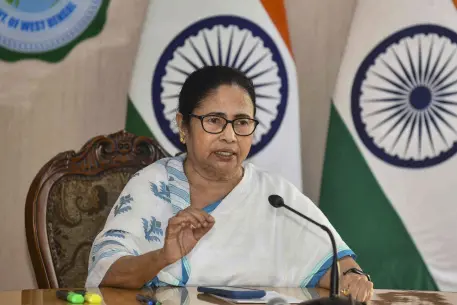
Chief Minister Mamata Banerjee, who rushed to the affected areas early Monday, announced ₹5 lakh compensation for each victim’s family and a government job for one kin.
She blamed the disaster partly on what she termed a “man-made flood”, alleging the Centre’s negligence in river dredging, de-siltation, and flood control.
“If the Centre had done its job of dredging the Ganga-Hooghly, if DVC had completed de-siltation, and if dams under Union control hadn’t been used against us, our people would have been spared,” Banerjee said in Jalpaiguri.
“I have repeatedly urged the Centre to set up an Indo-Bhutan River Commission, but my calls have gone unheard.”
Torrential rain and thunderstorms over the weekend triggered flash floods and landslides in the Darjeeling and Mirik hills.
Overflowing rivers — including the Teesta, Torsa, Sankosh, and Raidak — inundated vast stretches of land. Hundreds of stranded tourists were rescued by Army and NDRF teams, who continued relief work on Monday.
Among the casualties was eight-year-old Aarushi Chhetri from Mirik, killed in a landslide while visiting her grandmother. Himadri Purkait, a Jadavpur University student touring the region, remains missing.
The India Meteorological Department has forecast a further drop in rainfall across North Bengal by Tuesday.
Centre Counters “Discrimination” Charge
A day after Banerjee’s remarks, the Centre rejected her allegations of “discrimination” and “inaction” in flood management.
The Ministry of Jal Shakti said that India and Bhutan already have multiple institutional mechanisms, including the Joint Group of Experts (JGE) and Joint Technical Team (JTT) to coordinate on trans-border river issues affecting Bengal.
“India and Bhutan are already working closely through JGE, JTT, and JET to address river erosion, silt deposition, and flash floods,” the ministry said in a post on X.
It added that ₹1,290 crore has been released to West Bengal under the Flood Management and Border Areas Programme (FMBAP) and clarified that no state project is pending with the Centre.
Responding to Banerjee’s claim that the Ganga Action Plan had been halted, the ministry said:
“Sixty-two projects worth ₹5,648 crore have been undertaken in West Bengal under the Ganga Action Plan and Namami Gange — including the Tolly Nullah rejuvenation in Kolkata.”
The ministry also said eight additional rivers entering Bengal from Bhutan — such as Hashimara Jhora, Rokia, Dhawla Jhora, and Raidak I & II — have been taken up for joint studies on erosion and sedimentation.
As relief operations continue, both the state and Centre have promised coordination — but their public sparring underscores the growing tension over disaster management and river governance in Bengal’s flood-prone north.
Published: 07 Oct 2025, 10:01 am IST
Related Topics
Disclaimer: Kindly avoid objectionable, derogatory, unlawful and lewd comments, while responding to reports. Such comments are punishable under cyber laws. Please keep away from personal attacks. The opinions expressed here are the personal opinions of readers and not that of Mathrubhumi.
