
Governor accepts his resignation as the state prepares for the formation of a new government
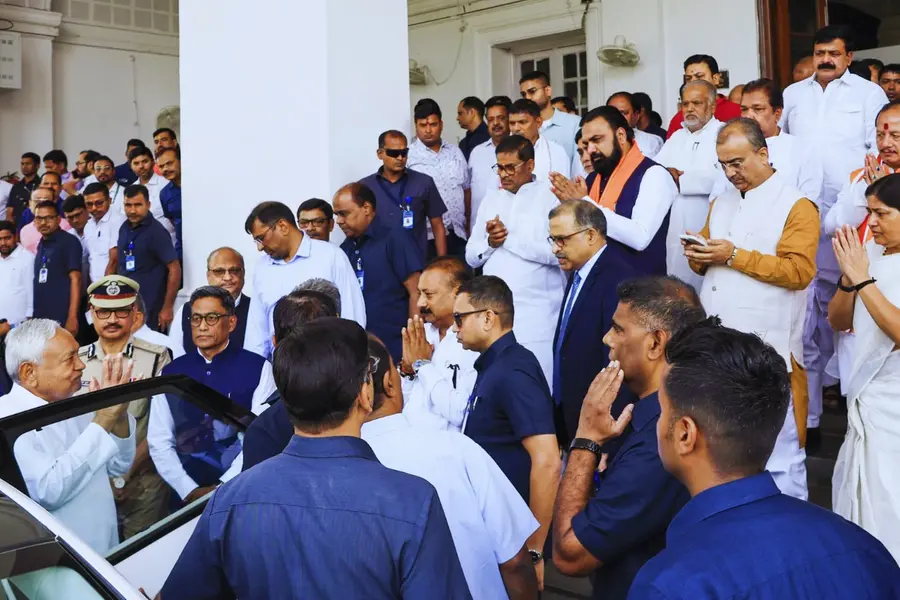
Patna: Nitish Kumar stepped down as the Chief Minister of Bihar on Tuesday, bringing to a close an influential political chapter that lasted nearly two decades. He handed over his resignation to Governor Syed Ata Hasnain at Lok Bhavan earlier this afternoon.
His resignation follows his transition to the Rajya Sabha, signalling a shift from state politics to a role at the national level.
"...We had decided that I would now leave the post of Chief Minister, and therefore, after today's cabinet meeting, I met the Governor and submitted my resignation to him. Now the new government will look after the work here. The new government will have my full cooperation and guidance," He wrote on X.
Nitish Kumar, who served a record 10 terms as Chief Minister since 2005, was elected to the Rajya Sabha on March 16. Constitutional provisions do not allow an individual to hold membership in both a state legislature and Parliament at the same time. This required him to resign from the Bihar Legislative Council and consequently vacate the Chief Minister’s post.
He was sworn in as a Member of Parliament in the Rajya Sabha on April 10. Following this change, Kumar will shift from his official residence at 1, Anne Marg to 7, Circular Road.
A defining figure in Bihar politics
For close to 20 years, Nitish Kumar remained central to Bihar’s political landscape. As the leader of the Janata Dal (United), his exit is being viewed as a consequential shift in the state’s politics.
His departure has opened the door for alliance partner Bharatiya Janata Party to appoint its first Chief Minister in Bihar, a state where the party has traditionally functioned either as a junior partner or within coalition arrangements. Deputy Chief Minister Samrat Choudhary is set to take over the role.
Leadership transition underway
The BJP-led National Democratic Alliance will hold a legislative meeting on Tuesday to formally choose its new leader. Samrat Choudhary has already been elected as the BJP legislature party leader, and his name is expected to be put forward at Lok Bhavan.
According to senior party sources, Choudhary is likely to be sworn in as Chief Minister on Wednesday, April 15, at 11 am.
Governance style and key initiatives
Nitish Kumar was known for his focus on social engineering and his willingness to change political alliances. His tenure saw several development-driven initiatives, including schemes such as providing bicycles to schoolgirls and pushing for infrastructure improvements across the state.
These efforts earned him the nickname ‘Sushashan Babu’, reflecting his emphasis on governance and administrative reforms.
Political journey
Kumar’s political career stretches over 50 years, beginning during the socialist movements of the 1970s. He first became active in public life as a student leader during Jayaprakash Narayan’s ‘Total Revolution’ movement between 1974 and 1977. During the Emergency, he was detained under the Maintenance of Internal Security Act.
After early electoral setbacks, he secured his first victory in 1985 from the Harnaut constituency, entering the Bihar Legislative Assembly.
Transition to national politics and ministerial roles
In 1989, Kumar moved to national politics after winning the Barh Lok Sabha seat. He later served in the Union Cabinet under both V P Singh and Atal Bihari Vajpayee, handling key ministries such as Railways, Agriculture, and Surface Transport.
During his tenure as Railway Minister, he introduced reforms including internet ticket booking and the tatkal reservation scheme.
Early Chief Ministerial stint and return to power
Kumar briefly held the Chief Minister’s position in 2000 for seven days following a hung assembly before stepping down.
He returned to power in 2005 in alliance with the BJP and prioritised restoring law and order, strengthening infrastructure, and promoting women’s empowerment. The bicycle scheme for schoolgirls became one of the most recognised initiatives during this period.
Political realignments
From 2013 onwards, Kumar became known for frequently shifting alliances, often described as ‘U-turns’, earning him the moniker ‘Paltu Ram’.
He parted ways with the BJP in 2013 over Narendra Modi’s elevation and formed the Mahagathbandhan with the Rashtriya Janata Dal in 2015. He later returned to the National Democratic Alliance in 2017.
Between 2022 and 2024, he again switched from the NDA to the Mahagathbandhan, aligning with the INDIA bloc, before eventually returning to the NDA once more.
Final term and exit
In the 2025 assembly elections, Nitish Kumar led the NDA to a significant victory and took oath as Chief Minister for a record 10th term.
With his resignation now formalised, Bihar enters a new political phase, as leadership passes to the Bharatiya Janata Party for the first time in the state’s history.
With agency inputs
Published: 14 Apr 2026, 03:32 pm IST
Related Topics
Disclaimer: Kindly avoid objectionable, derogatory, unlawful and lewd comments, while responding to reports. Such comments are punishable under cyber laws. Please keep away from personal attacks. The opinions expressed here are the personal opinions of readers and not that of Mathrubhumi.
