
Nitin Gadkari recalls meeting Hamas leader Ismail Haniyeh hours before his assassination in Tehran
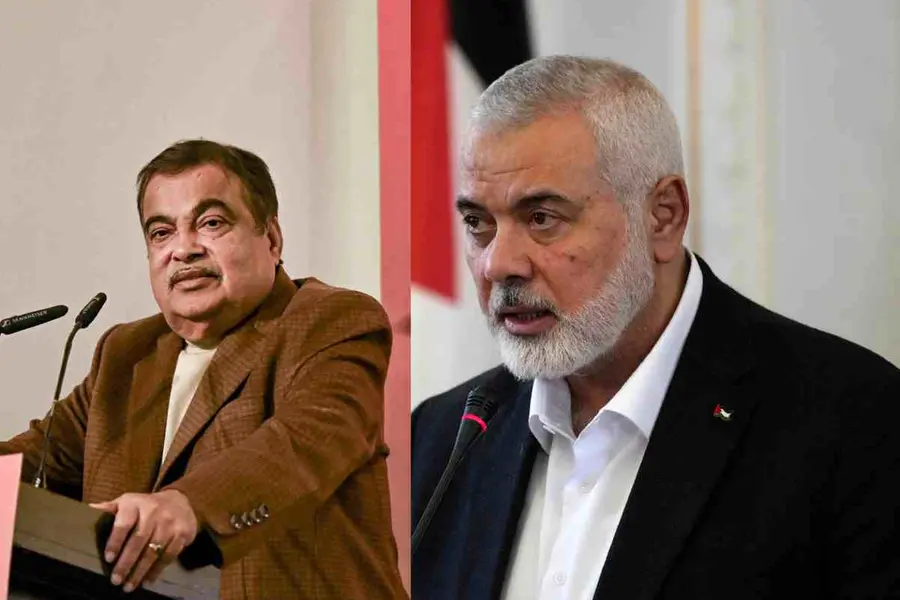
New Delhi: Union Minister Nitin Gadkari has spoken publicly about a chance encounter that placed him just hours away from one of the Middle East’s most startling assassinations — the killing of Hamas political chief Ismail Haniyeh in Tehran.
Addressing an audience at a book launch, Gadkari recalled his visit to Iran, where he had travelled to Iran at the request of Prime Minister Narendra Modi to attend the oath-taking ceremony of Iran’s newly elected President, Masoud Pezeshkian. The minister said the visit unexpectedly coincided with the final hours of Haniyeh’s life.
Ahead of the formal ceremony, senior leaders and dignitaries from several countries gathered informally at a five-star hotel in Tehran. Gadkari said it was during this interaction that he noticed Haniyeh, who stood out as the only attendee who was not a head of state.
“I met him and shook hands with him. He was the Hamas Chief. I saw him going to the swearing-in ceremony along with the President and the Chief Justice,” Gadkari recounted.
The Indian minister said he returned to his hotel after the ceremony. However, events took a dramatic turn in the early hours of the morning. At around 4 am, Gadkari was informed by Iran’s ambassador to India that his immediate departure was required.
When he asked for an explanation, Gadkari was told that Haniyeh had been assassinated. “I was shocked and when I asked how it happened, I was told that the details were still unclear,” he said.
Iranian authorities later confirmed that the killing took place at approximately 1:15 am on July 31. Haniyeh was staying at a high-security military facility in Tehran, guarded by the Islamic Revolutionary Guard Corps (IRGC). His bodyguard also lost his life in the attack.
Gadkari noted that questions surrounding the method of assassination persist even now. Gadkari said, “Some people say he was killed because of using his mobile phone. Some say it happened in some other way.”
Speaking more broadly at the same event, the Union Minister remarked that national strength acts as a deterrent on the global stage. Referring to Israel, he said that despite its small size, the country has projected influence through advanced technology and military capability.
Following the incident, the IRGC stated that a short-range missile had struck the building where Haniyeh was residing. He had been in Tehran specifically to attend President Pezeshkian’s inauguration.
Mossad angle emerges in assassination claims
According to a report by The Telegraph, Israel’s intelligence service, Mossad, allegedly worked with Iranian security personnel to place explosive devices inside the building where Haniyeh was staying.
According to the report, the initial plan had been to target Haniyeh during an earlier visit to Tehran in May, when he attended the funeral of former Iranian President Ebrahim Raisi. That attempt was reportedly dropped due to the presence of large crowds, which officials feared could compromise the operation.
The revised strategy allegedly focused on an IRGC guesthouse in northern Tehran, identified as a likely place of stay for the Hamas leader. Two Iranian officials cited in the report claimed that agents acting under Mossad’s direction planted explosives in three separate rooms within the facility.
Surveillance footage reportedly shows the operatives entering and leaving multiple rooms in a short span of time. After the devices were placed, the agents are said to have exited Iran without detection, while maintaining at least one operative inside the country. At around 2 am, the explosives in the room occupied by Haniyeh were remotely detonated.
Authorities within the IRGC have since acknowledged the severity of the security lapse. One official told The Telegraph that Mossad may have exploited members of the Ansar-al-Mahdi protection unit — a force responsible for safeguarding senior Iranian officials and allied leaders, both domestically and overseas.
Published: 25 Dec 2025, 12:36 pm IST
Related Topics
Disclaimer: Kindly avoid objectionable, derogatory, unlawful and lewd comments, while responding to reports. Such comments are punishable under cyber laws. Please keep away from personal attacks. The opinions expressed here are the personal opinions of readers and not that of Mathrubhumi.
