
Vice-presidential election uses ballot paper preference voting; NDA’s CP Radhakrishnan faces INDIA bloc’s Sudershan Reddy.
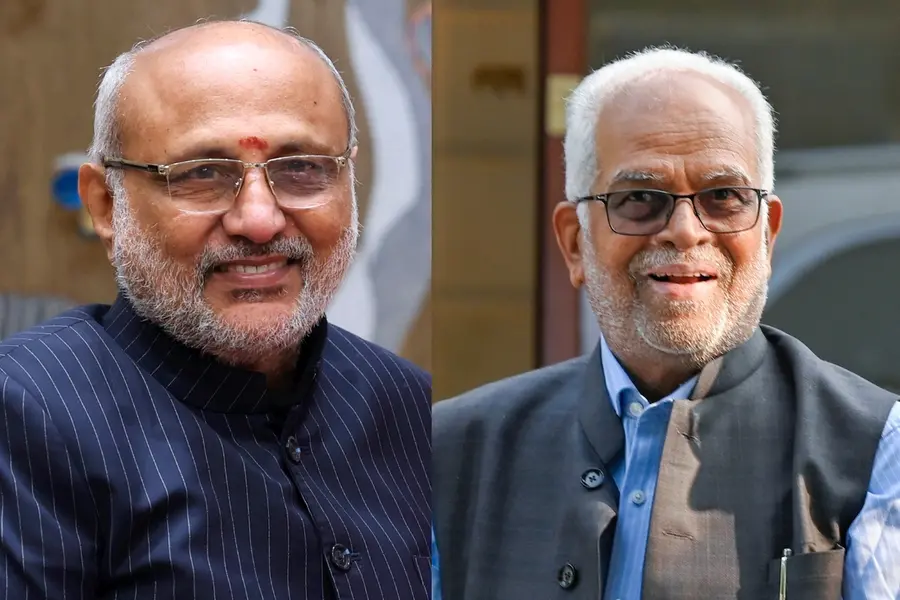
India’s next vice-president will be chosen through a ballot-paper vote on Tuesday, September 9, in a contest between NDA nominee CP Radhakrishnan and INDIA bloc candidate Sudershan Reddy. The election is being held after Jagdeep Dhankhar’s sudden resignation in July citing health reasons.
How does the election take place?
The vice-president is elected by members of both Houses of Parliament—the Lok Sabha and the Rajya Sabha—forming an electoral college of 786 members. With one seat vacant in the Lok Sabha and five in the Rajya Sabha, the actual strength is slightly lower. Out of this, a candidate needs 394 votes to win.
Voting will be conducted from 10 am to 5 pm on Tuesday, followed by counting at 6 pm the same day.
Why no EVMs in this election?
Unlike Lok Sabha or state assembly elections, electronic voting machines (EVMs) are not used in vice-presidential or presidential polls. Instead, MPs will mark their preferences on paper ballots.
This is because the system here is proportional representation through a single transferable vote. Each MP ranks candidates in order of preference by writing 1, 2, 3, and so on next to their names. If no candidate secures a majority in the first count, the votes of the least successful candidates are transferred based on the second or third preferences marked. This continues until one candidate crosses the halfway mark.
EVMs, which only tally votes in direct elections, cannot handle this preference-based system without a different technology. Officials explain that is why ballot papers remain essential for such elections.
Tomorrow’s scenario: who is contesting?
This time, the ruling NDA has fielded CP Radhakrishnan, the governor of Maharashtra and a senior BJP leader from Tamil Nadu. At 68, he is regarded as a soft-spoken, non-controversial leader with strong RSS roots. He belongs to the Goundar-Kongu Vellalar community and remains the only BJP leader from Tamil Nadu elected twice to the Lok Sabha, in 1998 and 1999. He took charge as Maharashtra governor on July 31, 2024.
Challenging him is B Sudershan Reddy, 79, a retired Supreme Court judge nominated by the opposition INDIA bloc. Known for landmark judgments, he had criticised the Union government’s delay in probing black-money cases and declared Salwa Judum, a state-backed militia in Chhattisgarh, unconstitutional before retiring in 2011.
Who has the numbers?
The NDA enters the contest with a clear advantage. In the 542-member Lok Sabha, it commands 293 MPs, while in the 240-member Rajya Sabha it has 129 supporters. This puts its total backing at about 422 votes, well above the 394 needed for a win.
The BRS and BJD have opted to stay away, further tilting the contest in favour of the ruling alliance.
Published: 08 Sept 2025, 04:11 pm IST
Related Topics
Disclaimer: Kindly avoid objectionable, derogatory, unlawful and lewd comments, while responding to reports. Such comments are punishable under cyber laws. Please keep away from personal attacks. The opinions expressed here are the personal opinions of readers and not that of Mathrubhumi.
