
NASA says stubble burning in northern India is increasingly occurring later in the day, complicating satellite monitoring and worsening air pollution risks.
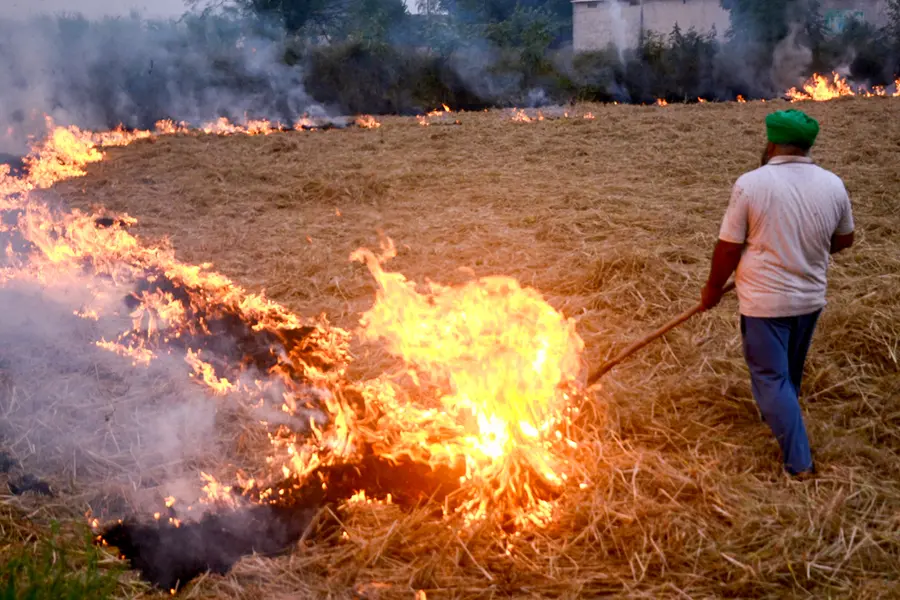
Washington: NASA has warned that stubble burning in northern India is increasingly taking place later in the day, a behavioural shift that scientists say could complicate efforts to track crop fires and accurately assess their impact on air pollution and air quality.
Satellite observations and recent studies show that while the overall stubble-burning season in 2025 followed the usual October-to-December pattern across the Indo-Gangetic Plain, the daily timing of fires has changed significantly, according to a NASA statement.
For decades, smoke and haze from post-harvest crop residue burning have spread across northern India after the rice harvest, often triggering severe air pollution episodes in Delhi and neighbouring regions. In 2025, air quality again deteriorated for nearly a month after fire activity intensified in the last week of October, said Hiren Jethva, an atmospheric scientist at Morgan State University working with NASA’s Goddard Space Flight Centre.
Jethva, who has tracked stubble burning in India using satellite data for more than a decade, said earlier fire seasons typically saw most crop fires lit in the early afternoon, between 1 pm and 2 pm. However, that pattern has shifted in recent years.
“In the past few years, stubble fires have occurred progressively later in the day,” Jethva said, adding that most fires now occur between 4 pm and 6 pm local time. “Farmers have changed their behaviour,” he noted.
The shift was identified using high-frequency observations from GEO-KOMPSAT-2A, a South Korean geostationary satellite launched in 2018 that records data every 10 minutes. By contrast, commonly used fire-detection sensors such as MODIS and VIIRS, which pass over the same location only once or twice a day, may miss a significant number of these late-evening stubble fires, scientists said.
Satellite imagery underscores the scale of the issue. On November 11, 2025, NASA’s Aqua satellite captured thick plumes of smoke spreading across Punjab, Haryana, Uttar Pradesh and Madhya Pradesh. Media reports said air pollution levels exceeded 400 on India’s Air Quality Index, the highest category, on multiple days during the period.
As in previous years, authorities in several regions responded by closing schools, curbing construction activity and imposing other emergency measures. Scientists note that when winds are weak and atmospheric conditions remain stagnant, pollution levels can rise to several times above World Health Organisation limits.
Jethva’s analysis found that stubble-burning activity in Punjab and Haryana in 2025 was moderate compared to recent years. Fire counts were higher than in 2024, 2020 and 2019, but lower than in 2023, 2022 and 2021.
Indian researchers have independently reported a similar trend. A 2025 study in the journal Current Science showed peak fire activity shifting from around 1.30 pm in 2020 to about 5 pm in 2024, based on Meteosat Second Generation satellite data. In December 2025, the International Forum for Environment, Sustainability & Technology published a multi-satellite analysis that reached comparable conclusions.
While the link between stubble burning and Delhi’s air pollution is widely recognised, scientists continue to debate the exact contribution of crop fires relative to other pollution sources such as vehicles, industrial emissions, domestic fuel use, fireworks and dust storms.
“Studies report contributions ranging from 10 to 50 per cent,” said Pawan Gupta, a NASA research scientist specializing in air quality,” said Pawan Gupta, a NASA research scientist specialising in air quality. Gupta estimates that crop fires account for 40 to 70 per cent of pollution on peak days, falling to 20 to 30 per cent over a month, and less than 10 per cent on an annual average.
He added that meteorological conditions, including low temperatures and a shallow boundary layer during winter, further complicate pollution assessment.
Scientists warn that the later timing of stubble fires could worsen overnight pollution build-up, as evening burns often coincide with weaker winds and reduced atmospheric mixing, allowing pollutants to accumulate more efficiently.
IANS
Published: 16 Dec 2025, 09:19 am IST
Related Topics
Disclaimer: Kindly avoid objectionable, derogatory, unlawful and lewd comments, while responding to reports. Such comments are punishable under cyber laws. Please keep away from personal attacks. The opinions expressed here are the personal opinions of readers and not that of Mathrubhumi.
