
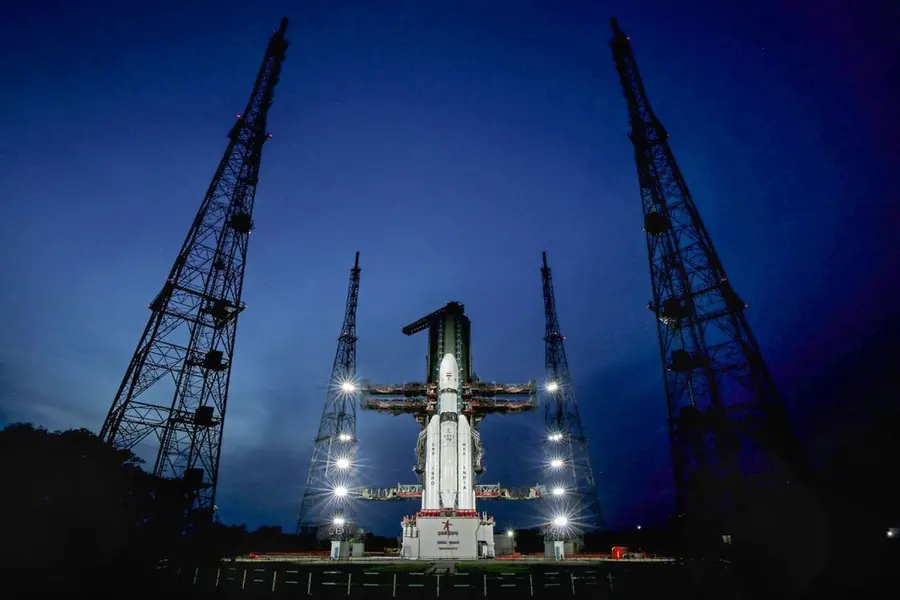
Ernakulam: Former NASA astronaut Steve Lee Smith has lauded India for its accomplishments in the space sector, remarking that the country has achieved feats unprecedented in global history.
Speaking to ANI, Smith said, "India has been very successful in space (sector) in the last 20 years, very well respected around the world. Mission Over Mars to circle Mars, it was the first time a country had ever done that. India landed on the moon last year. In the world history, they just did something no one has ever done."
"And just months later, India is preparing its own capsule to send humans to space and they have name their astronauts also. Hopefully, Indian Astronauts on an India's spaceship will go into space," he expressed his desire.
The Mars Orbiter Mission, unofficially known as Mangalyaan, was a space probe orbiting Mars since 24 September 2014. It was launched on 5 November 2013 by the Indian Space Research Organisation.
In related developments, NASA is set to train two Indian astronauts, one of whom is scheduled to fly to the International Space Station (ISS) later this year. ISRO Chairman S. Somanath previously announced plans for selecting four astronauts for training.
India's planned space station, named Bharatiya Antariksha Station, will be constructed and operated by the Indian Space Research Organisation (ISRO), expected to be completed by 2035. In contrast, NASA plans to retire the ISS by 2031.
The Indian space station will be significantly smaller than the ISS, weighing 20 tonnes (compared to ISS's 450 tonnes and China's Tiangong Space Station's 100 tonnes), and will be utilized for microgravity experiments in an orbit around Earth at an altitude of approximately 400km.
Additionally, the Indian Space Research Organisation (ISRO) announced that India's first solar mission, the Aditya-L1 spacecraft, completed its first halo orbit around the Sun-Earth L1 point on July 3.
Launched on September 2 last year, the Aditya-L1 mission is an Indian solar observatory stationed at the Lagrangian point L1, achieving its targeted halo orbit on January 6 this year. The spacecraft takes 178 days to complete one revolution around the L1 point.
ANI
Published: 13 Jul 2024, 07:11 pm IST
Disclaimer: Kindly avoid objectionable, derogatory, unlawful and lewd comments, while responding to reports. Such comments are punishable under cyber laws. Please keep away from personal attacks. The opinions expressed here are the personal opinions of readers and not that of Mathrubhumi.
