
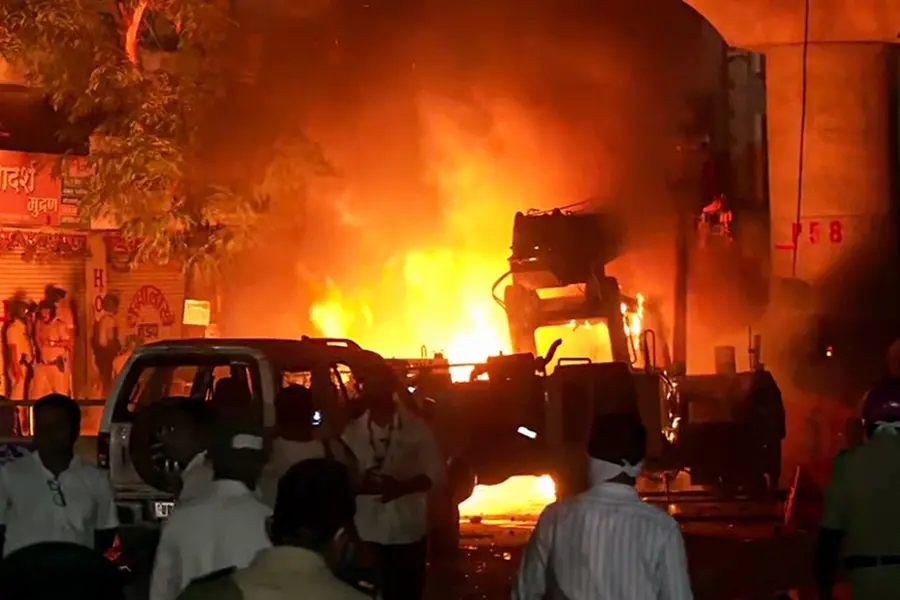
Maharashtra:Nagpur witnessed widespread violence on Monday as a protest demanding the removal of Mughal emperor Aurangzeb’s tomb spiraled into communal clashes. The unrest, triggered by unverified social media claims of holy book desecration, saw large-scale arson, stone-pelting, and police action, leaving several injured and prompting a citywide curfew.
How the violence unfolded
The tensions began in the morning with a Shiv Jayanti programme at the Chhatrapati Shivaji Maharaj statue in Nagpur’s Mahal area. Later, around 40–50 workers from the Vishwa Hindu Parishad (VHP) and Bajrang Dal staged a demonstration, demanding the removal of Aurangzeb’s tomb, a long-standing demand of right-wing groups.

During the protest, demonstrators set fire to an effigy of Aurangzeb, covering it with a sheet before burning it. However, shortly after, rumours spread that a religious text had also been set ablaze during the demonstration. These unverified claims quickly went viral on social media platforms, fueling tensions among local communities.
By evening, thousands of people from the Muslim community gathered in protest. Slogans were shouted, and the situation turned volatile around 7:30 PM. Clashes erupted as stone-pelting began, and soon, violent mobs took to the streets.
Arson and clashes escalate
As the situation worsened, several vehicles, including cars, motorcycles, and a crane, were set on fire. Shops and houses in the Chitnis Park and Mahal areas came under attack. Mobs engaged in heavy stone-pelting, targeting both civilians and law enforcement personnel.
Police forces were outnumbered, and initial attempts to disperse the crowd using baton charges failed. As violence escalated, security personnel were forced to fire tear gas shells to break up the rioters.
By the time order was somewhat restored, the damage was extensive:
- Over 30 police personnel and 56 civilians were injured.
- More than 60 rioters were detained.
- Multiple vehicles were torched, and houses were vandalised.
- Authorities were forced to shut down parts of the city under curfew.
Government response and curfew imposition
To contain further violence, authorities imposed a curfew under Section 163 of the Bharatiya Nagarik Suraksha Sanhita (BNSS) across multiple police station limits, including Kotwali, Ganeshpeth, Tehsil, Lakadganj, and other sensitive areas.
The Maharashtra Police Cyber Cell has launched an investigation into more than 100 social media accounts suspected of spreading false information that fueled the riots. Authorities have appealed to the public to ignore rumours, citing that old and doctored videos were being circulated to incite further unrest.
Meanwhile, heightened security has been deployed at Aurangzeb’s tomb in Chhatrapati Sambhajinagar after right-wing groups threatened to demolish the site, drawing parallels to the Babri Masjid demolition. The police are now verifying visitors’ identities and enforcing strict security measures around the tomb.
The political and religious context behind the unrest
The demand to remove Aurangzeb’s tomb has intensified in recent weeks, with BJP MP Udayanraje Bhosale and Bajrang Dal leaders leading the charge. They argue that Aurangzeb’s historical conflicts with the Marathas, particularly the execution of Chhatrapati Sambhaji Maharaj, make his grave a symbol of oppression.
Right-wing leaders claim that Aurangzeb was responsible for destroying Hindu temples and imposing religious taxes on non-Muslims, making his tomb an insult to Maharashtra’s history. However, opponents argue that his burial site, which is under the protection of the Archaeological Survey of India (ASI), is a historical landmark that should not be tampered with.
Union Minister Ramdas Athawale has pushed back against the demand, saying that removing Aurangzeb’s tomb serves no meaningful purpose and could escalate tensions further.
In response to the unrest, authorities in Maharashtra’s Chhatrapati Sambhajinagar district have tightened security around the tomb, making visitor registration mandatory to prevent any unauthorised attempts to damage the site.
Social media’s role in the violence
The Nagpur clashes once again highlight the dangerous role of misinformation on social media. Authorities say that doctored videos and inflammatory posts were deliberately circulated to escalate tensions.
The Maharashtra Police Cyber Cell has begun tracking and identifying individuals behind these accounts, with potential arrests and legal action expected. Officials have reiterated that no evidence of a religious text being desecrated has been found, reinforcing that the violence was sparked purely by baseless rumours.
The bigger picture: A pattern of unrest
This incident is not an isolated event. In recent years, Maharashtra has witnessed several communal clashes fueled by misinformation and historical grievances. From past controversies over Aurangzeb’s legacy to the Babri Masjid demolition’s echoes, political and religious tensions continue to shape public discourse.
Authorities are now under pressure to not only restore peace but also ensure that such incidents do not recur. While curbing fake news is a step in the right direction, experts argue that long-term measures, including stricter social media regulations and community engagement, are necessary to prevent further violence.
As Nagpur recovers from this devastating episode, one thing remains clear—misinformation, political rhetoric, and historical grievances continue to be potent triggers for communal unrest in India.
Published: 18 Mar 2025, 09:01 am IST
Related Topics
Disclaimer: Kindly avoid objectionable, derogatory, unlawful and lewd comments, while responding to reports. Such comments are punishable under cyber laws. Please keep away from personal attacks. The opinions expressed here are the personal opinions of readers and not that of Mathrubhumi.