
Citing potential interstate poaching gangs and a lack of transparency regarding cheetah mortality reports, Dubey is pushing for a CBI inquiry rather than a state-led SIT probe.
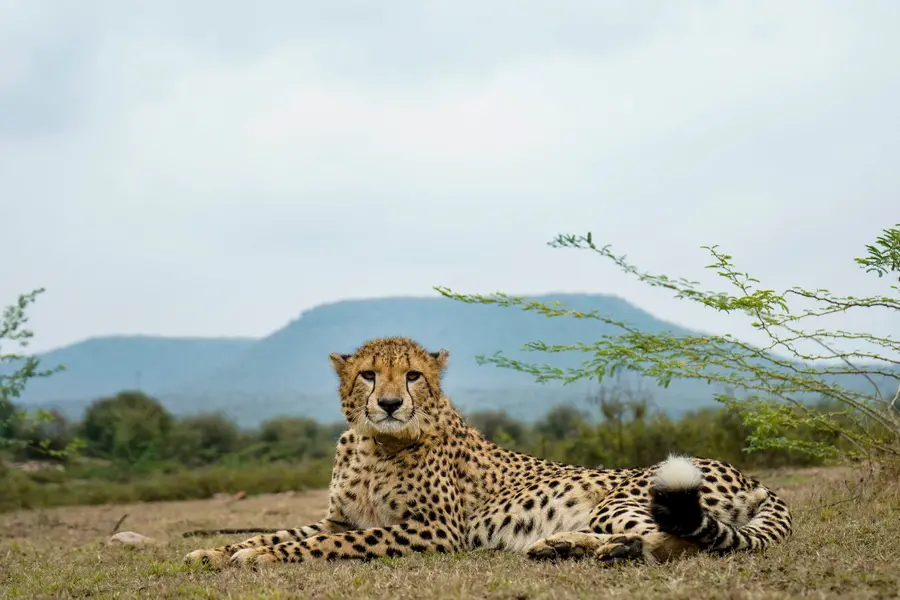
Bhopal: Pellets were allegedly found inside an injured radio-collared male cheetah rescued from Madhya Pradesh’s Morena district, wildlife activist Ajay Dubey claimed on Tuesday, raising suspicions of an illegal shooting incident. The cheetah, which was rescued on Sunday night, is currently undergoing treatment at the forest department’s medical facility in Jabalpur.
Dubey has accused the forest department of negligence and demanded a Central Bureau of Investigation (CBI) probe into the incident, besides the removal of Kuno National Park’s Field Director and the Divisional Forest Officer (DFO). The claims are yet to be independently verified, and the forest department’s response is awaited.
Speaking to Mathrubhumi English, Dubey claimed that pellets were found inside the cheetah’s stomach. “My sources have informed that pellets have been found inside its stomach,” he said, further claiming that ‘Bharmar’, a traditional muzzle-loader, was used to attack the animal. The cheetah has reportedly been identified as the 19-month-old male cub of Nirva, fitted with a radio collar.
“Earlier, when the Rajas-Maharajas would go on a hunt, they would use Bharmar to kill an animal. When it explodes, its pellets also explode everywhere. In this incident, Bharmar has been used to attack the cheetah,” claimed Dubey.
The Bhopal-based wildlife activist also claimed that local villagers alerted the forest department after hearing a gunshot, following which the department rescued the animal.
“It was the villagers who had heard a bullet being fired and informed the department. These people (the forest department) rescued it after they were informed by the locals. However, there is no mention of this in the press release issued by the department, and instead, claimed that they took a suo motu cognisance to rescue the animal.”
Dubey further alleged that the attack was a poaching attempt rather than an act of self-defence.
“You can’t shoot a cheetah in self-defence, because cheetahs don’t attack humans. This was a poaching attempt. I said it yesterday also, and I’m saying it today too. The department has hid this in their press note.”
Dubey also claimed that the state government is likely to announce the formation of a Special Investigation Team (SIT) to probe the incident on Tuesday, but questioned its credibility if the team comprised officials from the state forest department.
“The government will most likely announce an SIT probe in a while. But what is the use of such an SIT which will have people from MP’s forest department?”
He has demanded a CBI probe and the removal of Uttam Sharma, Field Director of Kuno National Park, and R Thirukural, Divisional Forest Officer of Sheopur.
But why is Dubey demanding a CBI probe?
In calling for a central agency investigation, Dubey cited historical precedents involving sharp declines in tiger populations in Alwar, Rajasthan, and Panna, Madhya Pradesh, where the National Tiger Conservation Authority (NTCA) had previously advised CBI inquiries.
“When the tiger population went to zero in Alwar and Panna in Rajasthan and MP, the NTCA recommended a CBI probe. The then Vasundhara Raje-led Rajasthan government gave permission to the CBI in 2005. However, MP denied it. The population in Panna Tiger Reserve was over, but no permission was given to the CBI.”
He argued that a central agency would be better placed to investigate suspected interstate wildlife crime.
“The CBI, at that time, and I believe it has upgraded now, had a specialised approach in wildlife offences and drugs. Also, when an inter-state gang is caught, no single state has sufficient power to conduct a free and fair enquiry in another state.”
Dubey alleged that an interstate gang was active in the region and cited previous arrests as grounds for seeking a central investigation.
“The gang which is poaching in this region is an inter-state gang. Previously, poachers from Rajasthan were nabbed in 2025 in Shivpuri district. And this year in July, a gang was caught in Agra, Uttar Pradesh. So when there is an inter-state gang involved, CBI enquiry is important.”
Dubey questioned transparency over cheetah deaths:
Dubey had earlier filed a Right to Information (RTI) application seeking the post-mortem reports of cheetahs that have died in India so far. He said his request was rejected on the grounds of national security.
“I had filed an RTI asking for post-mortem reports of cheetahs that have died so far. The cheetahs that have died, I have been told that the disclosure of their reports is a threat to national security.”
Questioning the rationale behind withholding the reports, Dubey cited the standard operating procedure (SoP) for investigating tiger deaths.
“There are four tests under the SoP of a tiger death - coloured photographs, post-mortem report, histopathological reports, and forensic report. So, if you hide all these reports (in a cheetah’s mortality), then how will accountability be fixed?”
He also questioned the absence of publicly available mortality data for cheetahs, pointing to the information on tiger deaths published by the NTCA.
“NTCA carries updated information on tiger deaths in India on its website, but they don’t do it for the cheetahs. The logic behind why I asked for the post-mortem reports in my RTI is: how do I believe the (cheetah) mortality figure is correct? Which official data suggests that this number of cheetahs have died? The deaths are being reported in the media. But where is the official figure?”
Dubey further questioned the transparency surrounding the cheetah reintroduction project in India.
“The population of tigers in the world is around 5,000. Cheetahs are about 13,000. You have brought cheetahs to India, which is fine. But while there is transparency regarding tigers, where is the transparency with the cheetahs?”
Meanwhile, Mathrubhumi English tried to contact Samita Rajora, Principal Chief Conservator of Forests (Wildlife), and Kuno National Park’s Field Director for their official responses. However, neither was available for comment at the time of filing this report.
Published: 27 Oct 2026, 01:47 pm IST
Related Topics
Disclaimer: Kindly avoid objectionable, derogatory, unlawful and lewd comments, while responding to reports. Such comments are punishable under cyber laws. Please keep away from personal attacks. The opinions expressed here are the personal opinions of readers and not that of Mathrubhumi.
