
As rebellion intensifies inside the Trinamool Congress, Mamata Banerjee finds herself confronting a dilemma that once tested Sonia Gandhi, whether to prioritise party unity or stand firmly behind her chosen heir, Abhishek Banerjee.
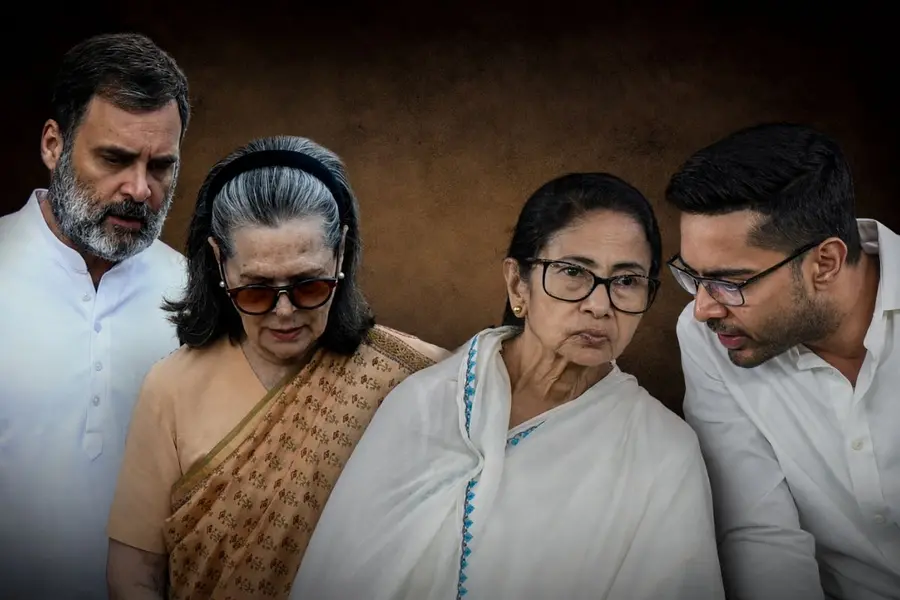
Every regional satrap eventually confronts a moment when personal loyalty collides with political survival. For Mamata Banerjee, that moment appears to have arrived.
The immediate trigger is the growing unrest within the Trinamool Congress (TMC), but the larger question haunting Bengal politics is one Sonia Gandhi faced years ago in the Congress: what happens when a leader’s chosen heir becomes the focal point of internal discontent?
The Congress experienced this during the G-23 rebellion. The revolt was never formally directed against Rahul Gandhi, yet the underlying grievance was unmistakable.
Veteran leaders increasingly felt excluded from decision-making as power became concentrated around a younger leadership circle.
Sonia Gandhi ultimately stood firmly behind her son, weathered the rebellion, and watched most dissenters either leave or reconcile with the party.
Rahul Gandhi emerged stronger, while critics accused the Congress leadership of prioritising family over organisational concerns.
A remarkably similar debate is now unfolding inside the TMC. At the centre of the storm is Abhishek Banerjee, Mamata Banerjee’s nephew and widely perceived political successor.
What was once whispered privately is now being articulated openly by sections of the party's old guard.
Their complaint is not merely about individual decisions but about what they see as a fundamental transformation of the party’s culture and power structure.
The latest flashpoint is senior MP Kalyan Banerjee, long regarded as one of Mamata Banerjee’s most dependable political warriors.
His reported ultimatum has laid bare the depth of the crisis. More significantly, it reflects a sentiment that appears to extend well beyond one disgruntled leader.
Many of the voices driving the rebellion believe the TMC's troubles are inseparable from Abhishek Banerjee's growing influence over the organisation.
Veteran leaders who helped build the party during its years of struggle increasingly feel they are being pushed to the margins as a new power centre consolidates itself.
For critics within the party, the issue is not succession itself but style. Mamata Banerjee built the TMC through relentless street politics, instinctive mass connect and direct engagement with workers.
Detractors argue that under Abhishek, the party is drifting towards a more centralised and managerial model, where consultants, strategy rooms and controlled messaging are replacing the rough-and-tumble political culture that once defined Trinamool.
Whether that perception is fair or not, it has gained traction among a section of the leadership that believes the organisation is losing touch with its grassroots foundations.
That leaves Mamata Banerjee facing an unenviable choice. If she stands unequivocally with Abhishek, she risks deepening the alienation of senior leaders at a time when the party can least afford further instability.
If she moves to placate the rebels, questions will inevitably arise about the authority and future of the man widely seen as her political heir.
Sonia Gandhi confronted a similar crossroads and chose family. Congress survived the immediate turbulence because of its institutional depth and national footprint, even as it paid a political price.
The challenge before Mamata Banerjee may be far more severe. Unlike the Congress, the TMC remains heavily dependent on her personal authority. Any prolonged internal conflict risks striking at the very foundations of the party.
The rebellion against Abhishek Banerjee is no longer a factional dispute. It has evolved into a larger contest over succession, power and the future identity of the Trinamool Congress.
And that is why this may well be Mamata Banerjee’s Sonia Gandhi moment.
Published: 12 Jun 2026, 08:01 am IST
Related Topics
Disclaimer: Kindly avoid objectionable, derogatory, unlawful and lewd comments, while responding to reports. Such comments are punishable under cyber laws. Please keep away from personal attacks. The opinions expressed here are the personal opinions of readers and not that of Mathrubhumi.
