
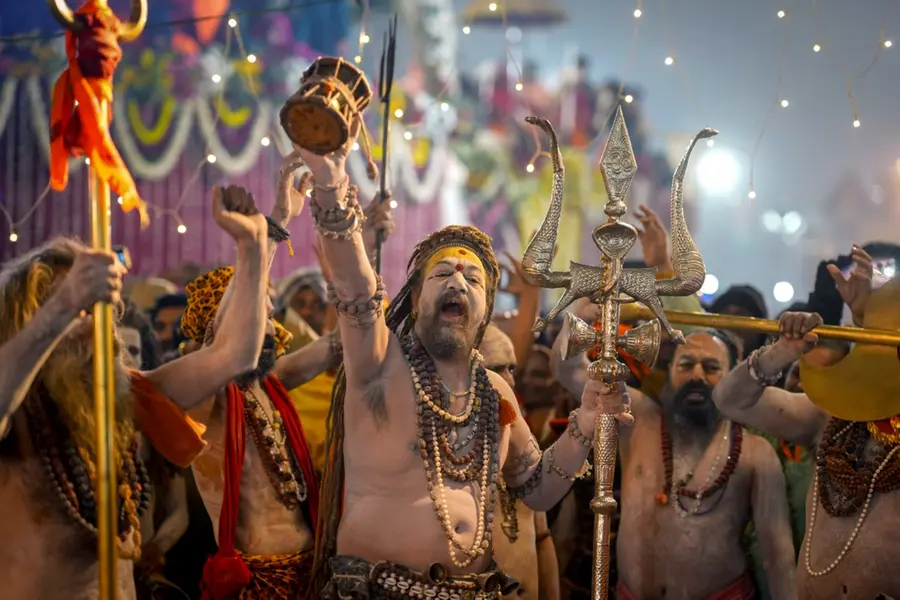
Prayagraj, India: The organisers of the world’s largest human gathering, the Mahakumbh, are taking unprecedented steps to address India’s historical challenges in managing crowds at large religious events. In an effort to prevent deadly stampedes, they are turning to artificial intelligence (AI) technology.
This year, organisers predict that up to 400 million pilgrims will visit the Kumbh Mela, a millennia-old religious event that involves ritual bathing in the sacred rivers of the Ganges and Yamuna. The festival, which began on Monday, will run for six weeks, drawing millions of Hindu devotees from across the globe.
The Kumbh Mela is notorious for its massive crowds and deadly stampedes, with several tragic incidents in its past. In 1954, more than 400 people were killed after being trampled or drowned in one of the deadliest crowd-related disasters worldwide. Another 36 people lost their lives during the 2013 festival, the last time it was held in Prayagraj.
Using technology to ensure safety
In an attempt to avoid such tragedies, authorities are deploying cutting-edge technology. Senior police officer Amit Kumar, who is heading the tech operations for the festival, explained, "We want everyone to go back home happily after having fulfilled their spiritual duties."
The new AI system is designed to monitor crowd density and movement, ensuring that sections of the crowd do not reach dangerous levels. The organisers are relying on a network of around 300 cameras, mounted on poles and drones, which provide real-time surveillance of the festival site and the surrounding roads.
"We can look at the entire Kumbh Mela from here," Kumar said, gesturing towards a glass-panelled command and control room that houses a team of police officers and technicians.
AI for crowd estimation and safety alerts
The footage from the cameras is fed into an AI algorithm that estimates crowd size across vast stretches of the festival grounds. The system is also cross-referenced with data from railways and bus operators to help organisers track the flow of people. The AI system raises an alarm if any section of the crowd becomes too concentrated, posing a potential safety threat.
Kumar elaborated on how the technology works: "We are using AI to track people flow, crowd density at various inlets, adding them up and then interpolating from there." This level of monitoring enables authorities to make real-time adjustments and avoid dangerous crowd bottlenecks.
A festival of immense scale
The scale of the Kumbh Mela this year is almost unimaginable, with organisers describing it as a temporary "country" in terms of size and population. Some six million devotees took a dip in the river on the first morning of the festival, according to official estimates.
Given the sheer number of people involved, some degree of crowd pressure is unavoidable.
"The personal bubble of an individual is quite big in the West," said Kumar, explaining that the critical crowd density at which the AI system triggers an alarm is much higher in India.
"We can afford to go several times higher than that."
Blending tradition and technology
The Kumbh Mela is steeped in Hindu mythology, originating from a battle between deities and demons for control of a pitcher containing the nectar of immortality. Despite its ancient roots, this year’s festival is a blend of faith and modernity, with technology playing a crucial role in safeguarding the masses.
Uttar Pradesh Chief Minister Yogi Adityanath, a devout Hindu monk, remarked that the festival is a perfect example of "the confluence of faith and modernity."
For many pilgrims, the presence of drones and cameras provides a sense of security.
"The fact that there are cameras and drones makes us feel safe," said a 28-year-old automotive engineer attending the festival.
AFP
Published: 18 Jan 2025, 10:05 am IST
Related Topics
Disclaimer: Kindly avoid objectionable, derogatory, unlawful and lewd comments, while responding to reports. Such comments are punishable under cyber laws. Please keep away from personal attacks. The opinions expressed here are the personal opinions of readers and not that of Mathrubhumi.
