
Stormy scenes in Parliament as repeated adjournments fail to halt the Centre’s push to introduce key Bills in the Lok Sabha.
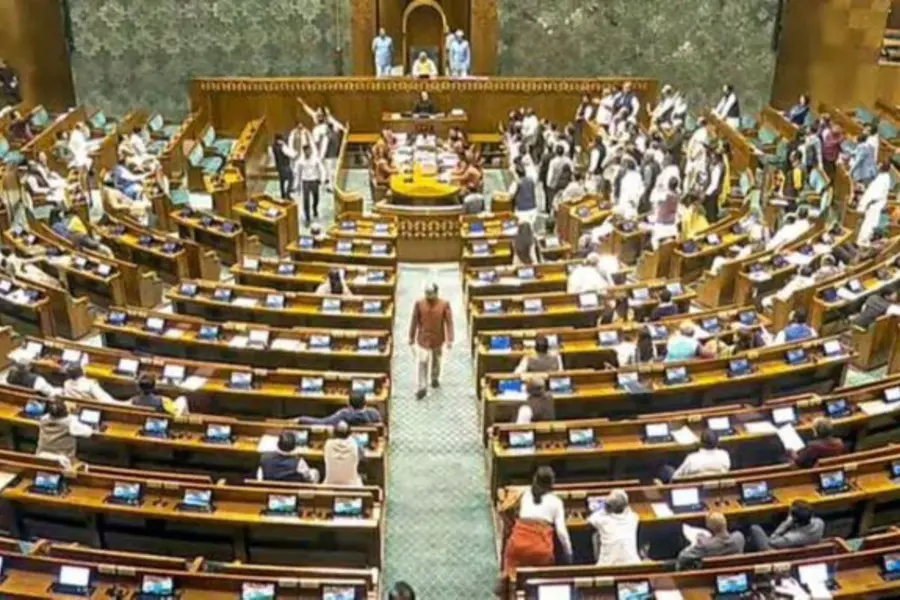
New Delhi: Parliament’s Winter Session entered a stormy phase on Day 11 on Monday, with repeated disruptions in the Lok Sabha even as the government pressed ahead with key legislative business amid sustained Opposition protests.
The Lok Sabha was adjourned twice earlier in the day following uproar during Question Hour and Zero Hour, as Opposition members stormed the Well of the House demanding an apology from Union Home Minister Amit Shah over what they described as “abusive” language used during previous proceedings.
Meanwhile, the government introduced three new Bills, including a key proposal to open the tightly regulated civil nuclear sector to private participation.
The Viksit Bharat Shiksha Adhishthan Bill aims to enable universities and other higher educational institutions to become independent and self-governing, backed by a transparent system of accreditation and academic autonomy.
The Sustainable Harnessing and Advancement of Nuclear Energy for Transforming India (SHANTI) Bill, introduced by Minister of State in the Prime Minister’s Office Jitendra Singh, seeks to open the civil nuclear power sector to private players and overhaul the existing liability framework by repealing the Atomic Energy Act, 1962, and the Civil Liability for Nuclear Damage Act, 2010.
The House also saw the introduction of the Repealing and Amending Bill, 2025, by Law Minister Arjun Ram Meghwal, which proposes to scrap 71 obsolete laws from the statute books.
The Viksit Bharat Guarantee for Rozgar and Ajeevika Mission (Gramin) (VB-G RAM G) Bill, 2025, has also been listed.
It seeks to repeal the Mahatma Gandhi National Rural Employment Guarantee Act of 2005 and establish a "rural development framework aligned with the national vision of Viksit Bharat 2047", by providing a statutory guarantee of 125 days of wage employment in every financial year to every rural household whose adult members volunteer to undertake unskilled manual work.
Congress MP Saptagiri Ulaka, who chairs the Parliamentary Standing Committee of Rural Development and Panchayati Raj, said the panel made several recommendations, including that for increasing the number of workdays and wages under the MGNREG scheme.
Ulaka, who chairs the Parliamentary Standing Committee of Rural Development and Panchayati Raj, said the panel made several recommendations, including that for increasing the number of workdays and wages under the scheme.
"When they (BJP) came to power, Prime Minister Narendra Modi had called it a scheme for digging pits... It was always their intention to end MGNREGS," Ulaka told PTI Videos.
"I don't know what problem they have with the name of Bapu, but they wanted to finish it because it was a Congress scheme. I head the Parliamentary panel, and we made so many recommendations -- to increase the number of days to 150, to increase the wages... the states have pending dues, West Bengal is not getting funds. They have brought a Bill, but why have they removed the name of Mahatma Gandhi?" he posed.
Asked about the government's move, Congress leader Priyanka Gandhi said, "Whenever the name of a scheme is changed, there are so many changes that have to be made in offices, stationery... for which money is spent. So, what is the benefit? Why is it being done?"
"Why is Mahatma Gandhi's name being removed. Mahatma Gandhi is considered the tallest leader not just in the country but in the world; so, removing his name, I really don't understand what the objective is. What is their intention?" she told reporters in the Parliament House complex.
"Even when we are debating, it is on other issues and not the real issues of the people. Time is being wasted, money is being wasted, they are disrupting themselves," the MP from Kerala's Wayanad added.
Senior Trinamool Congress leader and Rajya Sabha MP Derek O'Brien termed the government's move "an insult to Mahatma Gandhi."
"But then, are you surprised! These are the same people who hero-worshipped the man who killed Mahatma Gandhi. They want to insult Mahatma Gandhi and remove him from history," he said.
CPM General Secretary MA Baby called it an attempt to hide the fact that the scheme has been "dismantled".
"The Union Government's grandstanding over a total revamp of the MGNREGS is an attempt to hide the startling fact that the basic rights-based framework under which it operated is being dismantled, and the central share brought down drastically," he claimed.
"The buck is being passed on to states, and the Centre can now punish opposition-ruled states by cutting down allocations. It will also codify into law the technological interventions through which lakhs of people are being deprived of their entitlements," the Left leader alleged.
Terming the move "reckless" that has been made on the heels of the notification of the "draconian" labour codes, Baby claimed it would "worsen rural distress and is totally condemnable".
"We will fight tooth and nail against this disastrous move both inside and outside Parliament," the CPI(M) general secretary added.
MGNREGA, which was passed as the National Rural Employment Guarantee Act in 2005 and renamed in 2009, provides up to 100 days of wage employment for unskilled labour.
The proposed new law, meanwhile, provides for 125 days of work and talks about establishing a rural development framework aligned with the national vision of Viksit Bharat 2047.
It will be a centrally sponsored scheme, and every state government will have to prepare a scheme for giving effect to the guarantee proposed under this bill, within a period of six months from the date of the implementation of the Act.
The Centre would make an allocation for each state, to be estimated based on certain parameters. Further, expenditure in excess of the approved normative allocation shall be the responsibility of the state governments.
In the statement of purpose of the bill, Rural Development Minister Shivraj Singh Chouhan said MGNREGA has provided guaranteed wage-employment to rural households over the past 20 years.
However, "further strengthening has become necessary in view of the significant socio-economic transformation witnessed in the rural landscape driven by widespread coverage of the social security interventions and saturation-oriented implementation of major government schemes", he said.
In the Rajya Sabha, similar disruptions were witnessed, with BJP president and Leader of the House J.P. Nadda demanding an apology from Congress leader Sonia Gandhi over the same issue. Opposition members objected to the remarks, leading to repeated interruptions in the Upper House as well.
Despite the charged atmosphere and repeated adjournments, the government remained determined to move ahead with its legislative agenda during the Winter Session.
With several key Bills lined up for discussion, including proposed amendments to flagship schemes and structural reforms in education, further confrontations between the Treasury benches and the Opposition are expected in the days ahead.
Published: 15 Dec 2025, 11:24 am IST
Disclaimer: Kindly avoid objectionable, derogatory, unlawful and lewd comments, while responding to reports. Such comments are punishable under cyber laws. Please keep away from personal attacks. The opinions expressed here are the personal opinions of readers and not that of Mathrubhumi.
