
Women’s reservation and delimitation bills trigger heated debate in Lok Sabha during special Parliament session
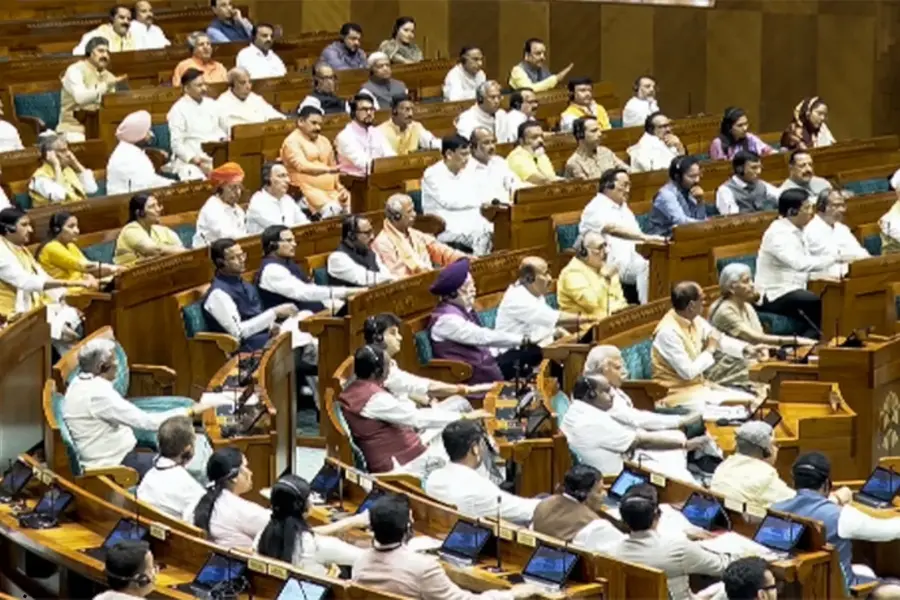
New Delhi: The Centre on Thursday introduced three key Bills during the special Parliament session, triggering a heated exchange with Opposition parties.
The April 16–18 session is focused on major constitutional amendments related to women’s reservation and delimitation, with intense debate over proposed seat expansion and implementation of 33 per cent quota for women.
The debate in the Lok Sabha on the women’s reservation and delimitation bills continued well past midnight, reflecting the intensity of discussions during the special Parliament session. Lawmakers from both the government and Opposition remained engaged in a prolonged exchange over constitutional amendments linked to women’s representation and electoral restructuring. The extended sitting underscored the high political stakes surrounding the proposed reforms, with the House continuing proceedings beyond scheduled hours to complete the discussion.
Kangana Ranaut calls women’s reservation bill ‘historic’, backs PM Modi’s vision
BJP MP from Mandi, Kangana Ranaut, has described the Nari Shakti Vandan Adhiniyam 2023 and its related provisions as “historic”, while lauding Prime Minister Narendra Modi’s vision on women’s empowerment. She said the measure marks a significant step towards correcting long-standing structural inequalities.
Ranaut said it is “the greatest time for women to be alive”, adding that the developments around women’s reservation represent a “big victory” for women across the country. Ranaut also supported linking the women’s reservation framework with the delimitation exercise, calling it a constitutional necessity. She said the process is important for ensuring balanced representation and effective governance.
NK Premachandran seeks clarity from PM, Home Minister on delimitation framework
RSP MP N. K. Premachandran, speaking in the Lok Sabha during the special Parliament session, questioned the Delimitation Bill while expressing support for the women’s reservation legislation. He raised concerns over the changing definition of population and asked how the proposed framework would be implemented, including seeking clarity on assurances given by the Prime Minister and Home Minister.
Premachandran also referred to concerns raised by southern states, stating that despite repeated assurances that there is no threat to their representation, apprehensions remain. He questioned whether the delimitation exercise could still impact the political balance, while reiterating his support for women’s reservation and urging greater clarity on the process.
TMC’s Pratima Mondal rejects bill, targets Centre in Lok Sabha
TMC MP Pratima Mondal, speaking in the Lok Sabha during the special Parliament session, accused the Centre of “trying to fool the people” over the women’s reservation bill, reiterating that her party opposes the delimitation linkage, not the quota itself. In a sharp remark directed at Union Home Minister Amit Shah, she said, “You are acting like Jinnah of India,” invoking the idea of the Partition of India to allege that the government’s approach could divide the country by linking representation to delimitation.
Amit Shah says delimitation will benefit South, explains 850-seat formula in Lok Sabha
Union Home Minister Amit Shah, speaking in the Lok Sabha during the special Parliament session, said that the proposed delimitation exercise will benefit southern states and not reduce their representation.
Shah also outlined the proposed expansion of the Lok Sabha to around 850 seats to enable 33 per cent reservation for women without cutting existing representation. He explained that the model is based on increasing the total number of seats, allowing one-third to be reserved for women while retaining open seats. He added that the final figure could be closer to 816, with 850 being a rounded estimate.
Addressing demands from Opposition parties, Shah further said that a caste census will be conducted as part of the next national census exercise. His remarks come amid an ongoing debate on women’s reservation, delimitation, and representation, with the government defending its framework as balanced and inclusive.
‘Trying to spread false narrative’: Amit Shah rebuts Opposition on women quota bill
Union Home Minister Amit Shah, speaking in the Lok Sabha during the special Parliament session, accused the Opposition of “trying to spread a false narrative” on the women’s reservation bill, responding to criticisms raised by leaders including Priyanka Gandhi. His remarks came as Parliament began its April 16–18 sitting, a key legislative moment during which the Centre has introduced a set of constitutional amendments aimed at enabling women’s reservation while also proposing changes to the electoral framework.
Amit Shah begins speaking in Lok Sabha on women quota bill
Union Home Minister Amit Shah has begun his address in the Lok Sabha during the special Parliament session on the women’s reservation bill. His remarks come amid an extended debate in the House, with discussions focusing on the implementation of the proposed legislation and related issues such as delimitation and representation.
Lok Sabha sitting extended till 11 pm discussion
Lok Sabha Speaker Om Birla has extended the House proceedings till 11 pm to allow continued discussion on the women’s reservation bill during the special Parliament session. The decision comes amid an intense and prolonged debate, with members across parties participating in discussions on the proposed legislation and related issues including delimitation and representation.
‘PM gave incomplete picture’: Priyanka Gandhi targets govt on women quota bill
Congress leader Priyanka Gandhi, speaking in the Lok Sabha during the special Parliament session on the women’s reservation bill, accused Prime Minister Narendra Modi of presenting an “incomplete picture” of the legislation. She said the Prime Minister’s remarks suggested that the BJP had long championed the bill, while also claiming not to seek credit, and pointed out that Rahul Gandhi had written to him in 2019 urging implementation of the measure.
Priyanka Gandhi also criticised the handling of the bill, warning against denying rights to one group while extending them to another. She argued that demands for broader representation, including caste-based considerations, should not be dismissed as technicalities. In a sharp remark, she said, “Women quickly recognise men who repeatedly try to mislead them,” while questioning the government’s approach to the legislation.
‘Narrative being created that Opposition is against it’: Dimple Yadav on women quota bill
Samajwadi Party MP Dimple Yadav, speaking in the Lok Sabha during the special Parliament session after Prime Minister Narendra Modi’s address, said a “narrative is being created” that the opposition is against the women’s reservation bill, which she rejected. She pointed out that the bill was already passed in 2023 with support from all parties, adding that “the question of opposition does not arise.”
Yadav also raised concerns over the sequencing of the process, arguing that a caste census should precede delimitation, followed by the implementation of reservation. She questioned why the nature of the bill was being repeatedly altered, while reiterating that all parties broadly support the legislation and that the opposition remains ready to cooperate if the government moves forward appropriately.
‘Who is delaying it’ KC Venugopal hits out at govt over women’s quota bill
Congress leader K. C. Venugopal, speaking in the Lok Sabha during the special Parliament session, criticised the government’s handling of the women’s reservation bill, calling aspects of it “anti-Constitutional.” He said the legislation could have been implemented as early as 2023, accusing the Centre of delaying the process and then blaming the opposition. “If you wanted, you could have implemented this bill in 2023 itself… and then the Prime Minister accuses us. Such drama from a Prime Minister is not understandable,” he said.
Venugopal added that the opposition is willing to support the bill’s passage, stating, “Even we are giving you a blank cheque, let the bill pass,” but questioned the delay, noting that “three years have passed.” He also invoked past leadership, saying India had strong women leaders, including a former Prime Minister, and criticised the current government while arguing for immediate and sincere implementation of women’s reservation.
‘Immediately implement 2023 Act’: Uddhav Thackeray demands rollout of women’s reservation
Shiv Sena (UBT) chief Uddhav Thackeray has called for the immediate implementation of the 2023 law providing 33 per cent reservation for women in the Lok Sabha and state assemblies. He urged the government to move without delay on operationalising the legislation, emphasising that the measure should be enforced promptly to ensure greater representation of women in legislative bodies.
‘We are not against women quota, but delimitation link’: Arvind Sawant questions govt in Lok Sabha
Arvind Ganpat Sawant of Shiv Sena (UBT), speaking in the Lok Sabha during the special Parliament session, questioned the government’s intent, stating that the opposition is not against the women’s reservation bill but opposes linking it to delimitation. Addressing the House amid disruptions, he said, “Why are you saying we are against women reservation? We are not. We are against how you are connecting it to delimitation.”
Continuing his remarks, Sawant also criticised the government over its stance on women’s issues, saying that while leaders speak about women’s empowerment, past incidents must not be forgotten. Referring to Manipur, he said, “You are talking about women and power and how the nation is grateful to them, but do you remember Manipur? You might have forgotten, we haven’t.”
‘I don’t want credit’: PM Modi on women’s reservation bill in Lok Sabha
Prime Minister Narendra Modi, addressing the Lok Sabha during the special Parliament session, said he does not want credit for the women’s reservation bill, stressing that the focus should be on its passage rather than political recognition. Responding to opposition remarks, he said, “I don’t want credit. After this bill passes, tomorrow I will give a full-page ad with whosoever’s photo you want,” adding that the government is willing to let anyone take credit if it helps move the legislation forward.
‘Those opposing women’s reservation not forgiven by voters’: PM Modi
Prime Minister Narendra Modi, speaking in the Lok Sabha during the special Parliament session, said that those who opposed women’s reservation in the past were “not forgiven” by voters in subsequent elections. He noted that whenever elections followed debates on women’s reservation, those against the measure faced public backlash. Modi added that this pattern did not occur in the 2024 elections as the proposal was passed unanimously, leaving no room for opposition on the issue.
‘Ours is the Mother of Democracy’: PM Modi in Lok Sabha on women quota bill
Prime Minister Narendra Modi, addressing the Lok Sabha during the special Parliament session on the women’s reservation bill, said that the government’s “intent is clean” and there is “no need to play with words.” He remarked that the proposal could be described as a guarantee or a promise, but emphasised that clarity of intent matters more than terminology.
During his speech, Modi reiterated that the women’s quota bill should not be given a political colour, calling it a “collective success” for the entire nation rather than a victory for any one party. He said the legislation reflects an effort to make India’s laws more sensitive and inclusive, adding that lawmakers are “about to give the country a new direction.”
He also highlighted India’s democratic legacy, describing it as the “Mother of Democracy” and noting that the idea of women’s reservation has evolved over the past 25–30 years to reach its current stage. Stressing inclusivity, Modi said that despite coming from an OBC background, his responsibility is to “take everyone forward together,” guided by the Constitution.
‘Let it come come first’: PM Modi says women quota bill is a ‘collective success’, urges no political colour
Prime Minister Narendra Modi, while addressing the Lok Sabha during the special Parliament session on the women’s reservation bill, said that the legislation should not be given any “political colour” and described it as a collective success for the entire nation rather than a victory for any single party.
He added that if the bill is passed, it would mark a significant step forward for India, with lawmakers “about to give the country a new direction.” Modi said the move reflects an effort to make legislation more sensitive and inclusive, while noting that India is progressing with renewed confidence in the 21st century and its global stature is rising.
PM Modi to speak in Lok Sabha at 3 pm
PM Narendra Modi is scheduled to address the Lok Sabha around 3 pm today during the special three-day Parliament session focused on women’s reservation and delimitation.
TMC on Women’s Reservation
TMC leader Kakoli Ghosh Dastidar said the 50% women’s reservation proposal is being pushed to politically benefit the BJP. She also questioned the timing of the move, pointing out that multiple elections are currently underway across the country.
Akhilesh Yadav on Census & Reservation
Samajwadi Party chief Akhilesh Yadav said the BJP is moving ahead with outdated census data and insisted that a fresh census should include caste-based enumeration. He stressed that the process must be conducted in a proper and systematic manner.
He also alleged that the women’s reservation Bill has been introduced with electoral motives rather than genuine reform. He claimed it is aimed at keeping the BJP in power and said the party will not succeed, adding that rising household costs, LPG shortages, and inflation are hurting women and weakening public support.
Tejasvi Surya defends delimitation
BJP MP Tejasvi Surya said that the proposed delimitation exercise should not be viewed as disadvantageous to southern states, adding that “the south could not have got a better deal than this” under the current framework.
Responding to Congress MP Gaurav Gogoi, he stated that delimitation is a constitutional requirement under Articles 81 and 82, which mandate balancing population-to-seat ratios and redrawing constituency boundaries. He said the process is essential to correct existing imbalances in representation.
Surya also pointed out that India’s population has increased significantly since 1971, while parliamentary seat counts have remained frozen, resulting in unequal constituency sizes. He argued that the delimitation exercise is necessary to align representation with present-day demographic realities, expected to be addressed by 2026.
Gogoi says Women’s Reservation should be on current 543 seats
Speaking in the Lok Sabha during the debate on the Women’s Reservation Bill, Congress MP Gaurav Gogoi said the quota should be implemented based on the current strength of the House, which has 543 seats, and should not be linked to the upcoming delimitation exercise. He said the government is repeatedly creating hurdles in implementing women’s reservation.
Gogoi further alleged that the Bills are not truly aimed at women’s reservation but are being used to push delimitation “through the back door.” He added that if the government had accepted the Opposition’s stand in 2023, the reservation could have been implemented much earlier.
Meghwal: “815 Seats, 272 Reserved for Women”
Union Law Minister Arjun Ram Meghwal said in the Lok Sabha that the Women’s Reservation Bill, passed in 2023, is set to be implemented based on the upcoming census after 2026 and the delimitation exercise. He explained that the proposal includes a 50% increase in the strength of Lok Sabha, taking the total to around 815 seats, with 272 seats reserved for women, ensuring one-third representation in the House.
He further assured that no state will lose representation in the process, adding that all states will retain their existing strength even after the expansion of seats.
Om Birla – House discipline & schedule
Lok Sabha Speaker Om Birla said the discussion on the three Bills will last between 15 to 18 hours, with voting scheduled for 4 pm the next day.
He also issued a strict warning to MP Vishal Patil, stating that he had already been given sufficient warnings and would not be allowed further speaking time if parliamentary rules are not followed.
Kiren Rijiju on debate duration & voting plan
Union Minister Kiren Rijiju informed the House that the discussion on the Bills will continue for around 12 hours. He said the Speaker has the authority to extend the debate if required, and confirmed that voting on the Bills will be conducted tomorrow.
Amit Shah defence of the legislative move
Union Home Minister Amit Shah defended the government’s decision, saying the two Bills have been brought together to ensure that women’s reservation is taken to its “logical end.” He indicated that the intent is to complete the legislative process in a structured and effective manner.
KC Venugopal's objection to clubbing bills
Congress MP KC Venugopal opposed the manner in which the Bills were introduced, stating that one of them is a Constitutional Amendment Bill while the others are not. He said clubbing different types of Bills together is not a good parliamentary practice and warned that it could lead to serious procedural and constitutional consequences.
Congress line-up for debate on 131st Amendment Bill
Congress has finalised its list of speakers for the debate on the Constitution (131st Amendment) Bill, 2026 in Parliament. The party will be represented by Gaurav Gogoi, Priyanka Gandhi Vadra, K.C. Venugopal, Manish Tewari, Praniti Shinde, K. Suresh, and Mohammed Javed. These leaders are expected to present the party’s position during the discussion on the Bill in the House.
207 MPs support bill introduction
Lok Sabha cleared the introduction of the Constitution (131st Amendment) Bill, 2026 with 207 votes in favour after a division was sought. The Opposition voted against the motion, while the Bill will now move to the debate stage in Parliament.
In a notable development, 86 NDA MPs were reported absent during the voting process.
Owaisi opposes Constitutional Amendment Bill
AIMIM MP Asaduddin Owaisi opposed the Bill, saying it goes against parliamentary democracy and federalism, which he called part of the Constitution’s basic structure. He argued that the Bill is not about women’s reservation but about altering representation dynamics, warning it could impact OBC and Muslim representation in legislatures.
NK Premachandran says 131st Amendment is about delimitation, not women’s reservation
RSP MP NK Premachandran opposed the introduction of the Bills, saying he stands firmly against them. He argued that the 131st Constitutional Amendment Bill is not related to women’s reservation, which was already passed unanimously in 2023, but is instead focused on delimitation.
He further said the government is attempting to alter the constitutional framework on how census data is used for delimitation, shifting it from a constitutional mandate to a law made by Parliament.
Amit Shah: Reservation based on religion cannot be allowed
Speaking in the Lok Sabha, Union Home Minister Amit Shah said that the government has already initiated the census process and taken a decision to conduct a caste census, with enumeration being carried out along with caste data. He added that if it were up to the Samajwadi Party, they would even assign castes to households.
Taking a strong line on the Opposition’s demand for reservations for Muslim women, Shah said it is “unconstitutional,” stating that reservation based on religion cannot be allowed under the Constitution.
Opposition demanded a division of votes
The Opposition demanded a division of votes in the Lok Sabha as the House took up voting on the introduction of the Women’s Reservation Bill. The motion requires a simple majority, with voting currently underway.
Procedural moment in Lok Sabha
Speaker Om Birla referred to Rule 72 of the House rules amid Opposition objections during the introduction of Bills.
As members from the Opposition raised points during the debate on the Bills, Om Birla paused proceedings to clarify Rule 72 of the Lok Sabha’s Rules of Procedure, which governs how objections to the introduction of a Bill are handled.
Under Rule 72, opposing members are allowed to make brief submissions, followed by the mover of the Bill. The Speaker then puts the motion to vote, except in the case of Finance or Appropriation Bills, where the motion is directly put to vote.
Samajwadi Party opposed the three Bills
MP Dharmendra Yadav opposed the three Bills, saying they are “completely against the Constitution” and alleging that separating delimitation from the census is a serious concern. He also warned that the government is “planning to do the same they did with Jammu and Kashmir and Assam.”
He said the party will not support the women’s reservation Bill unless it includes quotas for OBC and Muslim women. He urged the government to withdraw the Bills and instead implement the 2023 law on women’s reservation.
Amit Shah responds to opposition
Union Home Minister Amit Shah pushed back against the Opposition’s objections, stating that Congress MP KC Venugopal cannot raise arguments on the merits of the Bills at the stage of introduction.
He said the government will address all concerns during the discussion phase, adding, “we will give a strong reply to the Opposition during the debate.”
KC Venugopal opposes bills
Congress MP KC Venugopal strongly opposed the introduction of the Bills, calling them a “fundamental attack on indian federal structure.” He urged the government to first implement the 33% women’s reservation law passed in 2023.
He also accused the ruling NDA of attempting to “hijack the indian democracy” and said the move appeared politically motivated ahead of the 2029 elections, demanding that the Bills be withdrawn.
Bills introduced in Lok Sabha
Three major Bills were introduced during the session:
- Constitution (One Hundred and Thirty-First Amendment) Bill, 2026 — introduced by Law Minister Arjun Ram Meghwal, marking a significant constitutional proposal.
- Union Territories Laws (Amendment) Bill, 2026 — introduced by Home Minister Amit Shah to update and align legal frameworks governing Union Territories.
- Delimitation Bill, 2026 — also introduced by Meghwal, aimed at redrawing electoral boundaries, which could have major implications for representation.
Lok Sabha proceedings have been extended to allow more women speakers to participate in the debate on the Women’s Reservation Bill.
The Lok Sabha has been adjourned till 11 am on Friday (April 17, 2026).
Published: 16 Apr 2026, 11:31 am IST
Related Topics
Disclaimer: Kindly avoid objectionable, derogatory, unlawful and lewd comments, while responding to reports. Such comments are punishable under cyber laws. Please keep away from personal attacks. The opinions expressed here are the personal opinions of readers and not that of Mathrubhumi.
