
This marks the first-ever simultaneous commissioning of two major Indian Navy ships built by two separate shipyards — a historic moment for India's naval capabilities.
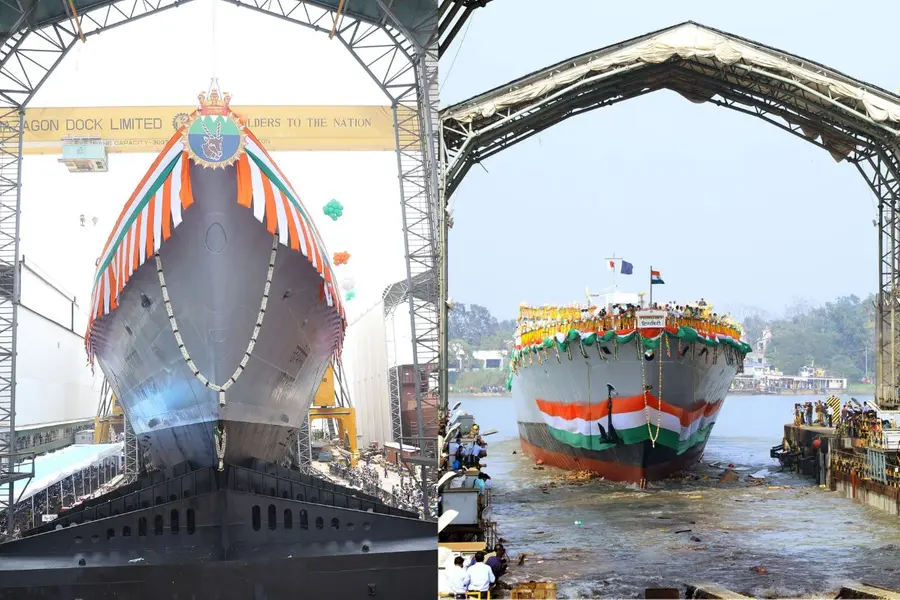
New Delhi: The Indian Navy is all set to commission two next-generation stealth frigates — INS Udaygiri (F35) and INS Himgiri (F34) — on August 26, 2025 in Visakhapatnam. This marks the first-ever simultaneous commissioning of two major Indian Navy ships built by two separate shipyards — a historic moment for India's naval capabilities.
This major event highlights India's accelerated naval modernisation, domestic shipbuilding strength and the growing success of the Make in India naval ships initiative.
Which shipyards built INS Udaygiri and INS Himgiri?
- INS Udaygiri, the second vessel under Project 17A, has been constructed by Mazagon Dock Shipbuilders Limited (MDL) in Mumbai.
- INS Himgiri is the first of the P17A-class ships built by Garden Reach Shipbuilders & Engineers (GRSE) in Kolkata.
Together, these ships represent the ability of India’s leading defence shipyards to deliver advanced Indian Navy stealth frigates with high indigenous content.
Adding further relevance, INS Udaygiri is also the 100th naval ship designed by the Indian Navy's Warship Design Bureau, showcasing decades of in-house naval design expertise.
What makes these Indian naval ships advanced and stealthy?
Both INS Udaygiri and INS Himgiri are part of the Project 17A class, which is an upgraded version of the Shivalik-class. These new-generation India naval ships displace approximately 6,700 tonnes, making them about 5% larger than their predecessors, while featuring enhanced stealth characteristics with a reduced radar cross-section.
Their cutting-edge propulsion systems use Combined Diesel or Gas (CODOG) mechanisms powered by diesel engines and gas turbines. They feature:
- Controllable-pitch propellers
- An Integrated Platform Management System (IPMS) for automation and control
The advanced weapon suite includes:
- Supersonic surface-to-surface missiles
- Medium range surface-to-air missiles
- 76 mm medium-range gun
- 30 mm and 12.7 mm close-in weapon systems
- Anti-submarine and underwater warfare capabilities
How do these ships reflect Make in India and Aatmanirbhar Bharat?
The commissioning of INS Udaygiri and INS Himgiri is a powerful symbol of self-reliance in naval defence production. These ships are a direct result of the Make in India naval ships mission and contribute significantly to the goals of Aatmanirbhar Bharat.
Over 200 MSMEs participated in their development, generating approximately:
- 4,000 direct jobs
- More than 10,000 indirect jobs
This industrial ecosystem is key to creating indigenous maritime capabilities and supporting India’s defence economy.
What are some recent achievements in indigenous naval shipbuilding?
The induction of these two stealth frigates comes after a series of successful indigenous ship commissions by the Indian Navy in 2025, including:
- INS Surat (Destroyer)
- INS Nilgiri (Frigate)
- INS Vaghsheer (Submarine)
- INS Arnala (ASW Shallow Water Craft)
- INS Nistar (Diving Support Vessel)
This ongoing momentum reflects India's strong push toward self-reliance in building Indian Navy ships.
How ready are Udaygiri and Himgiri for operational deployment?
Both ships have undergone rigorous sea trials, successfully testing their:
- Hull design and stability
- Propulsion systems
- Firefighting and damage control mechanisms
- Navigation and communication equipment
The commissioning of INS Udaygiri and INS Himgiri confirms they are fully mission-ready and capable of enhancing India's maritime operational readiness.
What will the commissioning ceremony signify for India?
The INS Udaygiri commissioning and INS Himgiri induction at Visakhapatnam will be more than just ceremonial—it will be a proud declaration of India’s growing maritime power.
These two Indian Navy stealth frigates, entirely designed, built and manned by Indians, symbolise a new era where India not only guards its oceans but does so with indigenous technology, talent and innovation.
As these ships officially join the fleet, the message to the world will be unmistakable: India's maritime frontier is protected by ships built in India — for India.
Published: 14 Aug 2025, 09:20 am IST
Related Topics
Disclaimer: Kindly avoid objectionable, derogatory, unlawful and lewd comments, while responding to reports. Such comments are punishable under cyber laws. Please keep away from personal attacks. The opinions expressed here are the personal opinions of readers and not that of Mathrubhumi.
