
The submarine significantly strengthens India's sea-based nuclear deterrence and survivability, crucial for its "No First Use" policy.
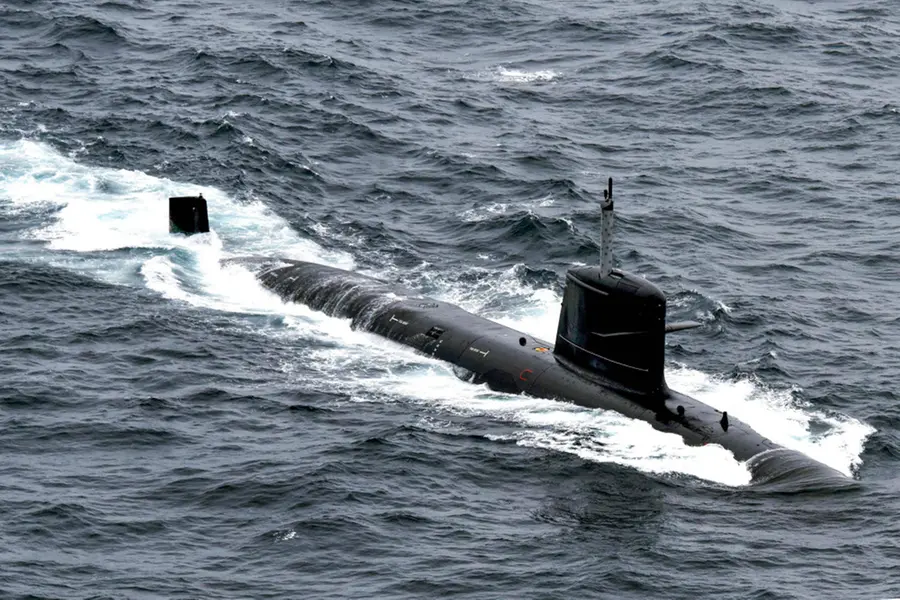
Visakhapatnam: The Indian Navy is poised to significantly escalate its strategic presence in the Indo-Pacific with the upcoming commissioning of INS Aridhaman, the nation’s third indigenously built nuclear-powered ballistic missile submarine (SSBN).
Government sources and naval officials confirmed Thursday that the vessel, codenamed S4, has completed its final phase of deep-sea trials and is scheduled for formal induction between April and May 2026. The move is seen as India's push for "Atmanirbhar Bharat" (self-reliant India) in high-end defence technology, with the submarine featuring nearly 75 per cent indigenous content.
Technical specs and design upgrades
Built at the Ship Building Centre in Visakhapatnam under the secretive Advanced Technology Vessel (ATV) project, INS Aridhaman represents a substantial evolution over its predecessors, INS Arihant and INS Arighaat.
The vessel displaces approximately 7,000 tonnes, making it nearly 1,000 tonnes heavier than the lead ship of its class. This increased displacement is attributed to a "stretched" hull design measuring roughly 130 meters, which accommodates a larger missile payload. It is powered by an upgraded 83 MW pressurised light-water reactor, providing it with virtually unlimited range and the ability to maintain submerged speeds of up to 24 knots.
Doubled firepower and strategic reach
The most critical advancement of the Aridhaman is its vertical launch system (VLS). Unlike the earlier boats, which featured four launch tubes, Aridhaman is equipped with eight tubes, effectively doubling the firepower of the fleet.
- Missile Loadout: The submarine can carry up to eight K-4 intermediate-range ballistic missiles, capable of striking targets at a distance of 3,500 kilometres. Alternatively, it can be configured to carry 24 K-15 "Sagarika" short-range missiles.
- Long-Range Deterrence: The integration of the K-4 missile allows the Indian Navy to target strategic locations across the continent without leaving the relative safety of its "bastion" waters in the Bay of Bengal.
Maritime security and the nuclear trade
The induction of Aridhaman will mark a "tipping point" in India’s maritime security architecture. Under the nation's "No First Use" nuclear doctrine, a credible sea-based deterrent is essential for a survivable second-strike capability.
- Continuous Patrols: Naval experts note that a minimum of three SSBNs is required to maintain a "continuous at-sea deterrent," ensuring that at least one nuclear-armed vessel is on patrol at all times while others undergo maintenance or training.
- Stealth and Survival: Unlike land-based silos or aircraft, nuclear submarines are nearly impossible to track when submerged. Aridhaman’s improved acoustic silencing and advanced indigenous sonar suites (USHUS and Panchendriya) make it the most "survivable" leg of India's nuclear triad.
The arrival of the Aridhaman comes as a fourth, even larger variant of the class (codenamed S4) has already commenced sea trials, signalling a rapid expansion of India's underwater strategic fleet through 2027.
Published: 20 Feb 2026, 11:46 am IST
Related Topics
Disclaimer: Kindly avoid objectionable, derogatory, unlawful and lewd comments, while responding to reports. Such comments are punishable under cyber laws. Please keep away from personal attacks. The opinions expressed here are the personal opinions of readers and not that of Mathrubhumi.
