
The CATS Warrior is a low-observable UCAV designed to function as a “loyal wingman” that can accompany and support manned fighter jets during combat missions.
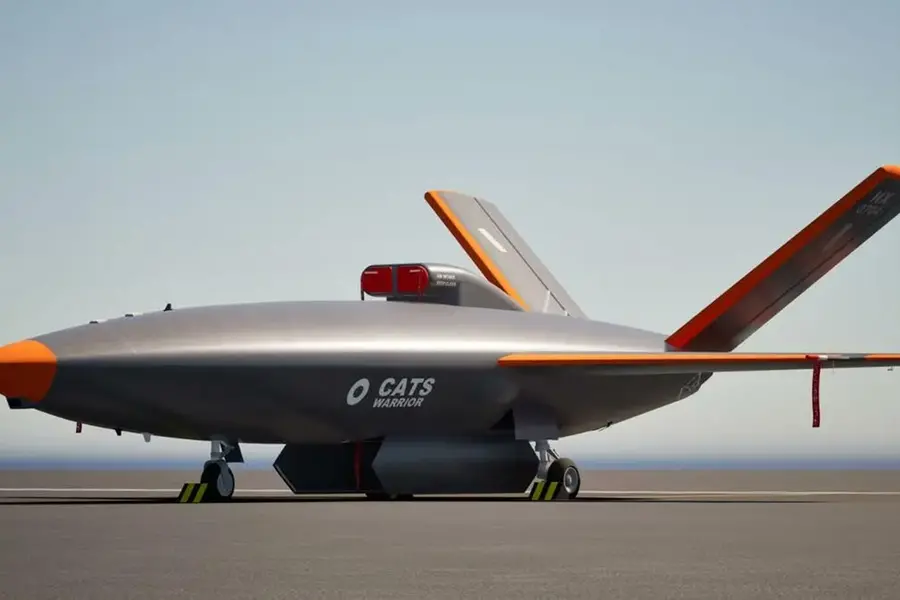
New Delhi: India’s ambitious indigenous unmanned combat aerial vehicle (UCAV) project under the Combat Air Teaming System (CATS) Warrior initiative is steadily progressing toward completion. According to recent reports, the first test flight of the CATS Warrior is scheduled for 2026, with the prototype currently in its final stages of development.
The CATS Warrior, a key component of the broader CATS programme, is being developed by Hindustan Aeronautics Limited’s (HAL) Aircraft Research and Design Centre (ARDC), in collaboration with Bengaluru-based private startup NewSpace Research and Technologies, as part of a public-private partnership.
The CATS Warrior is a low-observable UCAV designed to function as a “loyal wingman” that can accompany and support manned fighter jets during combat missions. It is engineered for autonomous operations, with capabilities for both land-based and aircraft carrier operations.
The CATS Warrior was first showcased as a scaled-down mock-up at Aero India 2021. HAL later displayed a full-scale prototype at Aero India 2025, signalling the project's steady advancement. Once operational, the CATS Warrior is expected to mark a significant milestone in India’s indigenous defence and aerospace capabilities.
Why is it important?
It will team up with Indian Air Force (IAF) fighters such as the Tejas, AMCA, TEDBF, Su-30MKI, and Jaguar, which will act as its motherships. A smaller, naval version is also under consideration for the Indian Navy.
Controlled by its mothership, the Warrior will perform a variety of tactical roles, from reconnaissance and absorbing enemy fire to offensive strikes using internal and external weapon pylons. In high-risk scenarios, it may even be deployed in kamikaze-style missions by crashing into high-value enemy targets.
The CATS Warrior is designed to carry out a range of combat roles, including reconnaissance, drawing enemy fire, and striking targets. Operated remotely by a mothership aircraft, it has the capability to return to base after completing its mission. In high-risk operations, it can also be deployed as a kamikaze drone, intentionally crashing into high-value enemy targets to protect manned aircraft and maximise mission impact.
Meanwhile, supporting the development of the UCAV, the Defence Research and Development Organisation (DRDO) is conducting final-stage trials of the indigenous Kaveri jet engine in Russia.
Defence officials confirmed to ANI in April that the engine, which has about 25 hours of testing left, is being considered for integration with the upcoming UCAV platform. The completion of these trials depends on test slot availability with the Russian authorities.
Published: 16 Jul 2025, 08:17 pm IST
Related Topics
Disclaimer: Kindly avoid objectionable, derogatory, unlawful and lewd comments, while responding to reports. Such comments are punishable under cyber laws. Please keep away from personal attacks. The opinions expressed here are the personal opinions of readers and not that of Mathrubhumi.
