
The deal facilitates easier professional movement for Indian experts in IT, healthcare, and engineering.
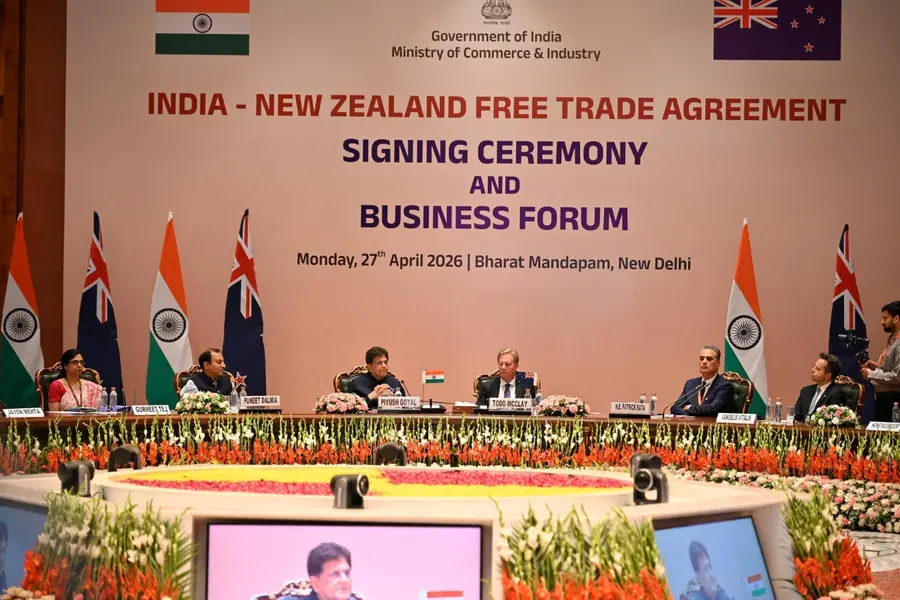
New Delhi: India and New Zealand finalised a landmark comprehensive Free Trade Agreement on Monday, a move that abolishes duties on all Indian exports to New Zealand and secures a $20 billion investment pledge for the South Asian nation.
The pact was signed in New Delhi by Commerce and Industry Minister Piyush Goyal and New Zealand Trade Minister Todd McClay. The agreement marks the culmination of a diplomatic push that began in March 2025 and reached a conclusion in December.
Minister Goyal characterised the treaty as a testament to the "shared trust" between the two democracies and a cornerstone for economic consistency.
“This FTA reflects the shared trust between the two nations, the confidence of policy stability, business environment stability and all of this leading to a resilient supply chain,” Goyal stated during the proceedings.
Tariff Reductions and Protections
The agreement provides India with zero-duty access for 100 per cent of its tariff lines, encompassing 8,284 export categories such as machinery, pharmaceuticals, textiles, and automotive parts. In exchange, India will remove tariffs on approximately 70.03 per cent of its own lines, representing nearly 95 per cent of New Zealand’s export value. These reductions will be implemented through a phased approach for certain goods.
Significantly, India successfully negotiated the exclusion of its sensitive dairy industry from the deal. Other protected agricultural sectors, including sugar, spices, edible oils, and onions, are also exempt from concessions to safeguard domestic farmers.
Agneshwar Sen, Trade Policy Leader at EY India, noted that the deal removes an average tariff of 2.2 per cent on Indian goods, which previously reached as high as 10 per cent for labour-intensive sectors like apparel.
“Crucially, India has secured this without compromising its most sensitive sectors. Dairy, edible oils, sugar, spices, onions, and key agricultural commodities are explicitly excluded from India’s concession list, protecting domestic farmers and industry,” Sen remarked.
Investment and Labor Mobility
As part of the framework, New Zealand has committed to facilitating $20 billion in capital flows into India over the next 15 years. These investments are slated for manufacturing, agritech, food processing, and renewable energy sectors.
The treaty further establishes professional mobility pathways, easing the transition for Indian experts in the fields of engineering, healthcare, education, and information technology. Additionally, a new fast-track system will allow Indian food processors to import New Zealand raw materials duty-free, provided they are utilised for re-export.
Trade Composition and Political Context
Current bilateral trade remains modest, totalling $2.4 billion in the 2025 fiscal year. India primarily exports petroleum products and engineering goods to New Zealand, while importing wool, wood, and steel. High-tariff items such as wine are expected to see gradual duty decreases under the new rules.
While the agreement enjoys broad support, it sparked political friction within New Zealand. The Labour Party offered its backing despite internal reservations, while the New Zealand First party voiced opposition centred on immigration concerns.
Labour leader Chris Hipkins acknowledged that while the deal did not meet every ideal criterion for his party, it remained a strategic necessity. The domestic debate was also marked by controversial rhetoric from New Zealand First deputy leader Shane Jones regarding the link between trade and immigration.
Published: 27 Apr 2026, 02:53 pm IST
Disclaimer: Kindly avoid objectionable, derogatory, unlawful and lewd comments, while responding to reports. Such comments are punishable under cyber laws. Please keep away from personal attacks. The opinions expressed here are the personal opinions of readers and not that of Mathrubhumi.
