
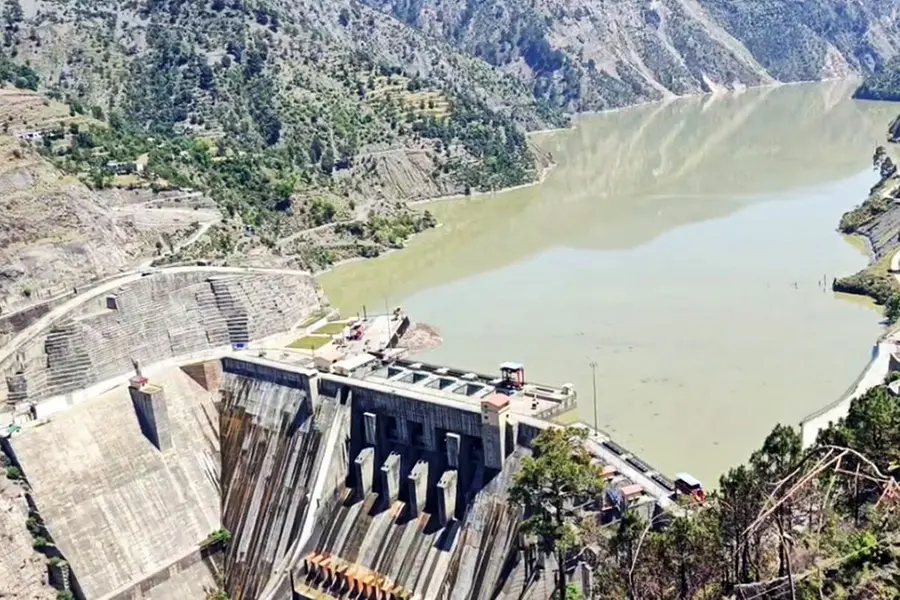
India has commenced work to enhance the reservoir holding capacity at two hydroelectric projects located in the Himalayan region of Kashmir, sources familiar with the matter have informed Reuters. This development follows heightened tensions with Pakistan, which prompted India to suspend the long-standing Indus Waters Treaty.
This action marks the first significant step by India to operate outside the framework of agreements governed by the Indus Waters Treaty, a pact that has remained unbroken since 1960 despite three wars and numerous other conflicts between the two nuclear-armed neighbours.
Last month, however, New Delhi suspended the treaty, which ensures water supply to a significant portion of Pakistani farmlands, in the aftermath of a terror attack in Kashmir that resulted in the deaths of 26 people. India identified two of the three assailants as being of Pakistani origin.
Islamabad has reacted strongly to the suspension, threatening international legal action and denying any involvement in the attack. A spokesperson warned, "Any attempt to stop or divert the flow of water belonging to Pakistan ... will be considered as an act of war."
According to three sources who spoke to Reuters on condition of anonymity, a "reservoir flushing" process aimed at removing sediment began on Thursday. This operation is being carried out by India's largest hydropower company, the state-run NHPC Ltd, and authorities in the federal territory of Jammu and Kashmir.
While this initial work may not immediately jeopardize water supply to Pakistan, which heavily relies on rivers flowing through India for its irrigation and hydropower needs, sustained efforts across other projects could eventually have an impact. There are reportedly more than half a dozen such hydroelectric projects in the region.
The sources further revealed that India did not inform Pakistan about the ongoing work at the Salal and Baglihar projects. This is the first time such an exercise has been undertaken since the projects were built in 1987 and 2008/09, respectively, as the Indus Waters Treaty had previously restricted such activities.
Neither India's NHPC nor the relevant government authorities responded to requests for comment from Reuters.
Since gaining independence from British colonial rule in 1947, India and Pakistan have fought two of their three wars over the disputed territory of Kashmir, in addition to numerous shorter conflicts.
The flushing operation reportedly lasted for three days, commencing on May 1st. "This is the first time such an exercise has taken place and will help in more efficient power generation and prevent damage to turbines," one of the sources told Reuters. The source added, "We were also asked to open the adjustable gates for cleaning, which we did from May 1," indicating an aim to operate the dams without prior restrictions. Residents on the Indian side of Kashmir along the banks of the Chenab river reported observing water releases from both the Salal and Baglihar dams between Thursday and Saturday.
The construction of both the Salal and Baglihar projects had previously involved extensive negotiations with Pakistan, which has consistently voiced concerns about potential reductions in its water share.
Under the 1960 Indus Waters Treaty, brokered by the World Bank, the Indus River and its tributaries were divided between the two nations. India was granted full rights over the eastern rivers (Ravi, Beas, and Sutlej), while Pakistan receives water from the three western rivers (Indus, Jhelum, and Chenab), which flow downstream from Indian territory. 1 The treaty also mandated that India share hydrological flow data and issue flood warnings.
Water minister CR Patil had previously vowed to "ensure no drop of the Indus river's water reaches Pakistan." However, government officials and experts on both sides acknowledge that an immediate cessation of water flow is not feasible, as the treaty permits India to build hydropower plants without significant storage dams on the rivers allocated to Pakistan.
In recent years, Prime Minister Narendra Modi's government has sought to renegotiate the Indus Waters Treaty, and the two nations have attempted to resolve some of their differences at the Permanent Court of Arbitration in The Hague, particularly concerning the water storage capacity of the Kishenganga and Ratle hydroelectric plants in the region.
Published: 05 May 2025, 01:24 pm IST
Disclaimer: Kindly avoid objectionable, derogatory, unlawful and lewd comments, while responding to reports. Such comments are punishable under cyber laws. Please keep away from personal attacks. The opinions expressed here are the personal opinions of readers and not that of Mathrubhumi.
