
Rahul Gandhi, Mamata Banerjee and top opposition leaders attend the INDIA Bloc meeting in Delhi, while DMK and AAP stay away. Here's who is in and out.
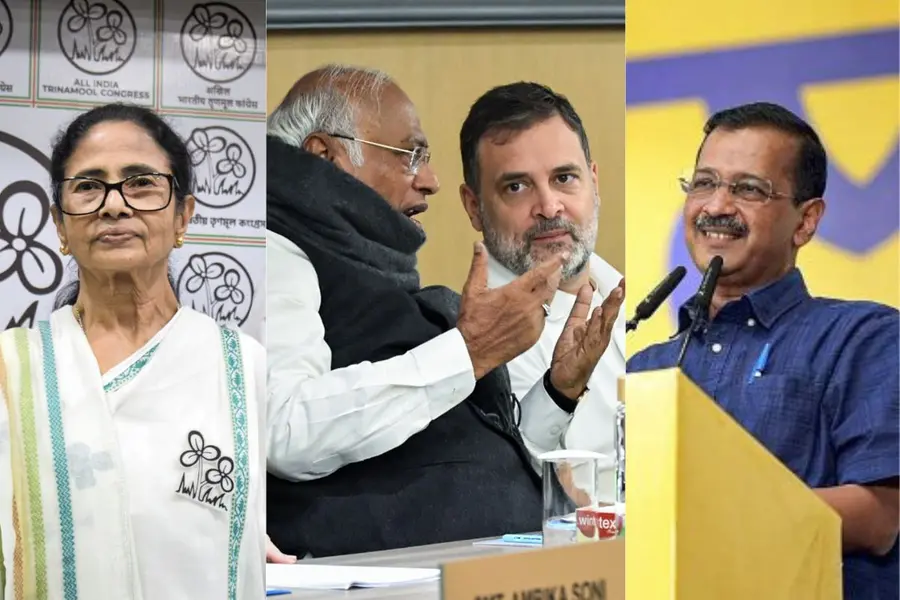
New Delhi: The opposition's INDIA alliance is set for its most consequential meeting in nearly two years on Monday, as leaders from 23 parties gather in New Delhi to reassess strategy, address internal strains and chart a roadmap against the BJP after a series of political setbacks reshaped the opposition landscape.
The meeting at the Constitution Club comes at a time when the alliance is grappling with altered power equations following recent assembly election defeats suffered by two of its major regional pillars — the Trinamool Congress (TMC) in West Bengal and the DMK in Tamil Nadu.
Senior opposition leaders, including Rahul Gandhi, Congress president Mallikarjun Kharge, TMC’s Mamata Banerjee, Abhishek Banerjee, Samajwadi Party chief Akhilesh Yadav, RJD leader Tejashwi Yadav and Shiv Sena (UBT) chief Uddhav Thackeray, are expected to attend the gathering.
Who's In?
According to Congress general secretary Jairam Ramesh, 23 political parties have confirmed participation in what he described as an "INDIA janbandhan" meeting.
Apart from the Congress, TMC, Samajwadi Party, RJD, Shiv Sena (UBT) and Left parties, several regional outfits are expected to join discussions focused on strengthening opposition coordination ahead of the next state elections and the 2029 Lok Sabha battle.
The meeting is also expected to formally open the door for actor-politician Vijay's Tamilaga Vettri Kazhagam (TVK).
Who's Out?
While the alliance seeks to project unity, two notable absentees are expected to dominate conversations.
The Aam Aadmi Party (AAP), which has steadily distanced itself from the opposition grouping over the past year, is not expected to participate.
The DMK has also decided to stay away from the meeting after its relationship with the Congress deteriorated in Tamil Nadu following the latter's decision to align with the TVK-led ruling establishment in the state.
Several other parties unable to attend have nevertheless conveyed support for the alliance's broader opposition agenda, according to Congress leaders.
TMC looks to regain momentum
For Mamata Banerjee's Trinamool Congress, the meeting provides an opportunity to reassert its national role after losing power in West Bengal.
Party leaders are expected to seek support from alliance partners over what they describe as political attacks and pressure on TMC leaders following the state's change in government.
TMC Rajya Sabha MP Derek O'Brien signalled the party's intent ahead of the meeting, saying opposition parties were gathering with a shared purpose and a commitment to collective action.
Left-Congress friction returns
Behind the show of unity, old disagreements remain unresolved.
The CPM is expected to raise concerns over allegations that surfaced during the Kerala Assembly elections, where Congress leaders accused the Left of indirectly benefiting the BJP.
Left leaders have strongly rejected those claims and are likely to seek clarity from the Congress leadership during the meeting.
CPM general secretary M.A. Baby has already written to Kharge, arguing that such accusations undermine the spirit of cooperation on which the opposition alliance was built.
CPI general secretary D. Raja has also indicated that Left parties intend to place their concerns before alliance partners during the discussions.
BJP targets opposition divisions
The BJP has seized on the emerging differences within the opposition camp.
Party spokesperson Shehzad Poonawalla claimed the latest disagreements exposed deep divisions within the alliance and questioned its ability to function as a coherent political alternative.
Opposition leaders, however, insist that differences among partners do not diminish their common objective of challenging the BJP and safeguarding democratic institutions.
Apart from organisational matters, alliance leaders are expected to discuss a range of national issues, including voter-roll revisions, inflation, unemployment, economic challenges and allegations of misuse of central investigative agencies.
Congress leaders maintain that opposition parties remain united in their criticism of what they describe as attacks on constitutional institutions, electoral processes and federal principles.
With PTI inputs
Published: 08 Jun 2026, 06:51 am IST
Related Topics
Disclaimer: Kindly avoid objectionable, derogatory, unlawful and lewd comments, while responding to reports. Such comments are punishable under cyber laws. Please keep away from personal attacks. The opinions expressed here are the personal opinions of readers and not that of Mathrubhumi.
