
The Centre has told the Delhi High Court that only the GST Council can decide GST rates on air purifiers and warned that judicial interference would violate the constitutional framework.
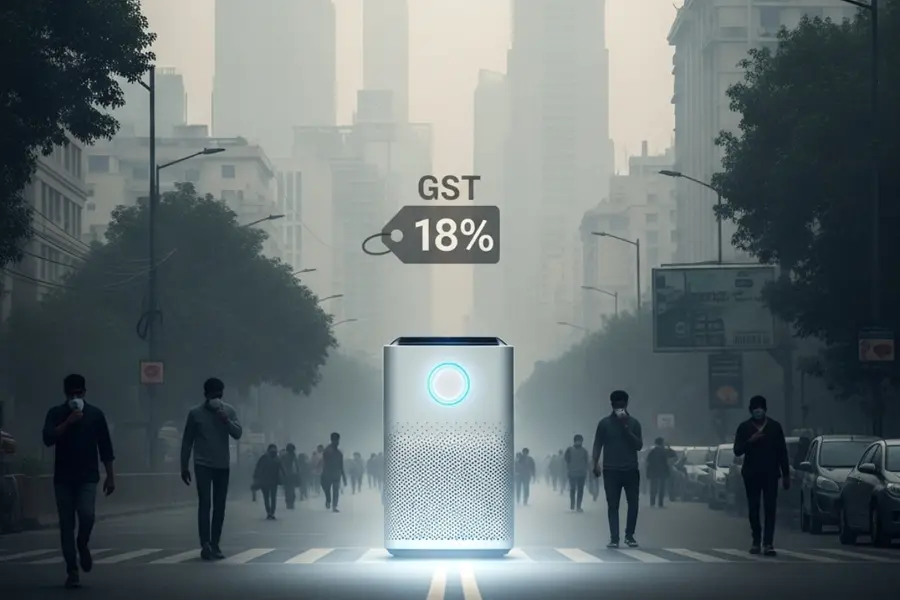
New Delhi: The Union government has informed the Delhi High Court that decisions regarding the Goods and Services Tax (GST) on air purifiers, including rate, classification, and reduction, fall exclusively within the mandate of the GST Council. The Centre cautioned that any judicial direction on this matter would be constitutionally impermissible and undermine the framework of cooperative federalism.
In a detailed counter-affidavit filed in response to a public interest litigation (PIL) seeking a reduction of GST on air purifiers and their reclassification as “medical devices, the government emphasised that the GST Council is a constitutional body established under Article 279A of the Constitution. It is the “sole constitutionally designated authority” empowered to recommend GST rates, exemptions, and classifications.
“The constitutional text leaves no scope for parallel, substitute, or competing recommendation-making by any other institution or authority in matters expressly entrusted to the GST Council,” the affidavit said. It added that any court-mandated fixation of GST rates would bypass the carefully calibrated constitutional mechanism.
“It is settled law that courts do not substitute themselves for constitutionally designated decision-makers, particularly in matters involving economic policy and fiscal structuring,” the affidavit stated.
The Centre underlined that GST decisions, particularly rates, emerge from a complex process of cooperative federalism, balancing the fiscal interests of both the Union and the States. Judicial interference, it warned, could disturb the federal equilibrium. Any direction to modify GST rates, convene the GST Council, or compel it to adopt a particular outcome “would amount to the Court stepping into the shoes of the GST Council,” it said.
On classification, the government clarified that air purifiers fall under tariff heading 8421, attracting 18 per cent GST, while medical devices are classified under headings 9018–9022 and benefit from a concessional 5 per cent GST following Council rationalisation. “Air purifiers are not taxed at the highest slab; the top GST rate is 40 per cent,” the affidavit said.
The Centre also noted that the issue of GST on air purifiers is under consideration through parliamentary procedures, following recommendations of the Department-related Parliamentary Standing Committee on Science and Technology, Environment, Forests and Climate Change. “Entertaining the present petition at this stage would amount to parallel consideration of matters currently under parliamentary review,” it added.
Terming the PIL a “colourable and motivated attempt,” the government claimed its true objective was not GST reduction but securing regulatory reclassification of air purifiers as medical devices, which could restrict public access and create monopolistic conditions.
The matter is listed for hearing before the Delhi High Court tomorrow. During a December 26 hearing, a Vacation Bench of Justices Vikas Mahajan and Vinod Kumar granted the Centre 10 days to file its counter-affidavit after Additional Solicitor General N Venkataraman sought time for a detailed response.
The petitioner, advocate Kapil Madan, argued that air purifiers are being taxed under the wrong GST slab and relied on the Parliamentary Committee’s recommendations. “Any delay would only prolong the suffering of residents in the national Capital,” he said.
Earlier, a Bench led by Chief Justice Devendra Kumar Upadhyaya had asked the GST Council to consider reducing the 18 per cent GST on air purifiers, observing that a 5 per cent rate could be appropriate in view of worsening air quality in Delhi-NCR. The Bench had remarked that if clean air cannot be ensured for citizens, at the very least the GST on air purifiers should be reduced, suggesting a temporary exemption as an emergency measure.
IANS
Published: 09 Jan 2026, 09:15 am IST
Related Topics
Disclaimer: Kindly avoid objectionable, derogatory, unlawful and lewd comments, while responding to reports. Such comments are punishable under cyber laws. Please keep away from personal attacks. The opinions expressed here are the personal opinions of readers and not that of Mathrubhumi.
