
The Congress party is facing mounting pressure as the Bharatiya Janata Party (BJP) escalates its attack, linking the Nehru-Gandhi family to controversial Hungarian-American businessman George Soros. The BJP has alleged that the connection between Soros and the Congress, specifically Sonia Gandhi's role as co-president of the Forum of Democratic Leaders – Asia Pacific (FDL-AP).
In a post on X, the BJP highlighted the familial ties between Soros and the Nehru-Gandhi family, claiming that Fori Nehru, a Hungarian like Soros, was married to Braj Kumar Nehru, Jawaharlal Nehru's cousin and former Indian diplomat, making her Rahul Gandhi's aunt. The BJP further pointed out that Soros maintained a long-standing relationship with Fori Nehru, with correspondence tracing back to when BK Nehru served as India's ambassador to the US. This has led the BJP to question whether the Nehru-Gandhi family, over the years, compromised India's strategic interests for personal and financial gain, further aligning with external interests, including those of the so-called "deep state."
These claims have intensified into a significant political slugfest, with the ruling party alleging that Sonia Gandhi is associated with an organization that has supported the idea of an independent Kashmir. But, people who are curious about the matter are still questioning the authenticity of the BJP's claim.
The Allegations and Political Repercussions
Recently, Union Minister Kiren Rijiju has weighed in on the controversy, expressing concerns over the alleged ties between Sonia Gandhi and Soros. Rijiju has cautioned that these matters should not be viewed through a partisan lens, calling for unity against forces seen as "anti-India."
The BJP's rhetoric has escalated over time, with party MP Nishikant Dubey further fanning the flames on social media. Dubey took to X (formerly Twitter) to ask whether Soros financed Rahul Gandhi's Bharat Jodo Yatra, questioning whether Soros had contributed to the education of Indian children, including the children of Congress leaders.
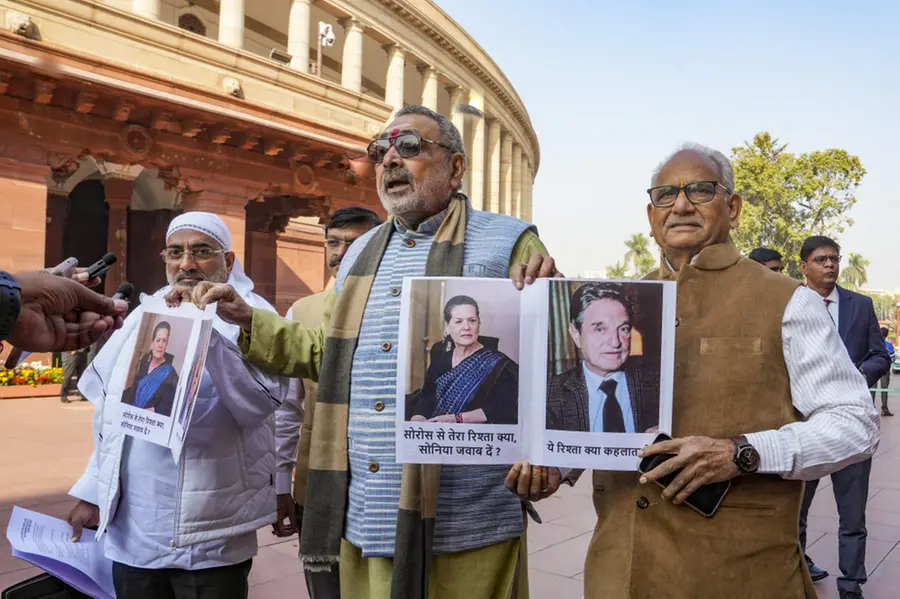
Meanwhile, Union Minister Giriraj Singh on Thursday staged a protest against Congress on the Parliament premises accusing the party leadership of having links with Soros.
Giriraj Singh held pictures of Congress Parliamentary Party Chairperson Sonia Gandhi and Soros.
The logjam over BJP's demand for a discussion on alleged links between Congress and George Soros led to adjournments in Rajya Sabha on Wednesday, with Parliamentary Affairs Minister Kiren Rijiju slamming the INDIA bloc parties over their no-confidence motion against Chairman Jagdeep Dhankhar.
In the Rajya Sabha, Leader of the House and Union Minister JP Nadda alleged that a senior Congress leader had links with US billionaire George Soros, and these should be discussed in the House because it is a matter related to India's sovereignty and its security.
These claims are not new. In 2023, BJP leader Smriti Irani had already accused Rahul Gandhi of associating with individuals linked to Soros during his trip to the United States. As these allegations resurface, they continue to be a point of contention, leading to an increasingly bitter political confrontation.
The Soros Connection: Unpacking the Background
George Soros has long been a key figure in global politics. Born György Schwartz in Budapest in 1930, Soros survived the Nazi occupation of Hungary before moving to the UK in 1947. After studying philosophy at the London School of Economics, he began his career in merchant banks before establishing his first hedge fund, Double Eagle, in 1969. This fund eventually led to the formation of Soros Fund Management, which became one of the most successful hedge funds globally.
Soros is best known for his philanthropic efforts and his advocacy for democracy, human rights, and social justice. His foundation, the Open Society Foundation (OSF), which he founded in 1984, has donated billions to causes aimed at promoting democratic governance and human rights across more than 120 countries. Through his philanthropy, Soros has been a powerful influence on liberal causes, and his support for democracy has earned him both praise and criticism, particularly from right-wing political factions.
Soros’s influence in global finance is also significant. He famously made $1 billion in profit in 1992 when he shorted the British pound, an event that earned him the nickname "The Man Who Broke the Bank of England." His wealth, however, has made him a target for conspiracy theories, particularly in India, where his political and financial activities have sparked suspicion among certain political circles.
Soros and India: A Controversial Legacy
The political storm surrounding Soros and his connection to Indian politics is also deeply rooted in his vocal criticism of Prime Minister Narendra Modi and the Indian government. In 2023, Soros took to the Munich Security Conference to voice his concerns over the Adani Group's financial troubles, following a report by the short-selling firm Hindenburg. Soros criticized Modi as "no democrat" and suggested that the controversy surrounding Adani could lead to a resurgence of democracy in India. This statement fueled the BJP's claims that Soros was attempting to influence India's democratic process, especially regarding Modi's leadership.
Soros's involvement in India’s political landscape is emblematic of his broader approach to global politics. He has often been a vocal critic of authoritarian regimes and has used his wealth to support causes that align with his vision of an open society. His funding of liberal movements and political activism around the world has made him a target for right-wing groups that view his influence as a threat to national sovereignty and democratic values.
Published: 12 Dec 2024, 01:39 pm IST
Related Topics
Disclaimer: Kindly avoid objectionable, derogatory, unlawful and lewd comments, while responding to reports. Such comments are punishable under cyber laws. Please keep away from personal attacks. The opinions expressed here are the personal opinions of readers and not that of Mathrubhumi.
