
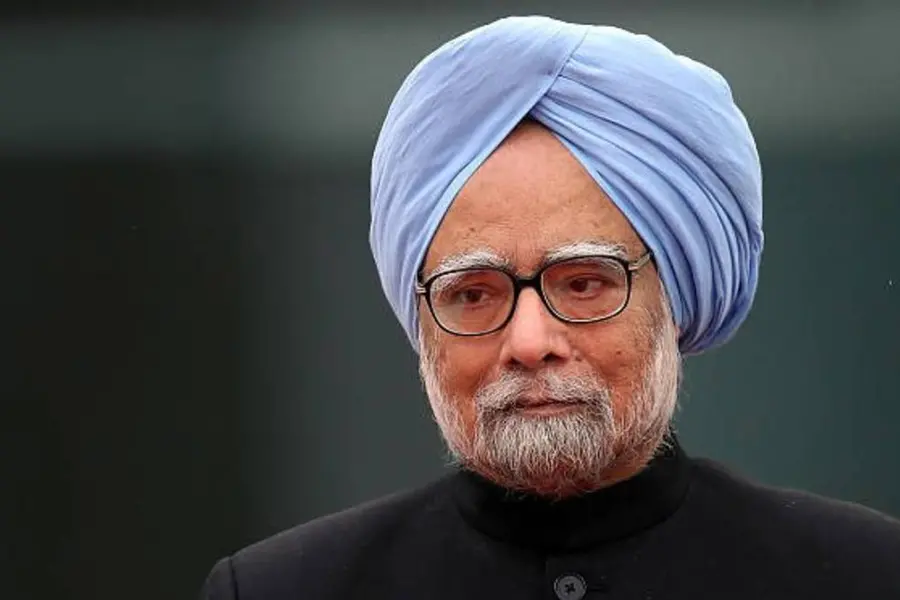
New Delhi: Veteran Congress leader and former Prime Minister Manmohan Singh passed away on Thursday. He was 92.
He was admitted to AIIMS Delhi on Thursday evening after his health took a turn for the worse.
In a medical bulletin released at 22:30 PM, AIIMS Delhi wrote, "With profound grief, we inform the demise of the former Prime Minister of India, Dr Manmohan Singh, aged 92. He was being treated for age-related medical conditions and had a sudden loss of consciousness at home on 26 December 2024. Resuscitative measures were started immediately at home. He was brought to the Medical Emergency at AIIMS, New Delhi at 8:06 PM. Despite all efforts, he could not be revived and was declared dead at 9:51 PM."
Singh served as India’s fourth longest-serving prime minister, following Jawaharlal Nehru, Indira Gandhi, and Narendra Modi. A prominent member of the Indian National Congress, he holds the distinction of being India’s first Sikh prime minister. He was also the first prime minister since Jawaharlal Nehru to be re-elected after completing a full five-year term.
Born in Gah, West Punjab, now part of Pakistan, Singh and his family moved to India during the Partition in 1947. He pursued his doctorate in economics at Oxford University before working with the United Nations from 1966 to 1969. Throughout the 1970s and 1980s, Singh held several prominent roles in the Indian government, including Chief Economic Advisor (1972–1976), Governor of the Reserve Bank of India (1982–1985), and Chair of the Planning Commission (1985–1987).
In 1991, during a severe economic crisis, newly elected Prime Minister P.V. Narasimha Rao brought Singh into his cabinet as finance minister. Singh spearheaded critical economic reforms that liberalized India's economy, despite facing significant resistance. These reforms not only stabilized the economy but also established Singh’s reputation as a forward-thinking economist on the global stage. However, the Congress Party performed poorly in the 1996 elections. During the Atal Bihari Vajpayee government from 1998 to 2004, Singh served as the leader of the opposition in the Rajya Sabha.
In 2004, when the Congress-led United Progressive Alliance won the general elections, Sonia Gandhi, the coalition’s chairperson, surprised many by nominating Singh to take on the role of prime minister.
Among the many awards and honours conferred upon Dr. Singh in his public career, the most prominent are India’s second highest civilian honour, the Padma Vibhushan (1987); the Jawaharlal Nehru Birth Centenary Award of the Indian Science Congress (1995); the Asia Money Award for Finance Minister of the Year (1993 and 1994); the Euro Money Award for Finance Minister of the Year (1993), the Adam Smith Prize of the University of Cambridge (1956); and the Wright’s Prize for Distinguished Performance at St. John’s College in Cambridge (1955). Dr. Singh has also been honoured by a number of other associations including the Japanese Nihon Keizai Shimbun. Dr. Singh is a recipient of honorary degrees from many universities including the Universities of Cambridge and Oxford.
Dr. Singh has represented India at many international conferences and in several international organizations. He has led Indian Delegations to the Commonwealth Heads of Government Meeting in Cyprus (1993) and to the World Conference on Human Rights in Vienna in 1993.
In his political career, Dr. Singh has been a Member of India’s Upper House of Parliament (the Rajya Sabha) since 1991, where he was Leader of the Opposition between 1998 and 2004. Dr. Manmohan Singh was sworn in as Prime Minister on 22nd May after the 2004 general elections and took the oath of office for a second term on 22nd May 2009.
Dr. Singh and his wife Mrs. Gursharan Kaur have three daughters.
Published: 26 Dec 2024, 10:28 pm IST
Related Topics
Disclaimer: Kindly avoid objectionable, derogatory, unlawful and lewd comments, while responding to reports. Such comments are punishable under cyber laws. Please keep away from personal attacks. The opinions expressed here are the personal opinions of readers and not that of Mathrubhumi.
