
Flying buses in India? Union Minister Nitin Gadkari says the futuristic transport system is part of the government's vision to ease urban traffic, alongside aerial pods, flash-charging electric buses and cleaner mobility solutions.
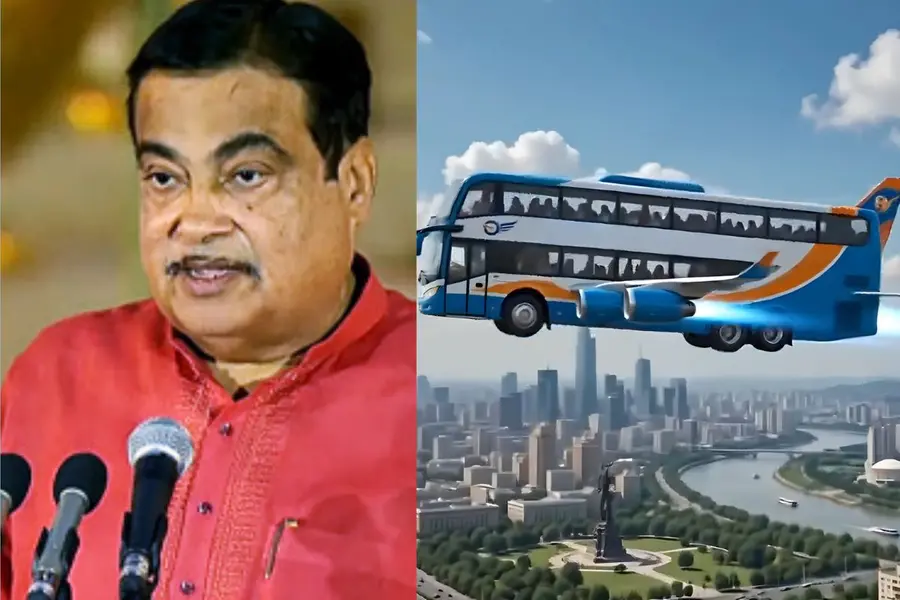
New Delhi: Flying buses may sound like science fiction, but Union Road Transport and Highways Minister Nitin Gadkari says they are part of India's transport future.
Revealing what could become one of the country's most ambitious mobility projects, Gadkari said the government is working towards introducing "flying buses" as part of an electricity-powered mass rapid transit network aimed at reducing traffic congestion in major cities. While the announcement has sparked excitement and curiosity, the minister's remarks also raise an obvious question: Are flying buses actually coming to India, and what exactly does Gadkari mean?
Speaking at the inauguration of the Lucknow-Kanpur Expressway, Gadkari said the proposed system would allow commuters to travel across cities in far less time than conventional road transport.
"Soon, I am going to introduce flying buses. Under my ministry, I will develop a Mass Rapid Transport System powered by electricity. It will enable people to travel from one corner to another so quickly that they won't even realise how fast they reached," he said.
What does Gadkari mean by 'flying buses'?
While the latest announcement did not include technical details or a project timeline, Gadkari has previously explained that the idea is linked to an aerial pod transport system rather than conventional buses that literally fly like aircraft.
During an earlier interaction with ANI, the minister said the government wanted to introduce a pod-based transport network above busy roads to ease traffic congestion. One of the proposed corridors is Dhaula Kuan-Manesar, a stretch that witnesses heavy traffic, while a similar study is also underway in Bengaluru.
The minister's vision extends beyond aerial pods.
He has also announced plans for flash-charging electric buses capable of carrying around 135 passengers. According to Gadkari, these executive-class buses would travel at speeds of up to 120 kmph and recharge in just 30 seconds after every 40 kilometres, allowing them to operate with smaller batteries while reducing operating costs by nearly 30% compared with diesel buses.
He has further spoken about introducing these buses on routes such as Delhi-Jaipur, Delhi-Dehradun and Bengaluru-Chennai.
For hilly regions, Gadkari has also proposed a double-decker ropeway-based transport system connecting mountainous areas in Uttarakhand and Jammu and Kashmir.
The renewed focus on futuristic mobility comes as the Centre continues to push cleaner transport technologies.
Only days ago, Gadkari strongly defended the rollout of E20 petrol, dismissing criticism that the fuel damages vehicles.
"Has there been any car in the country that faced issues due to the use of E20 petrol? Just name one," he said while addressing the Viksit Bharat Conclave.
The minister also alleged that misinformation was being spread about higher ethanol blending despite the absence of evidence linking E20 petrol to vehicle damage.
India's push for cleaner mobility
According to Gadkari, India spends nearly ₹22 lakh crore annually on importing fossil fuels, making the transition to alternative energy sources both an economic and environmental necessity.
India has already achieved 20% ethanol blending in petrol, using ethanol produced from agricultural feedstocks such as sugarcane, maize and surplus rice.
Published: 16 Jul 2026, 04:06 pm IST
Related Topics
Disclaimer: Kindly avoid objectionable, derogatory, unlawful and lewd comments, while responding to reports. Such comments are punishable under cyber laws. Please keep away from personal attacks. The opinions expressed here are the personal opinions of readers and not that of Mathrubhumi.
