
India, Japan's SkyDrive and Suzuki Explore eVTOL Medical Logistics
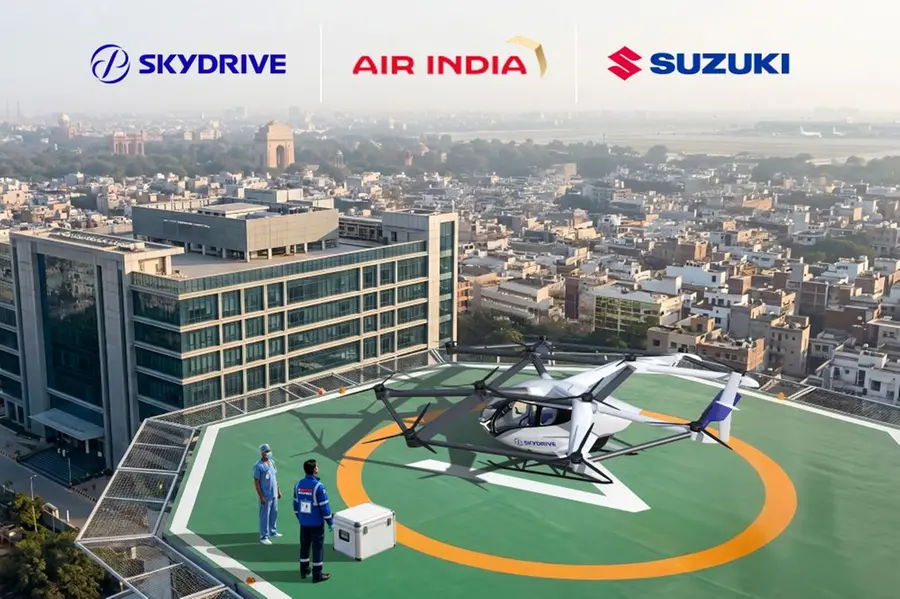
Air India, has joined hands with Japanese electric aircraft developer SkyDrive and automobile giant Suzuki Motor Corporation to explore a new way of transporting life-saving medical supplies. The three companies have signed a Memorandum of Understanding (MoU) to study whether electric vertical take-off and landing (eVTOL) aircraft can be used for medical air logistics across India.
At present, this is only a feasibility study. No commercial service has been announced. However, if the study proves successful and receives regulatory approvals, it could become an important step towards introducing a new form of air transport in India's healthcare system.
What is Medical Air Logistics?
Medical air logistics refers to the transportation of essential medical supplies using aircraft instead of road vehicles. This can include blood units, donated organs for transplantation, vaccines, medicines, laboratory samples, emergency medical equipment and other critical healthcare supplies.
The biggest advantage is speed. In many medical emergencies, even a delay of a few minutes can reduce the chances of saving a life. Fast transportation can make a significant difference, especially when organs need to be transplanted within a limited time or when blood and medicines must reach hospitals urgently.
Today, such transportation is usually carried out using helicopters, charter aircraft or road ambulances. However, helicopters are expensive to operate and cannot always be deployed quickly for short urban distances.
What is an eVTOL?
An eVTOL is an electric aircraft that can take off and land vertically like a helicopter but flies more like an aeroplane once airborne. Since it runs on electric power instead of conventional aviation fuel, it is expected to produce lower emissions, less noise and lower operating costs over time.
Unlike helicopters, many eVTOL designs are intended to be simpler to operate and could eventually make short-distance flights more affordable. Around the world, companies are developing eVTOL aircraft for urban transport, cargo movement and emergency services.
Does India need such a system?
India's cities are growing rapidly, but traffic congestion has become one of their biggest challenges. In cities such as Mumbai, Bengaluru, Delhi and Chennai, ambulances carrying critical medical supplies often lose valuable time while navigating congested roads. During peak traffic hours, even a journey of 15 kilometres can take more than an hour.
An eVTOL could potentially fly directly between hospitals, airports or medical centres, reducing travel times significantly. Instead of waiting in traffic, critical supplies could reach their destination in a fraction of the time.
For patients requiring emergency surgery or organ transplantation, those saved minutes could become the difference between life and death.
The partnership
Each partner brings different strengths to the project. Air India contributes its aviation expertise, airport operations knowledge and experience in handling cargo across India. SkyDrive is developing electric flying vehicles and brings the technology required for eVTOL operations.
Suzuki has spent decades building manufacturing facilities, dealer networks and supplier relationships in India. Its deep understanding of the Indian market can help identify suitable locations, operational requirements and long-term business opportunities.
Together, the three companies hope to study whether an eVTOL-based medical logistics network can be practical, safe and commercially viable in India.
Why are Japanese companies interested in India?
India has become one of the world's fastest-growing aviation markets. Rising urbanisation, expanding healthcare infrastructure and increasing investment in new transport technologies make it an attractive destination for companies developing advanced air mobility solutions.
For Japanese companies, India also offers a large domestic market, skilled engineering talent and strong government support for innovation and manufacturing.
SkyDrive has already been working with Suzuki in Japan, where Suzuki supports manufacturing of SkyDrive's aircraft. Extending that collaboration to India allows both companies to explore one of the world's largest potential markets for future air mobility services.
Rather than viewing India simply as an export destination, many global companies increasingly see the country as a future manufacturing and operations hub for advanced technologies.
Will this impact India's own eVTOL companies?
India already has several startups working on electric flying vehicles and advanced air mobility. Companies such as Sarla Aviation, The ePlane Company, and other emerging developers are designing aircraft suited to Indian conditions.
The arrival of global players like SkyDrive does not necessarily mean direct competition alone. It could also encourage collaboration, investment and faster development of the entire ecosystem.
Competition often pushes companies to innovate faster, improve technology and reduce costs. Indian startups may also benefit from increased investor interest, stronger regulations and greater public awareness about advanced air mobility.
At the same time, domestic companies could face pressure to speed up product development and certification as international manufacturers enter the market.
Ultimately, the market is expected to be large enough for multiple players, particularly if eVTOL services expand into passenger transport, cargo movement, emergency response and regional connectivity.
Challenges
Despite the excitement, several hurdles remain before eVTOL aircraft become a common sight in India. The aircraft must first receive certification from aviation regulators. New infrastructure, known as vertiports, will need to be developed for take-off, landing and charging.
Air traffic management systems must also evolve to safely integrate eVTOLs with existing aircraft operations. Battery performance, operating costs, weather conditions and public acceptance will all influence how quickly the technology can be adopted.
For these reasons, experts believe widespread commercial operations are still a few years away.
Will this benefit common man?
Although the current project focuses on medical logistics rather than passenger transport, its long-term impact could extend much further. If successful, hospitals may receive blood, medicines and organs much faster during emergencies. Rural and remote healthcare centres could gain quicker access to specialised medical supplies. Disaster relief operations could also become more efficient.
As the technology matures, the same infrastructure could eventually support passenger services, emergency response, cargo transport and disaster management.
For ordinary citizens, this could mean faster emergency healthcare, improved access to critical medical services and, in the future, a new transport option that helps reduce congestion in India's busiest cities.
The agreement between Air India, SkyDrive and Suzuki does not mean flying medical drones or air taxis will appear overnight. It is the beginning of a detailed study to determine whether such services can work safely and economically in India.
However, the partnership signals that global aviation and mobility companies increasingly see India as a key market for next-generation transportation. If the feasibility study delivers positive results and regulators provide the necessary approvals, medical air logistics could become one of the first real-world applications of eVTOL technology in the country, opening the door to a new era of faster, smarter and more accessible mobility.
Published: 01 Aug 2026, 12:07 am IST
ABOUT THE AUTHOR

Related Topics
Disclaimer: Kindly avoid objectionable, derogatory, unlawful and lewd comments, while responding to reports. Such comments are punishable under cyber laws. Please keep away from personal attacks. The opinions expressed here are the personal opinions of readers and not that of Mathrubhumi.