
The Election Commission has challenged the inclusion of 14.76 lakh West Bengal voters cleared during SIR adjudication, with appeals concentrated in minority-majority constituencies.
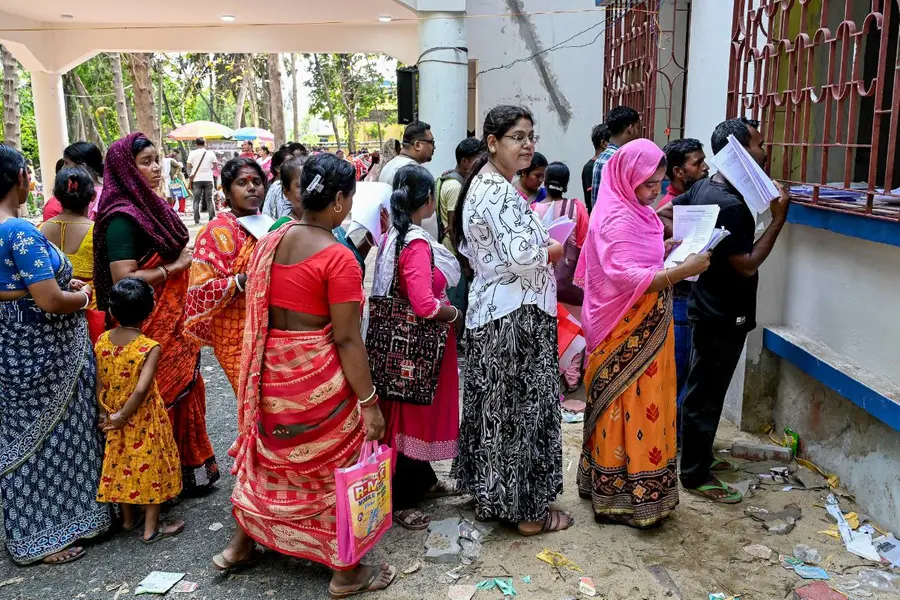
Kolkata: Nearly one in every two voters in West Bengal who were cleared by judicial officers during the Special Intensive Revision (SIR) of electoral rolls is facing another challenge to their inclusion, with the Election Commission of India (ECI) appealing against the names of at least 14.76 lakh voters already found eligible.
Records individually collected and verified by the Civic Research Group, an independent collective of researchers, analysts and field contributors in West Bengal, show that the Commission had challenged the inclusion of 14,75,887 voters as of October 17.
This represents 49.2% of the 30,00,545 voters who underwent adjudication and were subsequently cleared by judicial officers.
The appeals have raised questions about the grounds on which the poll panel seeks to overturn decisions made after scrutiny of voters' documents. The ECI has not publicly specified the reasons for these challenges or disclosed who authorised the appeals.
The figures assume significance because the voters concerned have already undergone judicial scrutiny and been declared eligible for inclusion in the electoral rolls.
How the second round of scrutiny unfolded
On February 28, around 60.06 lakh West Bengal voters were placed under adjudication after ECI software flagged them for alleged logical discrepancies or an inability to establish a link with the 2002 electoral roll.
Following directions from the Supreme Court, judges and judicial officers from West Bengal, Odisha and Jharkhand examined the cases under the apex court's supervision.
They found 32.68 lakh voters eligible and marked 27.16 lakh as ineligible.
The Commission's subsequent appeals seek to overturn the inclusion of nearly half of those cleared. If every appeal succeeds, the number of voters removed from the adjudicated pool could rise to 41.92 lakh, nearly 70% of the original group.
In 83 Assembly constituencies, the number of voters whose inclusion the ECI has challenged exceeds the number judicial officers found ineligible. The pattern is particularly pronounced in Malda district.
Judicial officers marked 2,39,375 voters in Malda as ineligible, while the Commission appealed against the inclusion of another 3,03,896 people who had been cleared.
If all these appeals succeed, the proportion of adjudicated voters removed in the district would rise from 29% to 66%.
Malda, Murshidabad account for a large share of appeals
Three districts, Malda, Murshidabad and Uttar Dinajpur, together account for 44.6% of the appeals filed by the Commission.
Malda tops the list with 3,03,896 challenges, followed by Murshidabad with 2,07,495 and Uttar Dinajpur with 1,45,969.
Sujapur in Malda has the highest number of challenged inclusions in any constituency, at 61,036. This amounts to 56.7% of the voters cleared there and 23.8% of the constituency's entire draft electoral roll.
Ratua, also in Malda, has 37,808 appeals, while Chanchal has 34,958. In Murshidabad's Raghunathganj, the Commission has challenged the inclusion of 33,855 voters. Chakulia in Uttar Dinajpur accounts for another 32,568 appeals.
Nine of the ten constituencies with the most appeals have minority populations exceeding 50%, and six lie along the border. All ten had elected Trinamool Congress MLAs in the 2021 Assembly election, and nine returned TMC candidates in the 2026 polls.
Disproportionate impact on minority-majority constituencies
The distribution of appeals also varies sharply with constituencies' demographic composition.
In the 41 Assembly seats where minorities constitute more than half the population, the Commission's appeals cover 5.9% of the draft electoral roll. In contrast, the corresponding proportion stands at 0.6% in the 89 constituencies where minorities account for less than 10% of the population.
The 41 minority-majority seats alone account for 5,99,155 appeals, or 40.6% of the statewide total. The Commission has challenged the inclusion of voters cleared by judicial officers in these constituencies, who make up 51% of the voters.
The figures also reveal a political concentration. The 80 constituencies the TMC won in 2026 account for 52.6% of all appeals, despite containing just over a quarter of the state's voters.
Appeals in these seats amount to 4% of their draft rolls, compared with 1.3% across the 207 seats won by the BJP. Constituencies that elected TMC MLAs in 2021 account for 84.4% of the appeals.
These patterns show the geographic and demographic concentration of the challenges, but the figures alone do not explain individual appeals or prove that every challenged voter is ineligible.
Appeals could outweigh Assembly victory margins
The potential electoral implications extend beyond the ongoing revision exercise. In 29 constituencies, the number of ECI appeals against inclusion exceeds the winning margin recorded in the 2026 Assembly election.
The BJP won 15 of these seats, the TMC 13, and the Congress one.
In Sujapur, the 61,036 appeals exceed the TMC's victory margin of 60,287. The figures do not show that the appeals will succeed or change any election result, but they underline the cases' possible electoral significance.
With municipal elections expected to be announced next month, the unresolved appeals have added another layer of uncertainty to the state's electoral landscape.
Tribunal backlog leaves voters waiting
Despite the scale of the dispute, the appellate process has made limited progress. As of the period covered by the records, tribunals had disposed of just 80,091 appeals, or 5.4% of the 14.76 lakh cases.
The available records do not show how many of these cases were allowed or dismissed.
In Malda, authorities had disposed of only 938 of 3,03,896 appeals. Murshidabad had decided only 145 of its 2,07,495 cases, while North 24 Parganas had recorded 33 disposals out of 1,18,049 appeals.
In Bankura and Purulia, where caseloads are smaller, tribunals had decided roughly three-quarters of the cases.
The records further indicate that tribunals have been unable to upload orders since September 21, after judges refused an ECI portal requirement to log in using Aadhaar credentials.
The Kolkata tribunals are handling these cases alongside appeals from around 22 lakh voters excluded during adjudication who are seeking reinstatement.
At a Supreme Court hearing on August 25, Justice Joymalya Bagchi reportedly stressed that appeals against exclusion should receive priority, observing that deletion amounts to “denuding a voting right”, while challenges to inclusion have other remedies under the law.
For the 14.76 lakh voters whose inclusion is being contested, the appeals mean defending their eligibility once again after judicial officers have already examined their documents.
With the Commission's grounds for challenge still undisclosed and a substantial backlog before the tribunals, the outcome remains uncertain.
Published: 22 Oct 2026, 05:01 pm IST
ABOUT THE AUTHOR

Related Topics
Disclaimer: Kindly avoid objectionable, derogatory, unlawful and lewd comments, while responding to reports. Such comments are punishable under cyber laws. Please keep away from personal attacks. The opinions expressed here are the personal opinions of readers and not that of Mathrubhumi.