
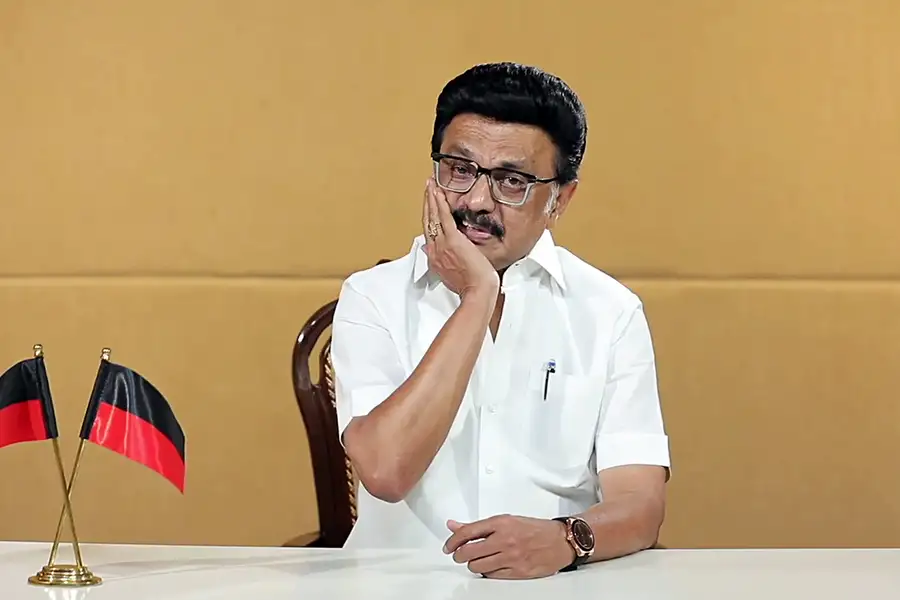
New Delhi: Dressed in black at a campaign stop in Namakkal on April 16, then Tamil Nadu chief minister M K Stalin set fire to a copy of the delimitation bill. The next day, his party joined a united opposition in handing the Narendra Modi government a rare defeat in the Lok Sabha.
On Saturday, at a meeting of DMK MPs chaired by Stalin in Chennai, the party adopted a resolution backing the Centre's revised bills. Around the same time, in New Delhi, Congress president Mallikarjun Kharge was meeting opposition leaders to draw up a common response to the proposed legislation. The DMK stayed away despite an invitation.
Representatives of at least 11 parties took part in Saturday's meeting at Kharge's residence. The NCP (SP) was also absent, with Supriya Sule citing party founder Sharad Pawar's ill health for skipping the meeting. The AAP and BJD, which are not constituents of the alliance, also stayed away despite being invited.
The line-up at Kharge's residence showed how far the INDIA bloc has come since April, when it stood united against the government, before splits and strained relations hollowed it out.
The Congress and the DMK are no longer allies, the Trinamool Congress and the Shiv Sena (UBT) have lost most of their Lok Sabha MPs to breakaways, and the NCP (Sharadchandra Pawar) is weighing support for a proposal it helped defeat seven months ago.
On April 17, the constitutional amendment to roll out women's reservation through delimitation drew 298 votes in favour and 230 against, falling 54 short of the required two-thirds majority.
Stalin had warned that using newer population figures to redistribute seats could diminish Tamil Nadu's share in the Lok Sabha.
As recently as August, DMK MP Dayanidhi Maran invoked a unanimous Tamil Nadu Assembly resolution seeking to freeze the House at 543 seats while questioning Chief Minister Vijay's stand on delimitation.
The fresh bill, set to be introduced on Monday, provides for a uniform 50 per cent increase on existing seat allocations and keeps the revised allocations and constituency boundaries in place until 2051. Under that formula, Tamil Nadu would retain roughly the same share of Lok Sabha seats, which meets the DMK's central concern, giving it room to endorse the bill.
However, the Congress has warned parties backing the bill that preserving each state's share of seats would still leave scope for gerrymandering -- constituency boundaries could be redrawn to give the BJP an electoral advantage.
The Congress ended its longstanding alliance with the DMK on May 6, two days after the DMK lost the Tamil Nadu Assembly election. The Congress backed actor Vijay's Tamilaga Vettri Kazhagam (TVK), which emerged as the single largest party, and said the tie-up would extend to future elections.
The DMK subsequently quit the INDIA bloc, taking 22 Lok Sabha MPs out of the alliance.
In June, 20 Trinamool Congress MPs broke away and announced a merger with the little-known Nationalist Citizens Party of India -- an NDA ally -- a month after the party was dislodged from power in West Bengal after three consecutive terms. Speaker Om Birla allotted them separate seats in July.
Disqualification proceedings against the TMC rebels are pending, and, for now, the BJP is counting on their votes to get the fresh delimitation-linked women's quota bill passed in the Lok Sabha.
By the end of June, six of Uddhav Thackeray's nine Lok Sabha MPs had crossed over to the Eknath Shinde camp. The Lok Sabha secretariat recognised the switch in July, leaving Shiv Sena (UBT) with three MPs.
On August 10, Sharad Pawar led his party's eight Lok Sabha MPs to meet Modi as the Centre sought support from non-Congress opposition parties for another attempt at passing the delimitation-linked amendment. To be sure, NCP (SP) leaders said they had raised constituency issues at the meeting, and party MP Amol Kolhe said delimitation did not come up.
On Friday, NCP (SP) spokesperson Jitendra Awhad said the party would back the proposal if it guaranteed a uniform 50 per cent increase. Its working president Supriya Sule said the party would spell out its stand in the House after examining the draft, though, by now, the NCP (SP) is widely expected to vote in favour of the bill.
Maharashtra Congress responded by reminding Pawar that it had given up its claim to a Rajya Sabha seat to help him get re-elected earlier this year.
The government could muster 353 votes if the Trinamool rebels, the lone Akali Dal MP, the DMK, the NCP (SP) and the YSR Congress Party, which has four MPs, back the bill. That would be six short if TMC MP Kalyan Banerjee's suspension remains in force and all 538 MPs other than him and the Speaker vote. With 353 votes in favour, the government would clear the two-thirds threshold if 529 or fewer MPs vote.
For the opposition, the immediate cost of a defeat would be psychological.
Uttar Pradesh, Punjab, Uttarakhand, Goa and Manipur go to the polls early next year. The biggest test is Uttar Pradesh, where the Samajwadi Party and the Congress together won 43 of 80 Lok Sabha seats in 2024 and are still negotiating how to divide the state's 403 assembly constituencies.
(Except for the headline, this story has not been edited by Mathrubhumi and is published from a syndicated feed.)
Published: 28 Nov 2026, 05:07 pm IST


Disclaimer: Kindly avoid objectionable, derogatory, unlawful and lewd comments, while responding to reports. Such comments are punishable under cyber laws. Please keep away from personal attacks. The opinions expressed here are the personal opinions of readers and not that of Mathrubhumi.
