
Chief Election Commissioner clarifies voter list revision in Bihar, addresses Rahul Gandhi`s concerns on machine-readable lists, transparency, and Booth Level Agents.
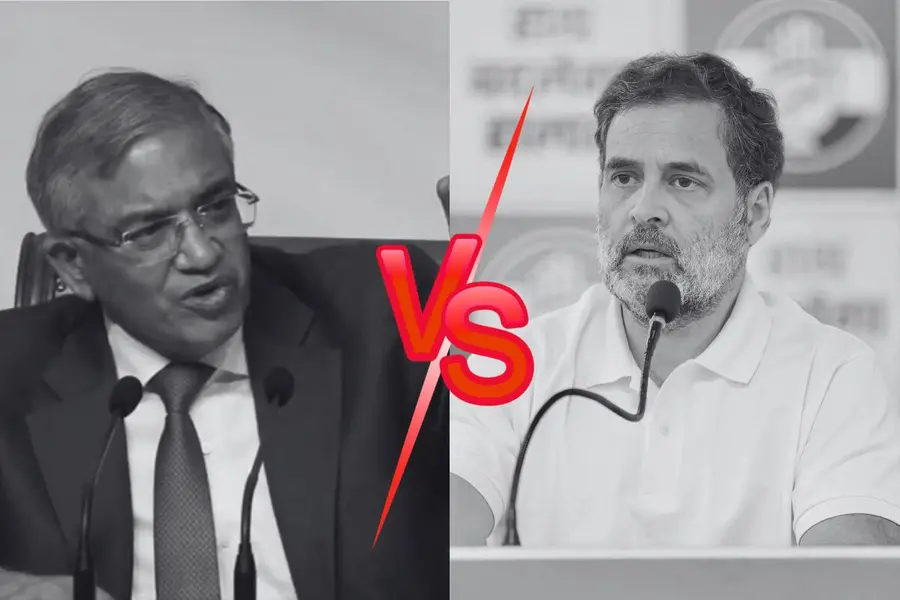
New Delhi: Chief Election Commissioner Gyanesh Kumar on Sunday addressed the criticism by opposition leaders, including Rahul Gandhi, regarding the ongoing Special Intensive Revision (SIR) of electoral rolls in Bihar and concerns over machine-readable voter lists. In a detailed media briefing, Kumar clarified the Election Commission’s position on these issues, reaffirming the ban on machine-readable electoral rolls and assuring that the revision process is transparent and inclusive.
Below is a point-by-point clarification by the Chief Election Commissioner in response to the concerns raised:
Point 1: Machine-readable voter list ban
What Rahul sought:
Opposition leaders questioned the availability of machine-readable voter lists and videography records for the last 10 years.
How CEC responded:
Gyanesh Kumar clarified that machine-readable voter lists are strictly prohibited. This stance follows a 2019 Supreme Court judgment and an Election Commission decision emphasising voter privacy.
“We recently saw some media reports displaying voter lists with photos of electors without consent, which is a breach of privacy,” he said.
While the Election Commission’s website allows voters to search and download the electoral roll by EPIC number, this does not constitute a machine-readable list and poses no privacy risk.
Kumar added that the Election Commission maintains an open-door policy for all parties and voters equally. He noted that on the ground, all stakeholders including booth-level officers and political representatives collaborate transparently by verifying voter lists, signing documents, and providing video testimonials. He expressed concern that verified documents are sometimes not communicated effectively to party leaders, causing misinformation.
ALSO READ: ‘ECI stands thoroughly exposed’: Congress hits back at EC, says Rahul quoted poll body’s own data
Point 2: Transparency and credibility of Bihar’s Special Intensive Revision
What Rahul sought:
Opposition parties accused the Election Commission of lacking transparency in the ongoing SIR of Bihar’s electoral rolls.
How CEC responded:
The CEC assured that officials and stakeholders are committed to making Bihar’s SIR a success. He mentioned that the doors of the Election Commission are always open to everyone and the poll body is working together with everyone in a "transparent" manner.
With over seven crore voters participating, he emphasised the process’s credibility and transparency. Political parties, voters, and election officials are working hand-in-hand to verify and finalise the voter lists.
"When more than seven crore voters of Bihar are standing with the Election Commission, then neither can any question mark be raised on the credibility of the Election Commission nor on the credibility of the voters," CEC said.
Point 3: Role of Booth Level Agents and claims filed in Bihar
What Rahul sought:
Questions were raised about the involvement of political parties in drafting voter lists and the volume of voter claims and objections.
How CEC responded:
The CEC informed that approximately 1.6 lakh Booth Level Agents from various parties participated in preparing and verifying the draft voter list in Bihar. To date, 28,370 claims and objections have been submitted by voters, reflecting active citizen engagement in the revision process.
"SIR has been started in Bihar. 1.6 lakh Booth Level Agents(BLA) have prepared a draft list...As this draft list was being prepared in every booth, the Booth Level Agents of all political parties verified it with their signatures...Voters have submitted a total of 28,370 claims and objections...," CEC Gyanesh Kumar said.
ALSO READ: CEC Gyanesh Kumar demands apology from Rahul Gandhi over vote theft allegations
Point 4: Duplicate voter entries and multiple voting
What Rahul sought:
Concerns were raised about people appearing in multiple voter lists, implying a risk of multiple votes being cast by the same individual.
How CEC responded:
Gyanesh Kumar clarified that a person being listed in multiple voter lists does not automatically mean they voted multiple times. He stated that the Election Commission has identified and corrected over three lakh cases where multiple people had the same voter ID card number. However, the issue of one person being registered as a voter in multiple places can only be effectively addressed through processes like the Special Intensive Revision (SIR).
ALSO READ: Rahul Gandhi sips tea with ‘dead’ voters, gives another blow to Election Commission | WATCH
Point 5: House number zero issue
What Rahul sought:
Rahul had raised concerns implying that voters with “house number zero” might be fake or fraudulent voters due to the unclear or missing house numbers on voter lists.
How CEC Responded:
Chief Election Commissioner Kumar clarified that many poor voters live without formal addresses and that having “zero” as a house number does not make them fake voters.
Kumar said crores of people have ‘zero number' in their house addresses because the panchayat or the municipality has not given the number to the house.
“There are unauthorised colonies in the cities, where they do not have a number, so what address should they fill in their form? So the instructions of the Election Commission say that if there is any such voter in this country, the Election Commission stands with him and will give him a notional number,” he said.
“Just because when he fills it in the computer, he sees zero, it does not mean that he is not a voter. In the conditions of becoming a voter, your address is not as important as your citizenship and your completion of eighteen years of age and as long as you live in the vicinity of that booth," Kumar said.
Where did this controversy arise?
Levelling allegations of "vote chori", Leader of Opposition in Lok Sabha Rahul Gandhi had on July 31, through a presentation at a press conference, cited data from the 2024 Lok Sabha polls to claim that over 1 lakh votes were "stolen" in Mahadevapura assembly segment in Karnataka through five types of manipulation, including duplicate voters, fake and invalid addresses and single-address voters.
The chief electoral officers of several states had asked Gandhi to file an affidavit under oath on his claims, but he had refused to do so.
Published: 17 Aug 2025, 07:45 pm IST
Related Topics
Disclaimer: Kindly avoid objectionable, derogatory, unlawful and lewd comments, while responding to reports. Such comments are punishable under cyber laws. Please keep away from personal attacks. The opinions expressed here are the personal opinions of readers and not that of Mathrubhumi.
