
The BJP's decision to accept Union Education Minister Dharmendra Pradhan's resignation was shaped by mounting student protests, fears of alienating Gen Z voters, security inputs warning of possible unrest and the electoral risks ahead of crucial Assembly elections, according to people familiar with the developments.
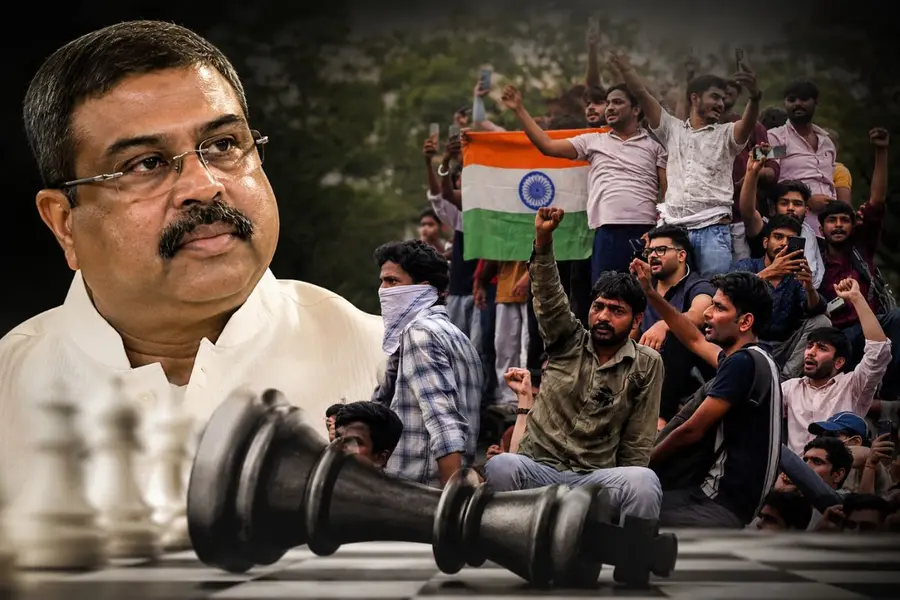
For weeks, New Delhi projected confidence as student protests over alleged examination irregularities refused to die down.
Ministers defended the government's actions, investigations gathered pace and assurances of justice continued to flow.
Yet on Saturday, the political narrative changed dramatically with Union Education Minister Dharmendra Pradhan stepping down. This move, sources say, was driven as much by political arithmetic as by governance.
People familiar with the developments said prolonged discussions within the government centred on two pressing concerns: the growing social and security implications of allowing the protests to continue, and the electoral costs of appearing indifferent to a nationwide student movement at a time when the BJP is preparing for another round of state elections.
Among the biggest worries was the possibility of alienating young voters, particularly Gen Z, a demographic that party insiders acknowledged had rallied across regional, religious and caste identities over the issue.
The protests, sparked by alleged irregularities in the conduct of the National Eligibility cum Entrance Test (NEET) and other public examinations, were spearheaded by the Cockroach Janta Party (CJP), a political collective that originated as an online satire movement in May before launching an indefinite sit-in at Jantar Mantar in June.
The organisation built support among students across the country, with one of its three primary demands being Pradhan's resignation.
According to people aware of the discussions, negotiations between the government and the CJP eventually reached a deadlock over that demand.
It was after these talks failed that Pradhan offered to resign, taking what sources described as 'moral responsibility' for the controversy.
Within the BJP, several leaders privately admitted that the protests had evolved into a significant political challenge for a party that governs at the Centre and across 22 states and two Union Territories with its allies.
One senior BJP lawmaker, speaking on condition of anonymity, argued that the party traditionally avoids accepting resignations under political pressure. The leader pointed out that the government had ordered a re-examination, initiated criminal proceedings against those accused and attempted to rectify the situation.
However, the lawmaker alleged that opposition parties and other vested interests had amplified the protests, making the issue increasingly difficult to contain.
The same leader said Prime Minister Narendra Modi personally sought to reassure students, but acknowledged that the government found itself struggling to regain the confidence of young protesters once the agitation gathered nationwide momentum.
Security considerations also became increasingly important. Sources said intelligence agencies warned the government by the middle of last week about the possibility of violence and wider social unrest over the weekend if the protests continued without a breakthrough.
Those assessments, officials said, accelerated internal discussions on finding a political solution.
One person familiar with the developments described the resignation as a tactical move aimed at preventing escalation, saying the government could not risk allowing the situation to spiral into bloodshed.
Even after Modi assured students of fast-track justice on Thursday and later announced plans to strengthen legal penalties for irregularities in public examinations, demonstrations showed little sign of slowing.
Adding to the pressure was feedback from the Rashtriya Swayamsevak Sangh (RSS), which reportedly advised the government not to underestimate the movement.
According to an RSS functionary, the organisation urged meaningful engagement with students and reiterated its long-standing demand for broader reforms in the education sector.
On Friday, RSS chief Mohan Bhagwat also spoke about India's changing generational mindset, observing that young people today seek answers based on logic and reasoning rather than unquestioned obedience.
Without referring directly to the protests or the CJP, he said institutions and families must engage with youth instead of relying solely on authority.
Party insiders also acknowledged the historical weight carried by student movements in Indian politics.
One BJP functionary noted that no political party can afford to lose the support of young voters, recalling how student-led mobilisations played defining roles during the JP Movement and the India Against Corruption movement.
With elections approaching in politically significant states such as Uttar Pradesh and Punjab, the leadership feared the protests could hand the Opposition a powerful campaign issue centred on youth dissatisfaction.
For a government known for weathering political storms without sacrificing senior ministers, Pradhan's resignation ultimately reflected something larger than one minister's future.
It underscored the growing political influence of organised student movements and the electoral risks of allowing youth anger to gather momentum unchecked.
(With inputs from PTI, HT and ANI)
Published: 26 Jul 2026, 09:43 am IST
Related Topics
Disclaimer: Kindly avoid objectionable, derogatory, unlawful and lewd comments, while responding to reports. Such comments are punishable under cyber laws. Please keep away from personal attacks. The opinions expressed here are the personal opinions of readers and not that of Mathrubhumi.
