
Delhi-NCR continues to record very poor air quality as pollution persists even while winter temperatures begin easing.
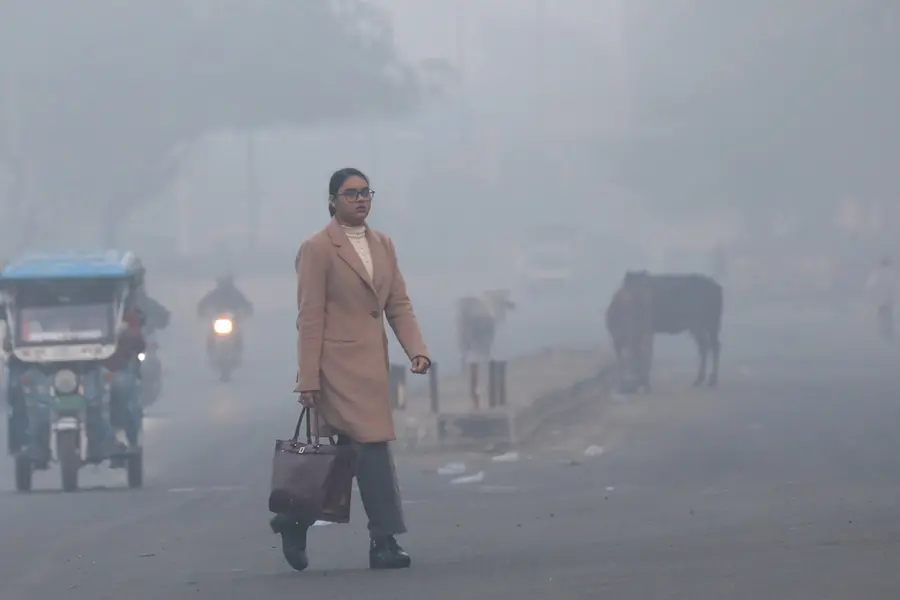
New Delhi: Air pollution levels across Delhi-NCR remained alarming on Wednesday, with the overall Air Quality Index (AQI) recorded at 380 at 8 am, keeping the region in the ‘very poor’ category, as per data released by the Central Pollution Control Board (CPCB).
Most parts of the national capital continued to report ‘very poor’ air quality, while a handful of locations slipped into the ‘poor’ category, offering limited comfort to residents facing prolonged pollution conditions.
Jahangirpuri registered an AQI of 395, while Rohini and Anand Vihar both recorded 391.
Wazirpur followed closely at 388, and Bawana reported an AQI of 384, reflecting consistently high pollution levels across north and northwest Delhi.
Several other areas also continued to report ‘very poor’ air quality, including Mundka with an AQI of 381, R K Puram at 378, Punjabi Bagh at 377 and Dwarka Sector-8, which also recorded 377.
Central and east Delhi remained heavily polluted as well, with ITO and Vivek Vihar each recording an AQI of 372.
Chandni Chowk and Patparganj were not far behind, both registering an AQI of 370, indicating persistent pollution across densely populated areas.
As per CPCB standards, an AQI between 0 and 50 is classified as ‘good’, 51 to 100 as ‘satisfactory’, 101 to 200 as ‘moderate’, 201 to 300 as ‘poor’, 301 to 400 as ‘very poor’, and 401 to 500 as ‘severe’.
Earlier, the Commission for Air Quality Management (CAQM) revoked Stage IV of the Graded Response Action Plan (GRAP) across Delhi-NCR on January 20 after a marginal improvement in air quality.
However, restrictions under Stages I, II and III of GRAP continue to remain in force across the region.
The ban on the entry of BS-IV diesel trucks and older heavy goods vehicles into Delhi has been completely lifted, providing some operational relief, though air quality remains a major concern.
Meanwhile, the winter chill in the capital has begun to ease gradually.
The maximum temperature is hovering around 24 degrees Celsius, while the minimum temperature has settled close to 7 degrees Celsius, offering some respite from the cold even as pollution continues to pose serious health risks.
IANS
Published: 21 Jan 2026, 09:40 am IST
Related Topics
Disclaimer: Kindly avoid objectionable, derogatory, unlawful and lewd comments, while responding to reports. Such comments are punishable under cyber laws. Please keep away from personal attacks. The opinions expressed here are the personal opinions of readers and not that of Mathrubhumi.
