
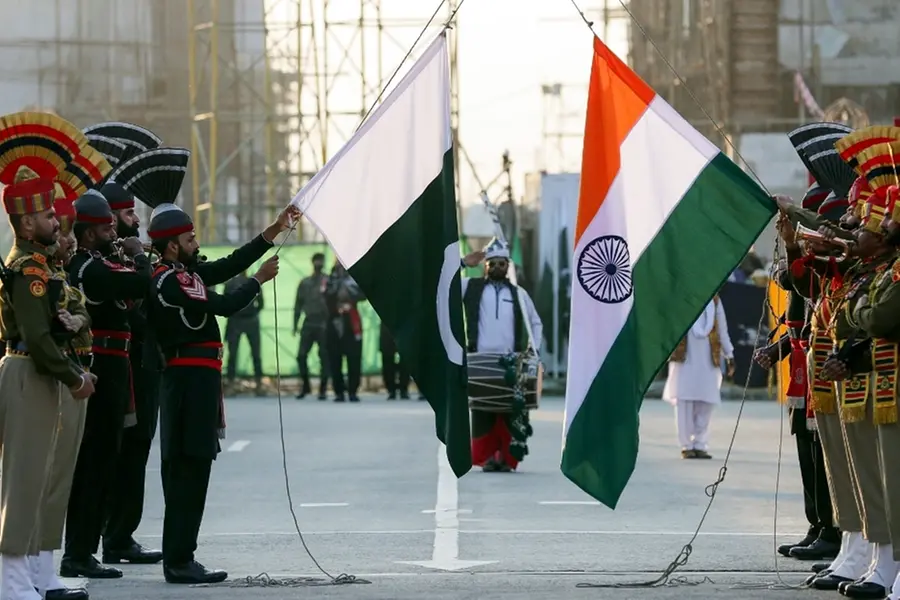
New Delhi: On Sunday, the usual border ceremony at the Attari-Wagah crossing between India and Pakistan in Punjab took an unusual turn. While the vibrant ceremony, complete with energetic patriotic music and lively crowds, continued as planned, the symbolic handshake between the soldiers of both countries was notably absent.
This absence served as a stark reminder of the deepening diplomatic tensions between the two nuclear-armed neighbours, with the ongoing standoff casting a shadow over what has traditionally been a symbol of cooperation.
The daily ceremony, which has become an iconic attraction, usually sees soldiers from both India and Pakistan performing a coordinated, theatrical display of military precision, culminating in a handshake that represents peace and mutual respect. However, with the escalating hostilities following a deadly terrorist attack in Indian-administered Kashmir on April 22, this ritual was conspicuously missing. The attack, which claimed the lives of 26 tourists, was claimed by The Resistance Front (TRF), a Pakistan-based terror group. India has accused Pakistan of supporting the attackers, leading to diplomatic tensions and retaliatory actions.
Following the attack, relations between the two countries rapidly deteriorated. Pakistan denied any involvement, but India’s accusations led to a swift escalation. Both countries exchanged gunfire across the border, expelled each other's citizens, and imposed a closure of the border, affecting not just diplomatic relations but also families separated by the international boundary.
Despite the tense atmosphere, the Attari-Wagah ceremony continued, drawing thousands of Indian spectators to cheer on their soldiers. Simarjeet Singh, a 17-year-old from Amritsar, expressed his pride in witnessing the show despite the ongoing political tensions. "It fills you with passion and patriotic pride to see our soldiers marching and waving our flag. But we can't ignore the situation around us, especially with what's happening in Kashmir," Singh said, his face painted with the Indian tricolour.
While the Indian side of the ceremony was filled with energy and patriotic fervour, the Pakistani side saw significantly fewer spectators, with only a small fraction of the usual crowd attending. In fact, the event’s atmosphere was notably subdued on the Pakistani side, reflecting the broader strain in bilateral relations.
For tourists like PK Nath, a 70-year-old visitor from Assam, the excitement of being at the border was tempered by growing concerns about security in the region. "We were planning to visit Jammu and Kashmir next, but with all that's happening, we're now a little apprehensive about the security there. It’s a delicate situation," Nath said, as he joined a group of fellow tourists at the ceremony. Nath also expressed support for India’s firm stance against Pakistan, stating, "We can't allow terrorists to come and kill people here without any consequences. I support the government's decision to expel Pakistani citizens and shut the border."
Despite these growing anxieties, many participants in the ceremony held strong nationalist sentiments. Harpal Singh, an Amritsar-based taxi driver who frequently brings tourists to the border for the ceremony, noted that while the tension was palpable, the spirit of the event remained intact. "It’s always a spectacle that impresses people. But yes, there's a sense of unease now. The situation is not as lighthearted as it used to be," Singh said.
The ceremony, a vestige of colonial times, commemorates the partition of British India in 1947, which divided the subcontinent into two nations—India and Pakistan—along religious lines. Since then, the Attari-Wagah border ceremony has become a unique tradition, despite countless diplomatic crises and military confrontations. The daily spectacle, with its goose-stepping soldiers, raised boots, and synchronised movements, is an effort to showcase national pride and military strength, even as the two countries have been locked in a bitter conflict for decades.
Reena Devi, a 54-year-old tourist from Tezpur, Assam, said she had always wanted to visit the border ceremony and was thrilled to experience it in person. "We just wanted to be here, see the soldiers, and be part of this tradition," she said. However, even for tourists, the ongoing tensions have cast a shadow. "We came here to enjoy the ceremony, but after hearing about the attack in Kashmir, there's a sense of apprehension. We’re hoping for peace, but we also understand the seriousness of the situation," Devi added.
The ongoing tensions, exacerbated by the terrorist attack in Kashmir, are taking a toll on ordinary people. For many, the border closure has led to the tearing apart of families, as relatives on both sides struggle to maintain contact. The fear of military escalation remains high, with some locals expressing anxiety over what the future holds. "Every day, we hear more about the attack, and everyone is talking about it," said KT Ramesh, a 57-year-old tourist from Kozhikode, Kerala. "There's anger, but there’s also a desire for peace. People want action, but not war. I hope the situation doesn’t escalate further."
As the ceremony ended, the presence of the locked gates and the absence of the customary handshake underscored the volatile state of India-Pakistan relations. The border, once a symbol of shared history and cultural ties, now stands as a reminder of the ongoing discord and the complex geopolitics between the two nations. For now, the future of the ceremony and the fate of India-Pakistan relations remain uncertain, with many wondering if peace can ever truly return to this contested region.
Published: 27 Apr 2025, 10:31 am IST
Related Topics
Disclaimer: Kindly avoid objectionable, derogatory, unlawful and lewd comments, while responding to reports. Such comments are punishable under cyber laws. Please keep away from personal attacks. The opinions expressed here are the personal opinions of readers and not that of Mathrubhumi.
