
Five villages in Chhattisgarh have restricted Christian pastors, priests and nuns from entering their areas for religious activities. The move, backed by a BJP MLA, has triggered a dispute over tribal rights, the PESA Act and religious freedom.
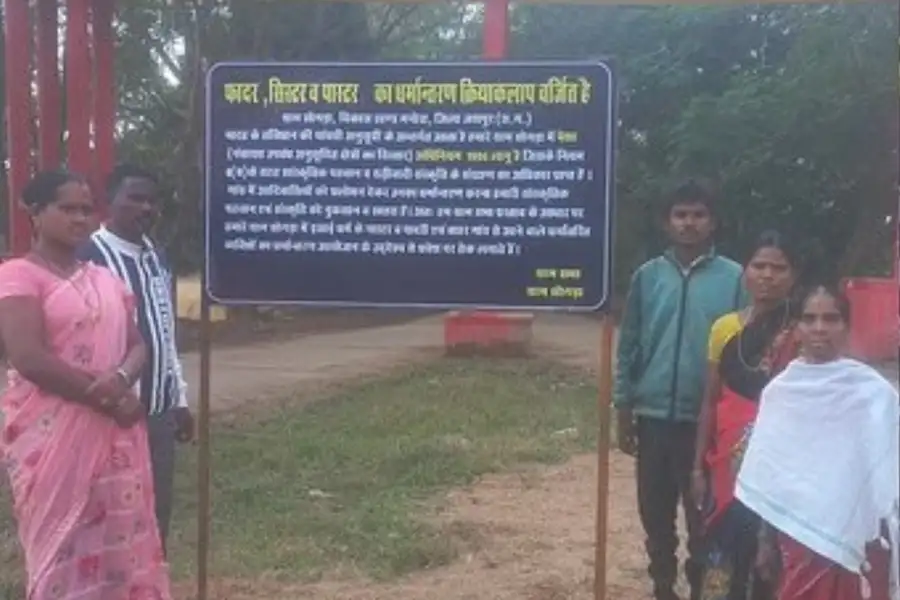
Chhattisgarh: Five tribal-majority villages in Chhattisgarh's Jashpur district have imposed restrictions on the entry of Christian pastors, priests and nuns, citing concerns over alleged religious conversion activities. The decisions were taken through Gram Sabha resolutions, with village authorities invoking constitutional provisions meant to protect tribal identity, customs and traditions.
The latest restriction was announced in Jabla village, where a notice board was installed on Friday after villagers unanimously passed a resolution. The board states that Christian religious leaders cannot enter the village for religious conversion activities, prayer meetings and other related programmes.
Jashpur BJP MLA Raimuni Bhagat was also present during the installation of the board and supported the villagers' decision.
Why have five villages banned Christian pastors and priests?
According to village representatives, residents were concerned about alleged religious conversion activities conducted in the name of healing services and prayer meetings.
Jabla village head Rainu Bhagat said villagers had raised concerns after similar allegations emerged from neighbouring villages. Following discussions, the Gram Sabha unanimously decided to restrict the entry of pastors, priests and nuns for conversion-related activities.
Similar resolutions have reportedly been passed in four other villages: Sogra, Chadia, Dumartholi and Tempu, all in the Manora development block.
The village authorities have cited the Panchayats (Extension to Scheduled Areas) Act, 1996, commonly known as the PESA Act, and the Fifth Schedule of the Constitution. They argue that Gram Sabhas have a responsibility to protect tribal identity, customs and traditional practices.
ALSO READ | Chhattisgarh liquor scam: Key accused Vikas Agrawal deported from UAE, arrested after 4 years
BJP MLA backs the village restrictions
Jashpur BJP MLA Raimuni Bhagat supported the decision and was present when the notice board was installed in Jabla.
She said villagers had informed her that pastors and nuns had previously visited the area for alleged religious conversion activities. The decision to restrict such activities was taken following concerns raised by residents.
The village representatives have maintained that the restrictions are intended to prevent religious conversion-related activities and protect local traditions.
Christian tribal organisation challenges the decision
The Christian Adivasi Mahasabha has strongly opposed the restrictions, arguing that the resolutions violate constitutional rights.
A delegation led by the organisation's state president, Anil Kispota, submitted a petition to the district administration and police on November 25. It demanded the removal of boards installed in four villages and sought action over the restrictions.
The organisation cited Articles 14, 15, 19 and 25 of the Constitution, arguing that restrictions targeting religious leaders of a particular community affect equality, freedom of movement and religious freedom.
Kispota warned that such measures could deepen divisions within tribal communities. He also called for a review of the legality of the Gram Sabha resolutions.
What does the PESA Act have to do with the ban?
The PESA Act, 1996, extends the Panchayati Raj system to Scheduled Areas and recognises the role of Gram Sabhas in protecting tribal customs, traditions and community interests.
The Fifth Schedule of the Constitution provides special administrative safeguards for Scheduled Tribes and Scheduled Areas.
The village authorities have invoked these provisions to justify their decisions. However, the key legal question is whether these powers allow Gram Sabhas to restrict the entry of religious leaders or prohibit religious activities.
Article 25 of the Constitution guarantees freedom of conscience and the right to profess, practise and propagate religion, subject to public order, morality, health and other constitutional provisions.
What happened in the earlier Kanker case?
The latest controversy follows similar restrictions imposed in eight villages in Chhattisgarh's Kanker district in 2025.
The Chhattisgarh High Court, on October 28, 2025, disposed of a petition challenging the village hoardings. It directed the petitioners to approach the relevant statutory authorities under the state's PESA framework.
In February 2026, the Supreme Court dismissed a challenge to the High Court's order, leaving the petitioners to pursue the available statutory remedy.
These proceedings concerned the specific Kanker dispute and did not establish a blanket approval for all village-level restrictions on religious activities.
Similar disputes have also emerged in Sukma district's Punpalli village, where a Gram Sabha passed restrictions concerning Christian religious activities and the use of community land.
The restrictions have also raised questions about the authority of Gram Sabhas and the role of the district administration.
According to The New Indian Express, Jashpur Sub-Divisional Magistrate Omkareshwar Singh said the administration had taken note of the reports and deputed a tehsildar to visit the villages and assess the situation.
He said further action would be taken after receiving the inquiry report. The administration also maintained that Gram Sabhas and Panchayats cannot override fundamental constitutional rights.
Why the village bans have become a bigger issue
The Jashpur controversy is not limited to religious conversion allegations. It raises a broader question about the relationship between tribal self-governance and individual constitutional rights.
- Tribal autonomy: Village councils argue that they have a responsibility to protect indigenous traditions and customary practices.
- Religious freedom: Christian organisations say restrictions targeting religious leaders affect constitutional freedoms.
- Legal authority: The dispute raises questions about whether PESA provisions can be used to impose restrictions on religious activities.
- Administrative responsibility: The district administration must examine the resolutions and determine whether they comply with applicable laws.
The distinction between preventing unlawful religious conversions and restricting religious activities is central to the debate. Allegations of forced or fraudulent conversion must be examined under applicable law, rather than automatically treating all prayer meetings or religious visits as unlawful.
With similar disputes reported in Kanker, Sukma and now Jashpur, the issue has become an important test of how tribal customs, local self-governance and constitutional freedoms are balanced in Chhattisgarh.
Published: 29 Nov 2026, 05:20 pm IST


ABOUT THE AUTHOR

Related Topics
Disclaimer: Kindly avoid objectionable, derogatory, unlawful and lewd comments, while responding to reports. Such comments are punishable under cyber laws. Please keep away from personal attacks. The opinions expressed here are the personal opinions of readers and not that of Mathrubhumi.