
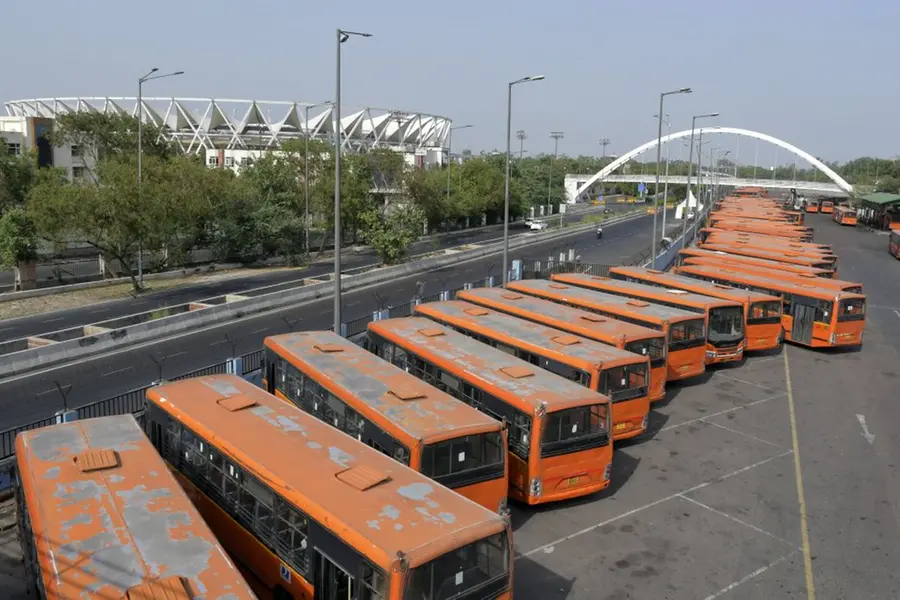
The Comptroller and Auditor General (CAG) has reportedly expressed serious doubts regarding the financial position and operational efficiency of the Delhi Transport Corporation (DTC), which has found its cumulative losses increasing from Rs 25,300 crore in 2015-16 to almost Rs 60,750 crore in 2021-22. The report, which is to be placed in the Delhi assembly on Tuesday by the newly-formed BJP government, blames the financial crisis due to an ageing fleet, inefficient route planning, and unaltered fare structures.
Key Findings: Declining fleet and piling losses
The report by the auditors reportedly points out several failures that have resulted in the financial deterioration of the corporation. Sources informed The Times of India that the foremost cause for such humongous losses was that there were no fare hikes since 2009, in spite of several such requests by the DTC. The cost of finances went even higher with the Delhi government offering free rides on buses to women.
The report is also faulting DTC for its inability to grow its fleet, hence recurring breakdowns and unsatisfactory services. At March 2022, the company had a fleet of 3,937 buses of which 1,770 were in the overage category, which had exceeded the length of operation and required phase-out. This 45% excess fleet translated into a high rate of breakdowns of 2.9 to 4.5 per 10,000 km, much higher than the national average and the performance of private cluster buses running in Delhi.
In the midst of a dire 1,740-bus shortage, the company added merely 300 new buses in 2022. The audit shows that DTC did not avail itself of Rs 233 crore lying in hand for the purchase of buses and did not avail an additional Rs 49 crore available under the Faster Adoption and Manufacturing of Hybrid and Electric Vehicles (FAME-I) scheme for want of decision-making and clarity on specifications.
Operational inefficiency, delayed projects and fiscal mismanagement
The CAG report also points to inefficient route planning, observing that DTC runs on 468 routes, which cover only 57% of the total 814 routes in Delhi. The corporation was unable to recover operational expenses on any of these routes, raking up Rs 14,199 crore in operational losses between 2015 and 2022.
In comparison, private cluster buses, running under a contract system, functioned much better than DTC buses on all parameters of functioning, even though they were working under the same conditions.
Between 2015 and 2022, the Delhi government had given a revenue grant of Rs 13,381 crore to DTC to fund its operations. But this was not enough to meet losses, and there remained a financial deficit of Rs 818 crore. The report also condemns DTC for not signing a Memorandum of Understanding (MoU) with the Delhi Transport Department, which would have established specific financial and operational performance targets.
The CAG has also pointed out tardiness in embracing new transport management systems
The Automatic Fare Collection System, which would have automated fare payment, was never executed. The CCTV surveillance system, which was envisioned nine years ago, is still incomplete.
The report is bound to heighten political tensions in Delhi. The BJP and the Congress have been repeatedly attacking the AAP government for not honouring its 2015 commitment to add 10,000 new buses to DTC's fleet.
Further, the report brings back to life an order of the 2007 Delhi High Court that directed DTC must have at least 11,000 buses. The Delhi cabinet, however, downgraded the goal to 5,500 buses later on, which has not been achieved yet.
Published: 25 Feb 2025, 09:45 am IST
Related Topics
Disclaimer: Kindly avoid objectionable, derogatory, unlawful and lewd comments, while responding to reports. Such comments are punishable under cyber laws. Please keep away from personal attacks. The opinions expressed here are the personal opinions of readers and not that of Mathrubhumi.
