
Days after the Cockroach Janta Party (CJP) ended its 37-day Jantar Mantar protest, BJP leaders Mahesh Jethmalani and Shehzad Poonawalla questioned the movement's funding and criticised its post-protest celebrations, triggering a fresh political controversy.
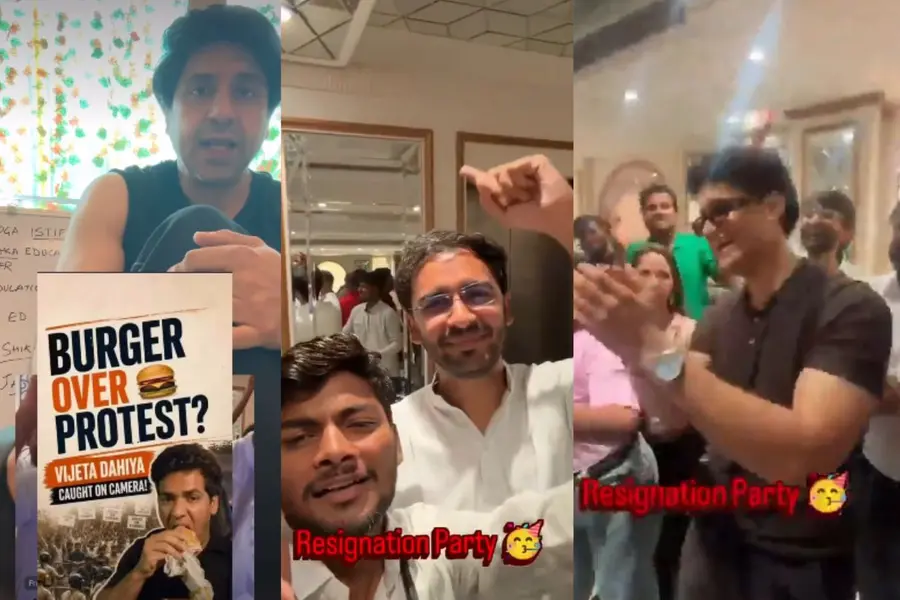
The Cockroach Janta Party (CJP) may have ended its 37-day protest, but the political battle around the movement is far from over. Days after the organisation withdrew its agitation following the resignation of Union Education Minister Dharmendra Pradhan, the BJP launched a fresh attack, questioning both the leadership's celebrations and the funding behind the month-long campaign.
Senior Supreme Court advocate and BJP Rajya Sabha MP Mahesh Jethmalani alleged that CJP leaders hosted a "victory party" at a Delhi hotel, where music and dancing continued despite the capital still recovering from violent clashes between protesters and police. Separately, BJP national spokesperson Shehzad Poonawalla accused the organisation of hypocrisy, contrasting the celebrations with its earlier decision to remove former spokesperson Vijyeta Dahiya after a video showed him eating a burger during the protest march.
Why is BJP questioning the protest's funding?
Beyond criticising the celebrations, BJP leaders have shifted the focus to the finances behind the agitation.
In his social media post, Jethmalani questioned how the protest was sustained for more than five weeks, asking who paid for travel, accommodation, food, sound systems, stage arrangements and other logistical expenses. He also sought greater transparency over the resources that enabled demonstrators to maintain their presence at Jantar Mantar throughout the protest.
ALSO READ: BJP welcomes Dharmendra Pradhan after resignation; Congress calls gesture 'insult to youth'
Shehzad Poonawalla said the celebrations exposed what he described as the movement's double standards.
Referring to the removal of former CJP spokesperson Vijyeta Dahiya over the viral burger video, the BJP spokesperson questioned why party leaders were now celebrating after the resignation of Dharmendra Pradhan. He also argued that the festivities were insensitive in light of the student deaths and examination-related issues that had formed the basis of the protest.
How did the 37-day CJP protest end?
The CJP called off its sit-in at Delhi's Jantar Mantar on July 26 after holding talks with Union ministers JP Nadda and Jitendra Singh.
The decision came shortly after Dharmendra Pradhan stepped down as Union Education Minister. According to the organisation, the Centre agreed to several demands, including compensation for families of students who died by suicide during the examination controversy and the withdrawal of FIRs registered against protesters in Delhi and BJP-ruled states. Another round of discussions on wider education reforms is expected in the coming weeks.
Supporters celebrated the announcement at Jantar Mantar before vacating the protest site.
ALSO READ: From Superman to Dora; How Gen Z turned Instagram into CJP protest's biggest stage
What sparked the month-long agitation?
The CJP emerged as a youth-led campaign after a controversial remark by a senior judicial functionary likening unemployed youth to "cockroaches." The movement later expanded into a nationwide protest over the NEET paper leak controversy and alleged irregularities in CBSE evaluations, eventually making Dharmendra Pradhan's resignation its central demand.
The protest escalated on July 20 when demonstrators marching towards Parliament clashed with Delhi Police. Baton charges, tear gas and injuries on both sides intensified political scrutiny of the agitation and kept the issue at the centre of the national debate until the minister's resignation.
Published: 27 Jul 2026, 05:00 pm IST
ABOUT THE AUTHOR

Disclaimer: Kindly avoid objectionable, derogatory, unlawful and lewd comments, while responding to reports. Such comments are punishable under cyber laws. Please keep away from personal attacks. The opinions expressed here are the personal opinions of readers and not that of Mathrubhumi.