
Bihar and Jharkhand have signed a Son River water-sharing MoU in New Delhi, seeking to address a long-pending issue between the two states.
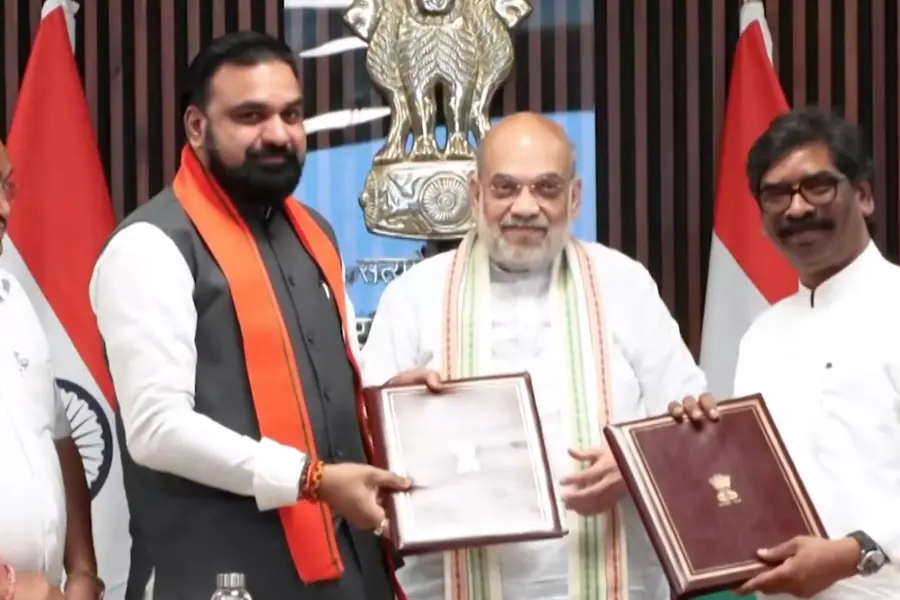
Patna: Bihar and Jharkhand signed a Memorandum of Understanding (MoU) on sharing Son River water in New Delhi on Monday, with Union Home Minister Amit Shah, Bihar Chief Minister Samrat Choudhary and Jharkhand Chief Minister Hemant Soren present.
The governments of Bihar and Jharkhand signed the MoU during a meeting chaired by Amit Shah. Union Jal Shakti Minister CR Paatil and senior officials from both states and the Centre also attended. The agreement concerns the long-pending issue of sharing Son River water between the two states.
Who was present?
The meeting was attended by Bihar Chief Minister Samrat Choudhary, Jharkhand Chief Minister Hemant Soren and CR Paatil, along with senior bureaucrats from Bihar, Jharkhand, the Ministry of Home Affairs and the Ministry of Jal Shakti.
Amit Shah chaired the meeting during which the agreement was signed.
The Son is a major tributary of the Ganga and flows through parts of Bihar and Jharkhand. Its waters are used for agriculture and irrigation in the region.
Because the river and its water resources involve more than one state, arrangements governing their use require coordination between the concerned governments.
The latest MoU is intended to provide an agreed framework for water sharing between Bihar and Jharkhand.
Why does the agreement matter?
Inter-state water-sharing arrangements can affect irrigation, agriculture and water availability in areas dependent on a river system.
The practical significance of the MoU will depend on the terms of the agreement and how those provisions are implemented by the two states.
The two governments will have to implement the terms agreed under the MoU. Details of the specific allocation and operational mechanisms will determine how the arrangement affects water use in the two states.
The agreement also provides a formal framework for addressing the previously unresolved differences over Son River water.
The agreement comes in the broader context of inter-state water management in India, where rivers often cross administrative boundaries and competing demands can require negotiated arrangements.
For Bihar and Jharkhand, the key issue now is implementation. The impact of the MoU will depend on whether the agreed water-sharing mechanism can be followed consistently, particularly during periods of varying rainfall and water availability.
The signing itself marks an agreement between the two state governments, but its longer-term effectiveness will be assessed through its implementation and its effect on water availability for users in both states.
Published: 31 Aug 2026, 06:54 pm IST
ABOUT THE AUTHOR

Related Topics
Disclaimer: Kindly avoid objectionable, derogatory, unlawful and lewd comments, while responding to reports. Such comments are punishable under cyber laws. Please keep away from personal attacks. The opinions expressed here are the personal opinions of readers and not that of Mathrubhumi.