
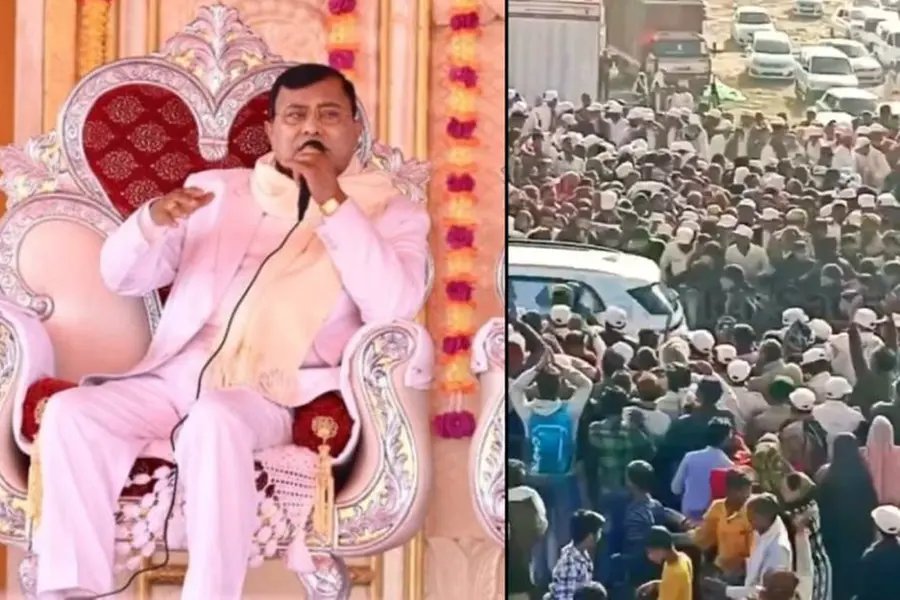
Mainpuri: Bhole Baba, the self-styled preacher whose recent sermon in Hathras led to a tragic stampede, is not evading the police, his lawyer informed AFP on Thursday, without revealing the preacher’s exact location.
The prayer meeting, held near the northern city of Hathras, resulted in the deaths of 121 people, predominantly women, following a rush to the exits among the 250,000 attendees. Since the incident, the former police officer-turned-spiritual leader has not appeared in public, while six organisers of the event have been detained.
Mathrubhumi English is now on WhatsApp; Join the channel
Local media speculated that Baba had taken refuge in his nearby monastery, where supporters have chained the gates to prevent public access.
Baba’s lawyer, A.P. Singh, asserted that his client was not responsible for the disaster and was not fleeing from the authorities.
"There is no reason for him to hide. He has never hidden in his life," Singh said. "He believes in the law. He is following police directions."
Singh attributed the stampede to "anti-social elements" in the crowd and confirmed Baba’s willingness to cooperate with the police investigation. "An investigation is going on. We will participate," he said.
Singh refrained from disclosing Baba’s precise location but mentioned that he remained in Uttar Pradesh, the state where his monastery is situated in Mainpuri, close to the site of the stampede.
Police Inspector Shalabh Mathur confirmed the arrest of six individuals linked to the disaster, all of whom were members of the organising committee.
"They were mainly working as volunteers," he told reporters on Thursday. "They were engaged in crowd management and collecting funds."
A police report issued after the stampede named several organisers of the prayer meeting sought arrest, but Baba's name was not among them.
Around 20 police officers were on guard outside the monastery on Thursday but had not entered the sprawling premises, which are also ringed by a five-metre-high wall.
India is home to numerous religious gurus or "godmen," whose followers seek miracles and offer money and possessions as tokens of loyalty. Baba was relatively unknown to the wider Indian public before this tragedy.
However, in Uttar Pradesh, he had built a substantial following, mainly among women from poor and marginalised communities.
Authorities had only permitted 80,000 people to attend the sermon, less than a third of the number that turned up.
Initially, officials blamed a dust storm for causing the panic, while police later suggested the stampede began when "followers started to collect earth" from where the preacher had passed.
One of Baba's devoted followers, standing outside the locked monastery's gates to show his support, said that blame for the stampede lay squarely at the feet of the preacher's audience.
"They were told to sit quietly and leave in an orderly fashion. What was the need to create a stampede?" said Rishipal Chaudhary, 40.
"These deaths are the fault of those who died and their family members."
Chaudhary said he was looking forward to Baba emerging in public again and expected that an even larger crowd than Tuesday's sermon would arrive to show their support.
"He cured my disease when no doctor or medicine could," he said. "He will open these gates whenever he feels like. If you think he can't see or hear what everyone is doing, you are wrong."
India has a grim history of deadly incidents at religious gatherings due to poor crowd management and safety lapses. In 2008, a stampede at a hilltop temple in Jodhpur resulted in the deaths of 224 pilgrims and injuries to over 400 others. AFP
Published: 05 Jul 2024, 06:23 am IST
Related Topics
Disclaimer: Kindly avoid objectionable, derogatory, unlawful and lewd comments, while responding to reports. Such comments are punishable under cyber laws. Please keep away from personal attacks. The opinions expressed here are the personal opinions of readers and not that of Mathrubhumi.
