
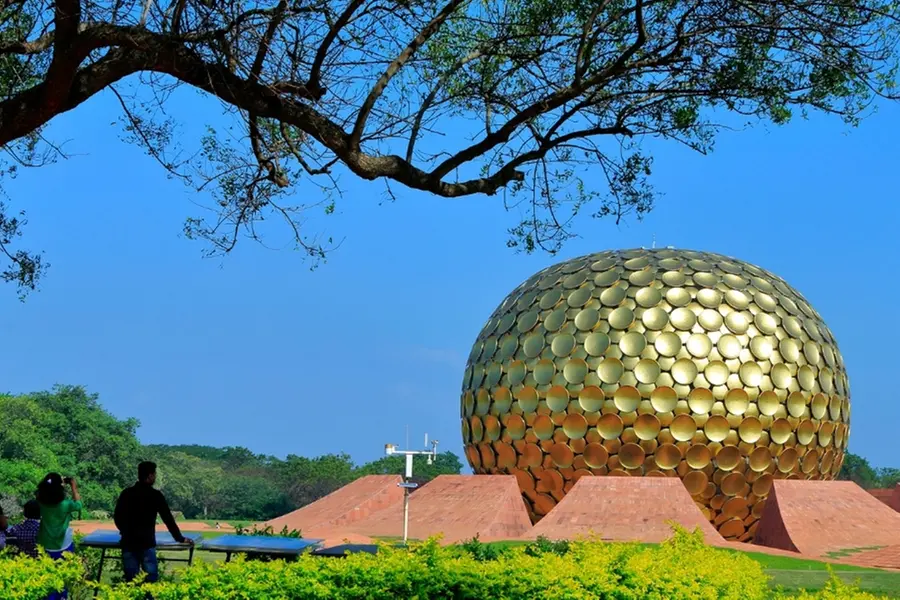
Tamil Nadu: The Auroville Foundation has entered into a formal agreement with the Centre for Development of Advanced Computing (CDAC), aiming to deploy smart infrastructure in the experimental township of Auroville. The Memorandum of Understanding (MoU), signed on 28–29 March 2025 during a high-level CDAC visit, outlines mutual cooperation in digital innovation, sustainable development, and cultural technology.
Auroville is an experimental township founded in 1968 in Tamil Nadu, near Puducherry, by French spiritual collaborator Mirra Alfassa, known as The Mother, under the vision of Indian philosopher and nationalist Sri Aurobindo. Conceived as a universal city without ownership, caste, religion, or nationality, Auroville was meant to serve as a model for human unity and sustainable living. It is governed under the Auroville Foundation Act, 1988, passed during Rajiv Gandhi's tenure to legally protect its autonomy.
As per the Foundation's release, the collaboration will pilot smart metering systems for water and electricity, an RFID-based tracking system for electric vehicles, and AI-driven platforms for preserving cultural and linguistic heritage. The deployment will be executed in partnership with Auroville’s Electrical Service, Water Service, and Aurinoco, the township's digital infrastructure arm. Initially, CDAC will provide 100 energy and water meters, with full-scale rollout contingent on pilot results.
Officials present at the signing included CDAC Director General Magesh Ethirajan, Executive Director S. D. Sudarsan, Auroville Foundation Secretary Jayanti Ravi, and Officer on Special Duty G Seetharaman.
The move aligns with India’s broader Digital India mission but has stirred debate within Auroville, which is already in the throes of a bitter governance and cultural conflict. At the heart of the issue is the rapid infrastructural transformation being pursued by the Foundation under the leadership of Jayanti Ravi, an IAS officer from the Gujarat cadre who took over as Secretary in 2021.
Critics argue the Foundation’s current redevelopment agenda — including road construction, tree-felling, and revision of The Mother’s original “Galaxy Plan” — undermines Auroville’s founding principles of peace, ecological harmony, decentralised governance, and spiritual unity. This vision, established by French-born spiritual leader Mirra Alfassa (The Mother) in 1968, was legally protected under the Auroville Foundation Act of 1988.
Auroville, located across Tamil Nadu’s Villupuram district and parts of Puducherry, was inaugurated with international support and built on ideals of caste-free, nationality-free human unity. Its community, made up of roughly 3,000 residents from nearly 60 countries, is now divided between those supporting modernisation and those alleging ideological appropriation.
The ongoing dispute is gaining national attention following a investigative report by The News Minute, titled "The RSS and BJP’s Quiet Takeover of Auroville". The report documents how the BJP and RSS may be leveraging the legacy of Sri Aurobindo — The Mother’s mentor and a spiritual nationalist — to embed a Hindutva-influenced vision into Auroville’s future.
According to the report, Tamil Nadu Governor RN Ravi, known for his affiliation with right-wing politics, was recently inducted into the Auroville Foundation’s Governing Board. This, alongside rapid urbanisation and bureaucratic overreach, has triggered resistance from many long-standing Aurovilians who view these developments as an existential threat to Auroville’s original ethos.
Supporters of the administration, however, claim the redevelopment is part of realising The Mother’s original vision of a 50,000-resident township, long stalled due to internal resistance and limited coordination with state authorities.
While the CDAC partnership may offer technological upgrades and improved resource management, critics worry it is symptomatic of a broader shift — one where centralised power and political ideology threaten to redefine Auroville’s identity from a grassroots spiritual experiment to a showcase of nationalist urbanism.
The Auroville township currently houses around 3,000 residents from over 60 countries and operates under a non-hierarchical, community-based governance structure. However, in recent years, Auroville has seen increasing centralisation under a government-appointed administration.
Observers and residents believe the RSS and BJP are showing growing interest in Auroville for ideological and strategic reasons. Sri Aurobindo’s blend of spirituality and nationalism aligns with the BJP's Hindutva narrative. Political analysts suggest that the BJP, which has struggled to gain cultural ground in Tamil Nadu, views Auroville as a potential ideological enclave that can symbolise its vision of spiritual nationalism while advancing its cultural influence in the southern state.
With the smart township project set to begin in the coming months, the clash between vision and implementation, tradition and transformation, remains unresolved.
Published: 07 Apr 2025, 11:58 am IST
Disclaimer: Kindly avoid objectionable, derogatory, unlawful and lewd comments, while responding to reports. Such comments are punishable under cyber laws. Please keep away from personal attacks. The opinions expressed here are the personal opinions of readers and not that of Mathrubhumi.
