
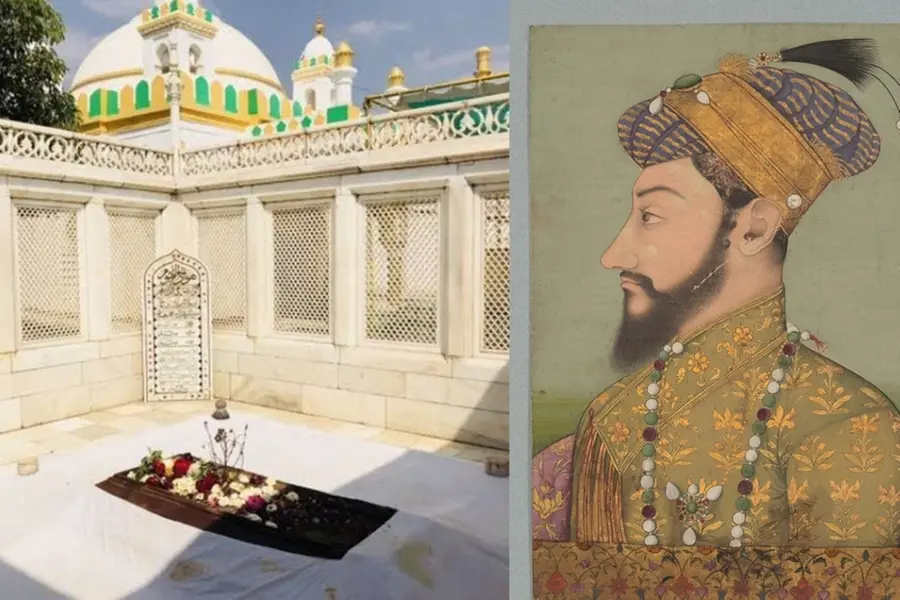
Maharashtra: The demand to remove Mughal emperor Aurangzeb’s tomb in Maharashtra’s Chhatrapati Sambhajinagar has intensified, with right-wing groups threatening action similar to the Babri Masjid demolition if authorities do not comply.
Bajrang Dal leader Nitin Mahajan issued a stark warning, stating, “If the government does not remove the grave, then we will do Karseva and do so ourselves. We all saw what happened in Ayodhya to remove the Babri structure.” His statement has sparked concerns over potential unrest, prompting authorities to heighten security around the site.
The tomb of Mughal Emperor Aurangzeb, located in Khuldabad, Chhatrapati Sambhajinagar (formerly Aurangabad), Maharashtra, has become a major political and communal flashpoint. Right-wing Hindu groups, including Bajrang Dal and VHP, are demanding its removal, arguing that Aurangzeb was a “tyrant” responsible for atrocities against Hindus, including the execution of Chhatrapati Sambhaji Maharaj, the son of Shivaji Maharaj. Some leaders have even threatened to take matters into their own hands, drawing comparisons to the Babri Masjid demolition of 1992.
Historical background: Why is Aurangzeb a controversial figure?
Aurangzeb, the last major Mughal emperor (1658-1707), ruled India with an expansionist and orthodox Islamic policy. His reign is marked by:
- The execution of Chhatrapati Sambhaji Maharaj in 1689 after he refused to convert to Islam.
- The reimposition of Jizya tax on non-Muslims.
- The destruction of Hindu temples, including the Kashi Vishwanath temple (where the Gyanvapi mosque stands today).
- His prolonged conflicts with the Marathas, which eventually led to the decline of the Mughal Empire.
Despite his military successes, Aurangzeb is widely despised in Maharashtra, where Maratha pride and resistance to the Mughals remain a significant part of the region’s history.
His tomb in Khuldabad is simple, as per his wishes, and was built with minimal expenses from his personal earnings. However, this historical site has repeatedly been at the centre of political controversies.
Why is it in the news again?
BJP MP Udayanraje Bhosale’s demand
Udayanraje Bhosale, a descendant of Chhatrapati Shivaji Maharaj, reignited the controversy by demanding the removal of Aurangzeb’s tomb, calling the Mughal emperor a “thief and looter”.
He stated, "What is the need... send a JCB machine and raze his grave... he was a thief and lootera (robber)."
Bajrang Dal’s ‘Karseva’ threat
Nitin Mahajan, a Bajrang Dal leader, issued a warning, saying, "If the government does not remove the grave, then we will do Karseva and do so ourselves. We all saw what happened in Ayodhya to remove the Babri structure."
Bajrang Dal and VHP have planned statewide agitations from March 17 to push for its removal.
Maharashtra government’s response
Deputy Chief Minister Devendra Fadnavis acknowledged that "everyone wants the tomb removed," but pointed out that the previous Congress government put the site under ASI protection, making any removal legally complex.
Union Minister Ramdas Athawale, however, opposed the demand, arguing that removing the tomb serves no purpose.
Security concerns and declining tourism
The Chhatrapati Sambhajinagar administration has banned Hindutva leader Milind Ekbote from entering the district to prevent any unlawful attempts at removal.
Feroz Ahmed Kabir Ahmed, the caretaker of the tomb, reported a sharp decline in visitors, from 2,500-3,000 daily to just 200-400 due to the controversy.
Local businesses, including shops and hotels, have also been affected, fearing communal tensions.
What next?
- The Maharashtra government is facing pressure from right-wing groups to act but is also bound by ASI’s legal protection of the site.
- Security has been beefed up around the tomb, with increased surveillance and visitor screening.
- As political parties and Hindutva groups escalate their rhetoric, this controversy could further deepen historical and communal tensions in Maharashtra.
The fate of Aurangzeb’s tomb remains uncertain, as it stands at the intersection of history, politics, and ideology.
Published: 17 Mar 2025, 09:04 am IST
Related Topics
Subscribe to our Newsletter
Disclaimer: Kindly avoid objectionable, derogatory, unlawful and lewd comments, while responding to reports. Such comments are punishable under cyber laws. Please keep away from personal attacks. The opinions expressed here are the personal opinions of readers and not that of Mathrubhumi.
