
In a video shared by writer Anand Ranganathan, Roy is heard stating that Pakistan has not deployed its military against its own population in the same manner as democratic India has.
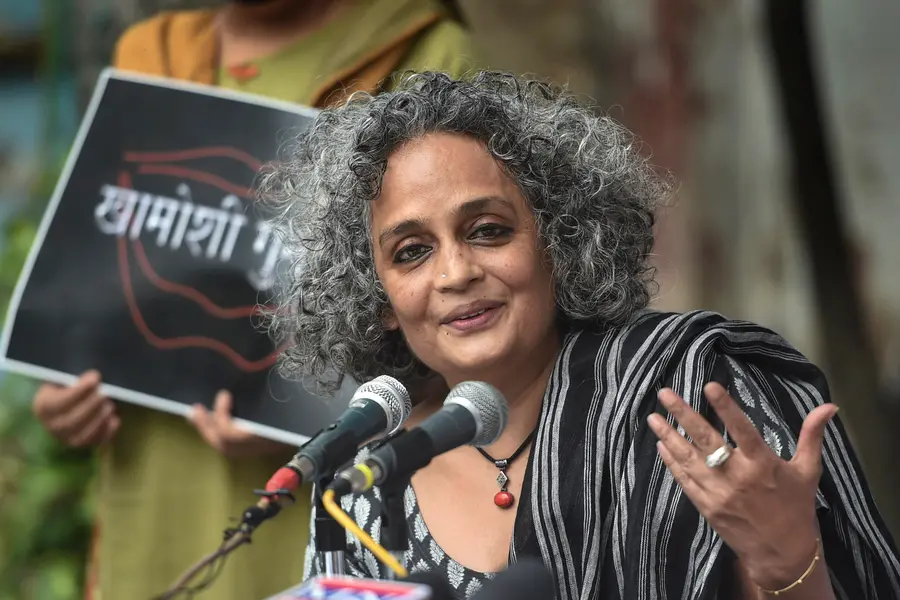
Author Arundhati Roy has faced strong criticism over her comments asserting that the Indian state has “perpetually waged war” on its own citizens, specifically tribal people and Muslims, since gaining independence, particularly in regions such as Kashmir, Manipur, Nagaland, Mizoram, Telangana, Punjab, Goa, and Hyderabad.
In a video shared by writer Anand Ranganathan, Roy is heard stating that Pakistan has not deployed its military against its own population in the same manner as democratic India has. She further argued that the upper-caste Hindu state has been in a constant state of war.
Also Read

Alongside the video, Ranganathan wrote on X (formerly Twitter): “When irresistible weed meets immovable hallucination.” He added, “According to Arundhati Roy, the 1961 liberation of Goa by India was in reality an Upper-caste Hindu State waging a war against Christians.”
Kanwal Sibal calls Roy “venomous”
Former Indian Foreign Secretary and current Chancellor of Jawaharlal Nehru University (JNU), Kanwal Sibal, subsequently reposted Ranganathan’s comments, condemning Roy’s remarks. He described her as “venomous against her own country” and “deeply anti-Hindu”. Sibal accused her of endorsing terrorism against the Indian state and claimed that she “blatantly distorts the truth to support her deeply communal and anarchist agenda”.
Sibal also refuted Roy’s comparison with Pakistan, pointing to several military operations undertaken by Pakistan against its own citizens, including:
- Operation Zarb-e-Azb (2014) in North Waziristan
- Operation Rahat-e-Nijat (2009) in South Waziristan
- President Musharraf’s 2006 campaign against Baloch insurgents, involving artillery attacks on Nawab Akbar Bugti
- Operation Azm-e-Istehkam (2024), an ongoing counter-insurgency initiative
“Ms Roy is a liar. Simples!”
Roy’s comments have prompted a significant backlash on social media, with numerous users accusing her of distorting historical facts and, in some cases, even suggesting that her citizenship should be revoked.
One user said, “She should have had a UAPA against her long long back”, while another tagged Kanwal Sibal, asking, “Sir, what exactly is stopping India from revoking her citizenship? Aren’t her statements enough reason already?”
Yet another user slammed Roy, stating, “Frankly, she knows that people expect her to make sensational statements every time she opens her mouth,” while another said, “Why complicate. Ms Roy is a liar. Simples!”
Over the last decade, Arundhati Roy has repeatedly found herself in the firing line of India’s current government—her critiques of state policies, particularly on Kashmir and freedom of speech, have often prompted legal action and censorship.
From the recent invocation of the stringent Unlawful Activities (Prevention) Act over her 2010 remarks to the banning of several of her books in Jammu & Kashmir as allegedly promoting “false narratives and secessionism”, Roy’s case illustrates a broader political climate in which outspoken dissent is increasingly met with suppression rather than engagement.
Published: 16 Sept 2025, 03:58 pm IST
Related Topics
Disclaimer: Kindly avoid objectionable, derogatory, unlawful and lewd comments, while responding to reports. Such comments are punishable under cyber laws. Please keep away from personal attacks. The opinions expressed here are the personal opinions of readers and not that of Mathrubhumi.