
Adani Ports to spotlight India’s Blue Economy leadership and sustainable maritime innovation at India Maritime Week 2025 in Mumbai.
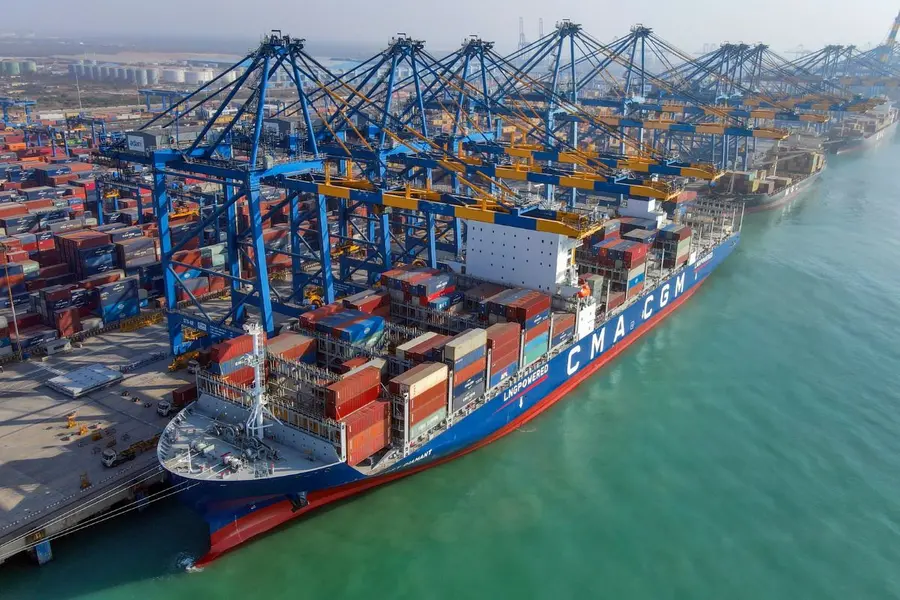
Ahmedabad (Gujarat): Adani Ports and Special Economic Zone Ltd (APSEZ), India’s largest port developer and operator, is set to take center stage at India Maritime Week (IMW) 2025, highlighting its pivotal role in advancing the nation’s Blue Economy and sustainable maritime future.
The five-day event, taking place at the Bombay Exhibition Centre, Mumbai from October 27–31, aims to bring together the global maritime community to discuss innovation, inclusion and sustainability in port-led development.
At its pavilion, Adani Ports will showcase how technology, inclusivity, Make-in-India innovation and green infrastructure are reshaping India’s maritime ecosystem. Built around four pillars — Aatmanirbhar Bharat, Women Empowerment, AI-powered Logistics and Impact — the pavilion will feature new Memorandums of Understanding (MoUs) to boost India’s port, dredging and harbour capabilities under the Make-in-India framework.
The event will also witness Prime Minister Narendra Modi’s attendance on October 29, followed by the Global Maritime CEO Forum, underlining India’s ambition to emerge as a global maritime leader.
Organised by the Indian Ports Association (IPA) under the Ministry of Ports, Shipping and Waterways, IMW 2025 will host over 1,00,000 delegates, 500+ exhibitors, 200+ global speakers and participants from more than 100 countries.
Over the last decade, India’s maritime policy has evolved rapidly through flagship initiatives like Sagarmala and Maritime Vision 2030, which together aim to transform India into a global maritime hub by promoting port-led growth, reducing logistics costs and building sustainable coastal infrastructure — all key enablers of Aatmanirbhar Bharat.
From its beginnings at Mundra Port in the 1990s, APSEZ has grown into a network of 15 ports across India and four international locations, backed by 12 multimodal logistics parks, 132 rakes and a fleet of over 5,000 vehicles. The company now handles nearly one-fourth of India’s total cargo, making it the country’s largest integrated transport utility.
Under its Harbour Business, APSEZ will sign multiple MoUs to reinforce its marine services leadership with
- Mumbai Port Authority (MBPA) for the supply and charter hire of six ASTDS tugs for seven years and one Green (GTTP) tug for 15 years.
- VO Chidambaranar Port Authority (VOCPA), Tuticorin, for the charter hire of two harbour tugs for seven years.
- Chennai Port Authority (ChPA) for one 60 TBP Escort Tug Vessel (ETV).-
- Directorate General of Shipping (DGS) for the construction of 12 tugboats, to be signed on October 29 in the presence of PM Modi.
In the dredging space, APSEZ will also ink an MoU to construct a self-propelled grab dredger, strengthening India’s indigenous maritime engineering capabilities.
The company will announce new strategic projects at Vadhvan Port, Haldia Port, Vizhinjam LNG bunkering, and Dighi Port, reaffirming its commitment to green capacity building.
A standout feature at the APSEZ pavilion is India’s first Trailing Suction Hopper Dredger (TSHD) simulator, developed indigenously by ARI Simulation under the Make-in-India program. The simulator underscores India’s growing engineering self-reliance and supports Sagarmala’s goal of expanding port capacity via domestic manufacturing.
Inclusivity remains central to APSEZ’s operations. At Vizhinjam Port in Kerala, India’s first transshipment hub, the company has trained and deployed the nation’s first women quay crane operators, reflecting how technology and skill development can drive equality in maritime jobs.
Its Zero Touch Multi-Modal Logistics Platform, powered by AI-based predictive analytics, integrates ports, rail, road, and inland waterways — reducing logistics costs and enhancing efficiency to strengthen India’s trade competitiveness.
India’s Blue Economy, currently contributing about 4% of GDP (USD 13.2 billion), is rapidly expanding across fisheries, renewable energy, coastal tourism, and logistics. With 100% FDI permitted in port infrastructure and green schemes like the Green Tug Transition Programme (GTTP) and Harit Sagar Guidelines, sustainability and self-reliance are becoming key growth drivers.
With a global presence in Haifa (Israel), Colombo (Sri Lanka), Queensland (Australia), and Dar es Salaam (Tanzania), Adani Ports continues to strengthen India’s SAGAR Vision (Security and Growth for All in the Region) — promoting regional trade resilience and cooperation.
ANI
Published: 26 Oct 2025, 02:47 pm IST
Related Topics
Disclaimer: Kindly avoid objectionable, derogatory, unlawful and lewd comments, while responding to reports. Such comments are punishable under cyber laws. Please keep away from personal attacks. The opinions expressed here are the personal opinions of readers and not that of Mathrubhumi.
