
Central government employee unions have intensified demands for restoring the Old Pension Scheme and revising the Terms of Reference of the 8th Pay Commission
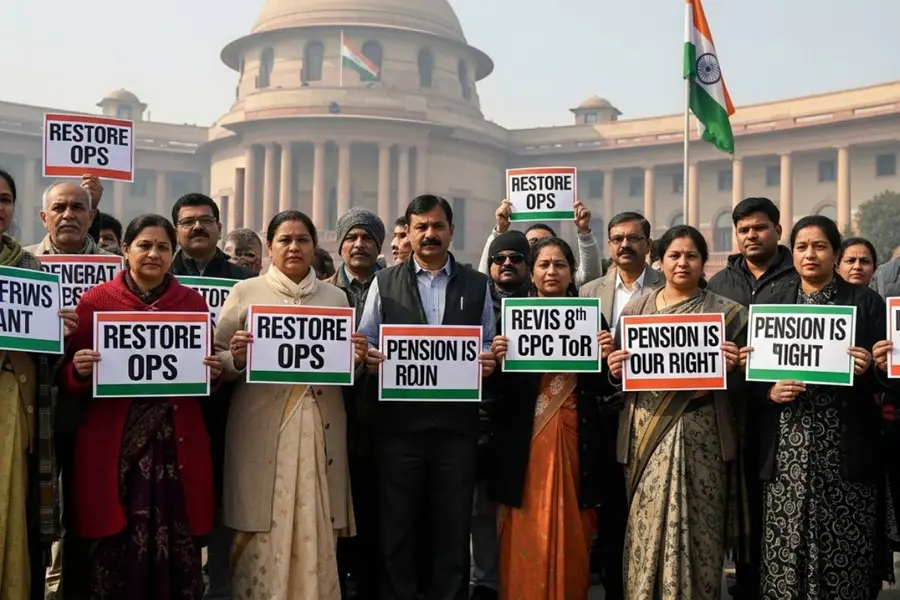
The 8th Pay Commission has come under renewed scrutiny as central government employee unions intensify their push for major changes to its Terms of Reference, arguing that key provisions affecting salaries and pensions have been overlooked.
What is the Pay Commission and what is the 8th Pay Commission?
A Pay Commission is a government-appointed body that reviews and recommends changes to the salary structure, allowances and pension benefits of central government employees and pensioners. Its recommendations help decide how much employees are paid and how their pensions are revised.
The 8th Pay Commission (8th CPC) is the latest panel set up to review pay and pension structures for nearly 50 lakh central government employees and around 69 lakh pensioners. Approved by the Union Cabinet on 3 November 2025, it will replace the 7th CPC system once its recommendations are finalised and implemented.
Why is the 8th Pay Commission back in focus?
The 8th Pay Commission has come under renewed scrutiny because employee unions claim that important provisions affecting salaries, pensions and retirement security have been left out of its Terms of Reference (ToR). Their demands have also revived the push to restore the Old Pension Scheme (OPS), which they argue offers guaranteed benefits that the National Pension System (NPS) and Unified Pension Scheme (UPS) cannot provide.
Why has the NC JCM written to the Prime Minister?
The National Council (Staff Side) of the Joint Consultative Machinery (NC JCM) has written to Prime Minister Narendra Modi seeking amendments to the 8th CPC’s Terms of Reference. The body says crucial clauses included in earlier Pay Commissions are missing this time, and these omissions could adversely affect central government staff, pensioners and Armed Forces personnel.
The letter has also been sent to finance minister Nirmala Sitharaman for urgent action.
What changes does the NC JCM want in the 8th CPC ToR?
The unions want several corrections to bring the ToR in line with earlier commissions. Their key demands include:
• Restoring the “expectations of stakeholders” clause removed from the ToR
• Reintroducing pension revision for all existing pensioners
• Explicitly including restoration of the Old Pension Scheme (OPS) as an item
• Removing the phrase “unfunded cost of non-contributory pension schemes”
• Declaring 1 January 2026 as the effective implementation date
• Granting 20% interim relief to employees and pensioners until the final report is released
Unions say removing references to stakeholder interests sends a worrying message about the government's intentions.
Why is the Old Pension Scheme back in demand?
Employee bodies say a large number of central government employees have refused to shift to the Unified Pension Scheme (UPS) ahead of the 30 November deadline. They argue:
• OPS provides a guaranteed lifelong pension, unlike the market-linked NPS and UPS.
• Calling OPS an “unfunded cost” treats pension rights as financial burdens rather than entitlements.
• Employees want stability and predictability in retirement, which they believe only OPS provides.
This is why restoring the Old Pension Scheme has re-emerged as a central demand.
What concerns exist about pension revision under the 8th CPC?
Although the government has stated that pensioners will be included under the 8th CPC, the current ToR does not clearly mention pension revision. The NC JCM has asked the government to add specific assurances such as:
• Restoring commutation benefits after 11 years
• Providing a 5% additional pension every five years after retirement
• Ensuring uniform pension revision for all existing pensioners
Employee unions say these clarifications are essential to avoid confusion before the final recommendations are made.
When will the 8th Pay Commission be implemented?
The 8th CPC was approved on 3 November 2025. Based on past timelines, implementation usually takes 18–24 months after the Commission submits its report.
This means the new pay and pension structure may come into effect around mid-2027 or early 2028.
Who will benefit from the 8th CPC?
The 8th Pay Commission will apply to:
• Nearly 50 lakh central government employees
• Around 69 lakh pensioners
• Defence Services personnel
• Employees of certain autonomous and allied bodies
Commission members:
• Justice Ranjana Prakash Desai – Chairperson
• Pulak Ghosh, Professor at IIM Bangalore – Part-Time Member
• Pankaj Jain, Secretary, Ministry of Petroleum & Natural Gas – Member-Secretary
What are the current salary and pension levels under the 7th CPC?
At present:
• Minimum basic pay: Rs 18,000
• Minimum basic pension: Rs 9,000
• Maximum basic salary: Rs 2,25,000
• Cabinet Secretary-level salary: Rs 2,50,000
• Fitment factor: 2.57
• Dearness Allowance/Dearness Relief (DA/DR): 58%
A 3% DA increase adds:
• Rs 540 to the minimum salary
• Rs 270 to the minimum pension
What happens next?
Multiple employee bodies have submitted detailed representations to the government. With the NC JCM demanding a major overhaul of the 8th CPC’s ToR, the government is expected to review and possibly revise key provisions before the Commission begins drafting its report.
Whether the Old Pension Scheme will return remains uncertain, but the pressure from employee unions is steadily growing as the deadline for shifting to UPS approaches.
Published: 23 Nov 2025, 05:12 pm IST
Disclaimer: Kindly avoid objectionable, derogatory, unlawful and lewd comments, while responding to reports. Such comments are punishable under cyber laws. Please keep away from personal attacks. The opinions expressed here are the personal opinions of readers and not that of Mathrubhumi.
