
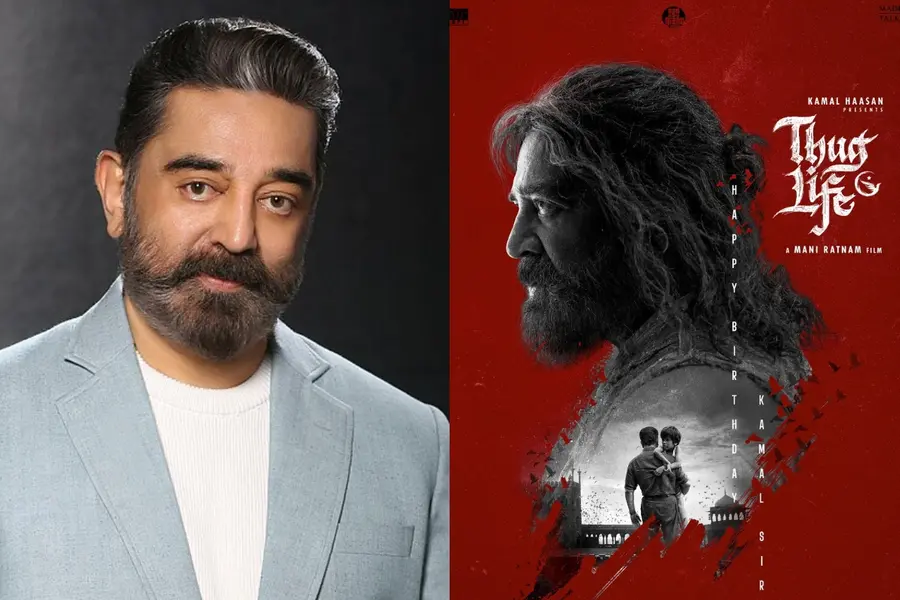
When a legendary filmmaker like Mani Ratnam joins forces with a powerhouse like Kamal Haasan, expectations soar—and rightfully so. ‘Thug Life’, their much-awaited reunion, promised cinematic brilliance, bolstered further by a talented ensemble cast featuring Silambarasan TR (STR), Nassar, Joju George, and Ashok Selvan, among others. But despite the buzz and build-up, the film, released on Thursday amidst its share of controversies, falls painfully short. What unfolds on screen is not a gripping saga, but a drawn-out misfire that leaves you watching the clock more than the story.
The story opens with Rangaraaya Shaktivel (Kamal Haasan) standing in the middle of a farm, recounting how Yamraj—the God of Death—has been after him since before he was born, and how he has repeatedly escaped death. It then cuts to a time when Shaktivel becomes a powerful gangster in Delhi who is wanted by the police. Meanwhile, Sadanand (Mahesh Manjrekar), his rival gang leader, meets him for a compromise, but instead, tips police about Shaktivel’s presence, leading to a shootout at a residential area, killing an innocent newspaper hawker. The man is left behind by his two young children, Amaran and Chandra, who also get separated in the shootout. While Amaran is rescued by Shaktivel and is brought up by him as his own, Chandra goes missing.
The timeline then moves forward to 2016, when Shaktivel’s elder brother Manickam’s (Nassar) daughter commits suicide after Sadanand’s nephew (played by Rohit Saraf) impregnates her and abandons her. This leads to Shaktivel and grown-up Amaran (STR) avenging her death by killing Sadanand’s nephew. Shakivel goes to jail for the murder and hands over the charge of his gang to Amaran in his absence. During his time in jail, Amaran strikes a business deal with Sadanand and convinces Shaktivel for it too. However, Shaktivel is soon brutally attacked by Sadanand’s elder nephew (Ali Fazal), which not only injures him but also causes a rift between Shaktivel and Amaran. The rest of the story traces how Shaktivel and Amaran’s bond transforms from that of a father and son to bitter enemies.
‘Thug Life’ starts on a pretty good note with some sleek action sequences, pacy background score, and some humanised stories. Before you know it, the story dives headfirst into the all-too-familiar territory of suspicion, scheming, and vengeance. It’s a done-to-death plot which is so predictable that you don’t even want till the end to know what’s going to happen eventually. The storyline is so weak that it completely makes you forget that it’s a Mani Ratnam film, or that it’s co-written by the director and Kamal.
One of the factors, apart from Mani-Kamal’s reunion, that made ‘Thug Life’ a highly anticipated film was its stellar cast. Unfortunately, here too, it turned out to be a letdown. With actors such as Kamal, STR, Nassar, Joju, Ashok, Trisha, Aishwarya Lekshmi, and Abhirami, among others, there were high expectations that the film would deliver power-packed performances by each one of them. Contrary to expectations, it doesn’t.
While Kamal delivers a commanding performance and holds his ground with ease, the rest of the cast is left with little to work with. STR, who plays the second most pivotal role after Kamal, makes a solid impact in the first half, but his character fizzles out in the second, offering barely anything of value, leaving a sense of letdown. Nassar and Joju face a similar fate, their talents underutilised and their presence reduced to mere plot fillers. Trisha’s character, Indrani, is the most baffling of all—neither emotionally resonant nor narratively relevant. Despite her screen presence and capability, she's saddled with a role so thinly written and seemingly inserted for glamour alone that it adds nothing to the story and leaves you wondering why she was there at all. Aishwarya as Chandra comes and goes, and Ali Fazal as Deepak is reduced to a sidekick.
What doesn’t completely disappoint about the film is its music. Mani got his favourite musician on board once again - AR Rahman. The two delivered a solid music and background score for their last venture, ‘Ponniyin Selvan’, and so were the expectations with this one too, given their track record. Rahman has succeeded in giving a score that’s catchy and pacey on occasion, yet it isn’t the best of his works. It does leave you a little upset, for you expect only a masterclass in music from him, but it’s still better than what the rest of the movie is.
If you are planning to go to the theatres to watch this mega reunion of the two stalwarts of Tamil cinema, know that you will be left heavily disappointed.
Rating: 2 out of 5 stars
Published: 05 Jun 2025, 02:59 pm IST
Related Topics
Disclaimer: Kindly avoid objectionable, derogatory, unlawful and lewd comments, while responding to reports. Such comments are punishable under cyber laws. Please keep away from personal attacks. The opinions expressed here are the personal opinions of readers and not that of Mathrubhumi.
