
From the Swiss Alps to the mustard fields of Punjab, Raj and Simran’s love story remains a cinematic milestone, proving that some magic never fades.
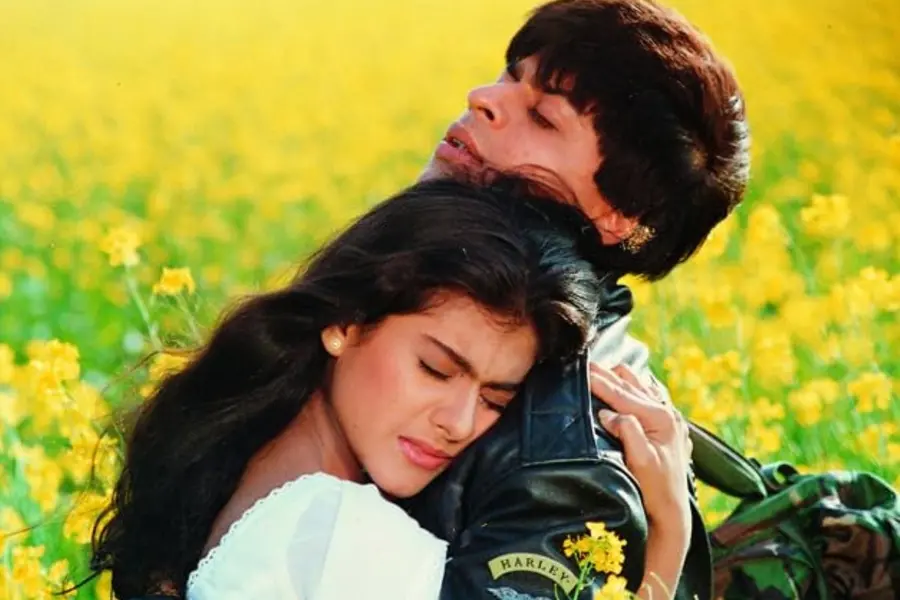
Can a film age like fine wine – growing mellower and richer with time – while still feeling out of step with today’s fast-changing world of swipe-right and swipe-left love? ‘Dilwale Dulhania Le Jayenge’ (‘DDLJ’) is that paradox. The Shah Rukh Khan–Kajol classic, released 30 years ago on October 20, 1995, continues to be adored by generations even as its conservative, patriarchal lens sits awkwardly in the age of modern dating.
“Come fall in love,” promised the film’s tagline – and audiences did, and still do. For some, the film rekindles an old flame; for others, it ignites a new one.
A romance for the ages
Aditya Chopra’s directorial debut followed the story of two London-bred youngsters, Raj and Simran, who fall in love during a European holiday but vow not to marry until their families approve. What began amidst the Swiss Alps and ended in the mustard fields of Punjab became one of Indian cinema’s most enduring love stories.
Even three decades later, ‘DDLJ’ continues to play every morning at Mumbai’s Maratha Mandir theatre, a record-setting run that few films can boast of. “Couples, young and old, come to the theatre even today to watch the romance, sepia tinted maybe but still fresh and gentle,” said Manoj Desai, executive director of Maratha Mandir.
On weekdays, between 70 and 100 people attend the 11:30 a.m. screening, while weekends draw 200 to 300 moviegoers. Tickets remain priced at Rs 50 for the balcony and Rs 30 for the dress circle – a nostalgic reminder of simpler times.
The film that changed the game
According to film historian SMM Ausaja, ‘DDLJ’ struck a chord when it arrived in the mid-1990s, a period dominated by slapstick comedies. “It was a landmark film in terms of romance, music, brilliant dialogues, iconic scenes including the train sequence. Performances were top class, and had a crackling onscreen chemistry of Shah Rukh Khan and Kajol. No film has been able to recreate this kind of magic in the romantic space,” Ausaja told PTI.
With its close-knit families, strong patriarchs and nostalgic yearning for “mera desh”, the film quickly became part of Indian pop culture. Its cast – including Farida Jalal, Amrish Puri, Anupam Kher and Parmeet Sethi – helped create a perfect blend of humour, drama and sentiment.
The film’s music, composed by Jatin-Lalit with lyrics by Anand Bakshi, remains evergreen. Songs like “Tujhe dekha to ye jaana sanam”, “Mehndi laga ke rakhna”, “Mere khwabon mein” and “Ho gaya hai tujhko to pyaar sajna” continue to echo through Indian weddings and playlists. Its dialogues too – from “Bade bade deshon mein, aisi baatein hoti rahti hain Senorita…” to “Jaa Simran ja, jee le apni zindagi” – have transcended time.
Aditya Chopra co-wrote the screenplay with Javed Siddiqui, while Manmohan Singh’s cinematography and Keshav Naidu’s editing added to the film’s charm. “DDLJ”, said Ausaja, “came at the right time.”
“That film triggered the so-called NRI movies. It happens once in a lifetime. The film cemented Shah Rukh's status as a top movie star. It was like what ‘Deewar’ was for Amitabh Bachchan. The way family values were celebrated it worked big time with people across all demographics,” he said.
The legacy lives on
Over the years, filmmakers have paid homage to its iconic moments – especially the famous train sequence where Raj stretches out his hand to Simran in a climactic embrace. The image remains a symbol of love conquering all odds.
Director Hitesh Kewalya, who helmed the same-sex love story ‘Shubh Mangal Zyada Savdhan’, said referencing ‘DDLJ’ made his film more relatable to audiences. “When the time came to write 'Shubh Mangal Zyada Savdhan', I was thinking about all the classic love stories that we have seen in our Hindi cinema. And it came naturally to me that if I have to tell a love story about two men who love each other, then DDLJ would be the reference point of that,” he said.
Behind the iconic details
Every detail in the film – from the brown leather jacket in the ‘Palat’ scene to the mandolin Raj strums and the cowbell Simran hangs outside her home – carries sentimental weight. The jacket, a favourite of Aditya Chopra’s, and the cowbell, bought in Switzerland as a nod to Yash Chopra’s Punjabi roots, became part of the film’s enduring iconography.
Kajol, who was just 21 when she played Simran, believes the magic of ‘DDLJ’ cannot be recreated. “I think that if today you had to make a film, you would have to make it like 'DDLJ', but it will never be 'DDLJ'. It will have to be different. And once you change people, the atmosphere, you will have to adapt the story to the current times, society and thought processes. And that changes the entire language of the film. So you will have to create your own magic,” she told PTI recently.
(With inputs from PTI)
Published: 18 Oct 2025, 02:11 pm IST
Disclaimer: Kindly avoid objectionable, derogatory, unlawful and lewd comments, while responding to reports. Such comments are punishable under cyber laws. Please keep away from personal attacks. The opinions expressed here are the personal opinions of readers and not that of Mathrubhumi.
