
Beyond the awards and records, S. Janaki's greatness lay in the emotions she poured into every song. Colleagues often recalled that she would keep singing until she felt every note carried the exact feeling the lyrics deserved.
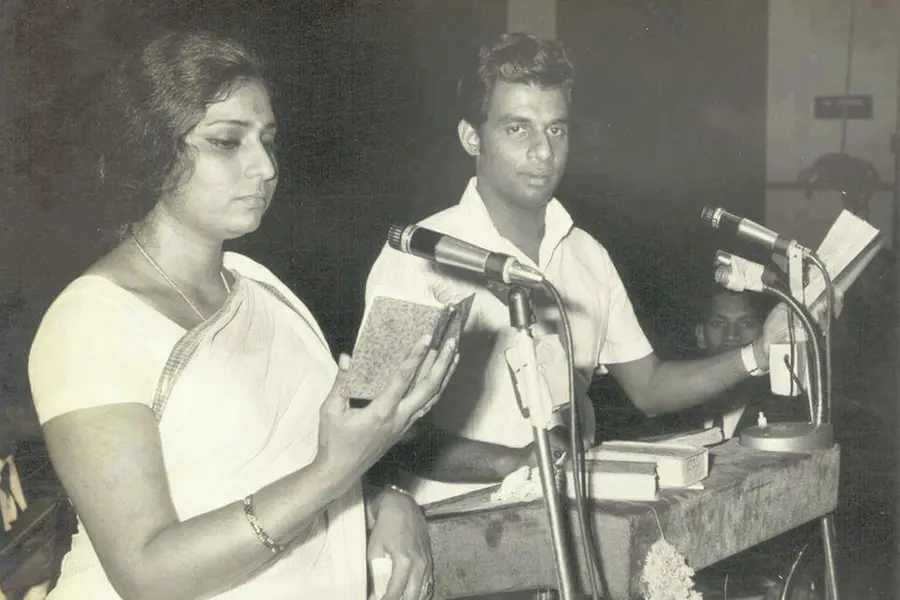
S. Janaki was ready to make any sacrifice for the perfection of every song she sang. Even if the recordist gave the "OK", she would not leave the microphone until she was completely satisfied. A perfectionist in every sense.
Poovachal Khader once shared a memorable experience about the recording of one of Janaki's most celebrated songs.
Also Read

"The famous journalist P.C. Sukumaran Nair had a room behind Chennai's Palm Grove Hotel. That's where the composing of Thakara took place. Bharathan and Nedumudi Venu were among the witnesses. As M.G. Radhakrishnan sang the tune, Venu would rhythmically tap the tabla, while Bharathan would sing along. They were unforgettable moments. It was on that celebratory night that the two songs from Thakara were born — Mauname Nirayum Mauname and Kudayolam Bhoomi Kudatholam Kulir."
The recording took place the following day. Janaki was captivated the moment she heard Mauname. The composition, with its touch of Shubhapantuvarali, flowed beautifully across three octaves.
Recalling the session, Poovachal Khader said: "There would be few songs in Janaki's musical career that she enjoyed and repeated as much. After every take, even if the recordist and music director said 'OK', Janaki would sing again, not satisfied. We who were listening were all amazed. It was impossible to say which take was the best. Every take seemed better than the previous one. Finally, when she finished singing with complete satisfaction, it was very late at night. Before leaving after the recording, she thanked us with folded hands for giving her the opportunity to sing such a beautiful song."
Janaki herself later revealed that one particular line from the pallavi always stayed with her: "Idile pokum kaattil, ivide viriyum malaril, kuliraay niramay ozhukum dukham."
She said there was a mysterious melancholy in both the lyric and its melody. "Every time it was sung, there was a silent ache in my heart."
That emotion continues to resonate with listeners even today. It was this very rendition of Mauname Nirayum Mauname that earned S. Janaki the Kerala State Award for Best Female Playback Singer in 1979.
The following year, history repeated itself.
Once again, Janaki won the State Award, this time for another collaboration between Poovachal Khader and M.G. Radhakrishnan — Nadhaa Nee Varum Kaalochana Kelkkuvaan from Chamaram, alongside songs such as Manjanikkoombil and Oru Mayilppeeleyaay.
That song, too, carries Janaki's unmistakable touch.
"Poovin kavilil thazhuki unarum puthumazhayude madhurachumbanam... kandu neram mindatha mohangal...
The singer pauses midway. Then comes a moment of silence. After the silence appears a slightly shy, affectionate smile. Behind that smile come three simple words, almost like a soliloquy: "Chamaaram veeshi nilpoo..."
The emotion Janaki infused into that single phrase remains unparalleled.
Reflecting on the lyrics, Poovachal Khader once said: "It is the emotional sweetness that Janakiyamma poured into her rendition that gave those lyrics an emotion beyond what was intended. My feeling is that the song would not have become so popular if anyone else had sung it."
Director Bharathan had always been fascinated by the light music broadcast on All India Radio. He often incorporated compositions inspired by those melodies into his films while giving them an entirely new musical identity.
Out of his admiration for the Tagore poem Nadhaa Nin Simhasanathil Bhaavaan Aaraalirangivannu, translated by G. Sankarakurup, composed by M.G. Radhakrishnan and sung by Susheeladevi on All India Radio, Bharathan decided to adapt its tune for Chamaram.
Retaining only the opening word, "Nadhaa", Poovachal Khader created a completely different lyric with a new emotional depth: "Nadhaa Nee Varum Kaalochana Kelkkuvaan Kaathorthu Njaanirunnu..."
It went on to become one of S. Janaki's greatest romantic songs.
When Janaki sang: "Thaavaka veethiyil en mizhippakshikal thooval virichu ninnu..."
Few listeners could remain untouched by its tenderness.
Bharathan also wanted one unique element in the recording — a smile in the middle of the song.
Initially, M.G. Radhakrishnan wondered whether such a smile would blend naturally with the composition's gentle flow. Janakiyamma erased every doubt. The smile she delivered seemed to emerge from the depths of her soul, becoming one of the song's defining moments.
Today, it is almost impossible to think of Nadhaa Nee Varum without remembering that unforgettable smile.
(Reprint of an article written by Ravi Menon for Mathrubhumi.com)
Published: 11 Jul 2026, 09:41 pm IST
Related Topics
Disclaimer: Kindly avoid objectionable, derogatory, unlawful and lewd comments, while responding to reports. Such comments are punishable under cyber laws. Please keep away from personal attacks. The opinions expressed here are the personal opinions of readers and not that of Mathrubhumi.