
“ Aapke paun dekhe....bade haseen hain ...inhe zameen par mat rakhiega...maile ho jaayenge”
Your feet are extremely beautiful ! don’t let them touch the ground...lest they be soiled..
A tall and dashing young man is seen boarding a train. On getting inside the compartment, he hears the jingling sound of an anklet, in sync with the rhythmic sound of the moving train. His attention falls on a lady who was sleeping peacefully. In fact he sees only the very beautiful anklet adorned, henna laced feet of the lady. Deeply affected by the beauty of her feet he writes the above mentioned lines on a paper, inserts it between her toes and very soon alights the train. Next morning the lady awakens to find the note and quiet unsurprising for a commercial Hindi movie, she falls in love with this stranger.
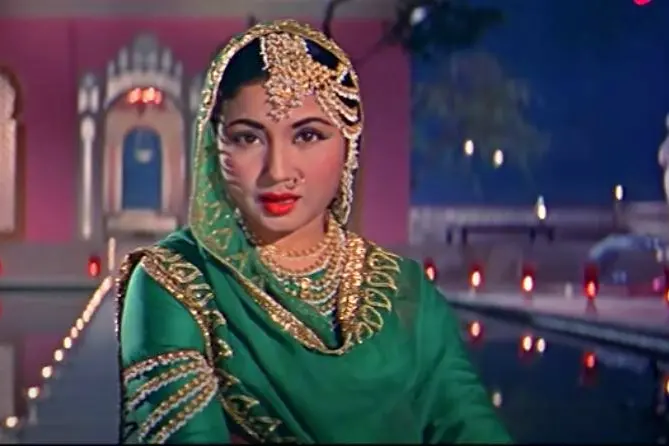
This scene, from the the famous movie 'Pakeezah', would be familiar to any ardent fan of Hindi cinema. Pakeezah is a female centric movie which tells the story of a courtesan called Sahibjaan. For a courtesan who was accustomed to the lusty and sleazy gaze of men, the note was her first taste of a sweet and innocent form of admiration. The note forms an indispensable part of the movie and whenever there is a discussion about “Pakeezah”, the note and its contents are invariably mentioned. The role of Sahibjaan was enacted by Meena Kumari, the greatest tragedinne of Hindi cinema.
'Pakeezah' also has the sad distinction of being the last movie, Meena Kumari acted in, before she bid adieu to this world.
The role of Saleem, the stranger who wrote the note was played by none other than Raj Kumar, an actor who was famous for his unique acting style and dressing sense. He acted in very few movies when compared to his contemporaries and his portrayal of Saleem in 'Pakeezah' is one of his most memorable roles.
Hindi cinema especially those from the so called golden era had a penchant for courtesans and nautch girls. There are numerous songs which have been picturised on them. In movies, like Devdas and Umrao Jaan the entire story revolves around the lives of these unfortunate women. Whenever the word courtesan is mentioned, the first thing that we are reminded of is the colourful and vibrant alleys of the old city of Lucknow. There, on either sides of these lanes were the “Kothas” or brothels, where lived these infamous nautch girls. Every night following the exit of sun from the sky, these brothels would wake up and get ready to receive their regular visitors, who were the “Nawabs” and the other rich men of the city.
One of the main reasons for Pakeezah finding a place in the list of classic movies is its musical score. There are six songs in this lyrical saga and each one of them is par excellence. The songs are so ideal for the situation that one wonders whether the songs were composed for Pakeezah or Pakeezah was made to fill up the small pause or silence between the songs.
Life in the olden days was simple and slow paced. People had enough time for the finer aspects of life. Over the years life became fast and mechanical. Every art form and literature is a reflection of the society at that point in time, music being no exception. The society was changing and so was music. The slow and melodious songs by the likes of Madan Mohan, Naushad, Roshan, C.Ramachandra etc hardly had any takers. Their creations were getting replaced by the fast and catchy songs by R.D.Burman and Lakshmikant Pyarelal.
Pakeezah was directed by Kamal Amrohi, the estranged husband of Meena Kumari. Starting from the movie “Mahal” he had never shied away from taking the uncharted path. He had conceived Pakeezah as a musical and inspite of the difference in opinion and resistance from his friends and well wishers , he chose Ghulam Ahmed to compose music for it.
GhulamAhmed, who had once worked as an assistant to Naushad, belonged to the older generation of music directors. Unfortunately he didn’t live long enough to see Pakeezah reach the silver screen. His unfinished work , including the background score was later completed by Naushad. The lyrics for the songs in 'Pakeezah' were written by Kaifi Azmi, father of the well known actress Shabana Azmi.
'Pakeezah' took sixteen years for its completion. The shooting started in the year 1956, at a time when Kamal Amrohi was still happily married to Meena Kumari. He had met Meena Kumari way back in 1938, when she was only five years of age. As destiny would have it, they met years later on the sets of the movie “Tamasha”. Kamal Amrohi was on the lookout for a female lead for his upcoming movie “Anarkali”. Meena Kumari had by then blossomed into a beautiful young woman. He offered her the lead role in “Anarkali”. Unfortunately, soon after the contract was signed, she had a road accident , and was bed ridden for four months. The movie got shelved, but there were better things in store for both of them. Kamal Amrohi became a regular visitor at the hospital where Meena Kumari was being treated and very soon love blossomed between them. Kamal Amrohi was an educated man and had great interest in poetry and literature. His intellect found a perfect mate in Meena Kumari. In spite of the age difference and the fact of him being a married man they secretly got married in the year 1952. When her father came to know about this union he got very angry and asked his daughter to leave Kamal Amrohi.
Instead she chose to leave her house forever and went on to live with her husband. Though Kamal Amrohi was an orthodox man he agreed to let Meena Kumari pursue her passion for acting, albeit with certain conditions. Over time she started flaunting the rules put forward by him and differences started creeping in. Meena kumari is considered to be the greatest Indian actress ever. She was also more popular and sought after than her husband. Jealousy, which “the bard” had famously called “the green eyed monster” started playing its dirty tricks on him. The insecurity that stemmed from this inferiority complex made him abuse her both physically and mentally. Finally when she could take it no more she left him.
During their happier days Amrohi had promised his wife that one day he would make a movie worthy enough of her legendary acting skills and beauty. Just as Shahjahan made Taj Mahal for his wife Mumtaz Mahal, he wanted to dedicate Pakeezah to his beloved wife, Meena Kumari whom he used to lovingly address as “Manju”. Pakeezah was initially shot in black and white. Kamal Amrohi wanted nothing but the best for his movie. Hence after the advent of cinematoscope , he discarded his entire previous work and started shooting Pakeezah once again in cinematoscope . But, by the time shooting for the movie restarted, his marital life with Meena Kumari had hit rock bottom. As a result of this, shooting of Pakeezah was again stopped. Many years later Sunil Dutt and his wife Nargis happened to watch the old but incomplete reels of Pakeezah and on their insistence Pakeezah was given one more chance.
Of the twelve musical gems that were presented to Kamal Amrohi by Ghulam Ahmed, only six were included in the movie. Kamal Amrohi, the perfectionist had picturized every shot, every set and every camera position in his mind, before the work began. Not only the costumes, even the bangles worn by Meena Kumari in the movie were personally selected by him. On his part Kamal Amrohi kept his promise. Meena Kumari had never looked as beautiful as she did in Pakeezah. This was not an easy task if one considers the fact that she was already in the final stage of liver cirrhosis which made her look bloated up and very old.
As mentioned before, the six songs by themselves are more than enough to give an outline of the story of Pakeezah. “Inhin logon ne” , the very first song of the lot introduces us to the sad life of a courtesan. Meena Kumari is seen dancing to entertain her guests who seem to look at her in a depraved manner. Kamal Amrohi was a dedicated man and he had a keen eye for details. In this song, the background shows a similar building where yet another nautch girl is seen dancing, almost imitating the steps of Meena Kumari.
The song “Inhin logon ne” is followed by another famous and evergreen song, “Chalte Chalte” which happens soon after the train journey. The lines “Chalte, Chalte....Yun Hi Koi Mil Gaya Tha” can be roughly translated as, “ while walking through the lanes of my life, I got to meet someone”. The song ends with the shrill whistle of a train, which reminds Saahibjaan of the fateful train journey that had changed the course of her life forever. More than the happiness and glow of a newfound love, it is profound sadness that we see on her face, as she is reminded of the reality of her life and the enormous social distance separating her from her lover.
The next song is Thade Rahio which is again what is popularly known as a “mujra”. Watching Meena Kumari in Pakeezah, it’s very hard to believe that she had reached the fag end of her life. In spite of her deteriorating health due to a severely damaged liver she gave a stellar performance. In many scenes and dancing sequences she was too weak even to stand up and Kamal Amrohi had to alter these scenes.
The remaining three songs take place after Saahibjaan meets Salim. These are ''Mausam hai aashiquana”, Chalo dildar chalo and the last song “Teere Nazar Dekhenge”.
“Chalo dildar chalo” is the only duet song in the movie. Let us imagine two lovers walking hand in hand under a moonlit sky with the moon and stars being the only witnesses to this rendezvous of theirs. If we are to pick one Hindi song befitting this night, it is “Chalo dildar chalo”. The song was supposed to be picturised on Rajkumar and Meena Kumari. Unfortunately, by the time the shooting of the song started Meena Kumari was hospitalised. This can be easily made out by watching the visuals, as the face of the Saahibjaan remains concealed throughout the song.
The title of the movie“Pakeezah” in Urdu means “The pure one”. At first glance it seems very odd to name the story of a courtesan as Pakeezah. Such was the love of Saleem for Saahibjaan that he wanted to marry her even after knowing that she was a courtesan. He takes her to a Quazi to solemnise their marriage. On seeing her reluctance in answering when the quazi asks her name, Saleem, without even blinking an eyelid answers, “Pakeezah” and Saahibjaan for the first time in her life gets to know the meaning of true love.
The last song in the movie is “ Teere Nazar Dekhenge”, where Saahibjaan is seen performing on the day of the marriage of Saleem to another lady. While dancing she breaks a glass lamp on purpose and dances on its broken pieces. Her beautiful feet, the feet which Saleem had fallen in love with, the feet from where the saga of their love began, is seen to be a smeared with blood. This being symbolic of her broken heart, her shattered dreams and a bitter end to her only chance of life and happiness.
Pakeezah was to Meena Kumari what Mughal e Azam was to Madhubala. The movie had a happy ending, but unfortunately that cannot be said about our tragedienne Meena Kumari. She died a few days after the release of Pakeezah due to liver cirrhosis, a result of her heavy drinking. She was only thirty eight years of age at the time of death. This great actress made a grand exit from silver screen as well as her life with Pakeezah. Meena kumari had willed her death upon herself. If life for her was ruthless and cruel, death was more merciful in the sense that it didn’t make her wait long for it to embrace her in its arms.
Pakeezah was just a commercial movie. With time, the story line of Pakeezah has lost its relevance. The courtesans and the Nawabs don’t exist even in the memories of the residents of this old city. The colourful and vibrant alleys of Lucknow has lost most of its old world charm. Gone are the lazy evenings filled with dance and music. The beat of the tabla and the clinking of the anklet have been replaced by the cacophony of the modern life. Kamal Amrohi’s “Pakeezah” has been lost forever in the mists of time. If there is one thing in Pakeezah that has and will continue to endure the assault by the merciless time, it is its music. The music that was created with love and passion by the combined effort of great personalities like Kamal Amrohi, Gulam Ahmed, Naushad, Kaifi Azmi and numerous others who were involved in it. The music which is a testimony of an era gone by when even the flow of the sands of time had a rhythm to it.
Published: 13 Nov 2020, 10:10 am IST
Related Topics
Disclaimer: Kindly avoid objectionable, derogatory, unlawful and lewd comments, while responding to reports. Such comments are punishable under cyber laws. Please keep away from personal attacks. The opinions expressed here are the personal opinions of readers and not that of Mathrubhumi.