
Filmmaker Manu Ashokan opens up about the message behind ‘Eyes’, the dangers of romanticising stalking on screen, and why possessiveness should never be mistaken for love.
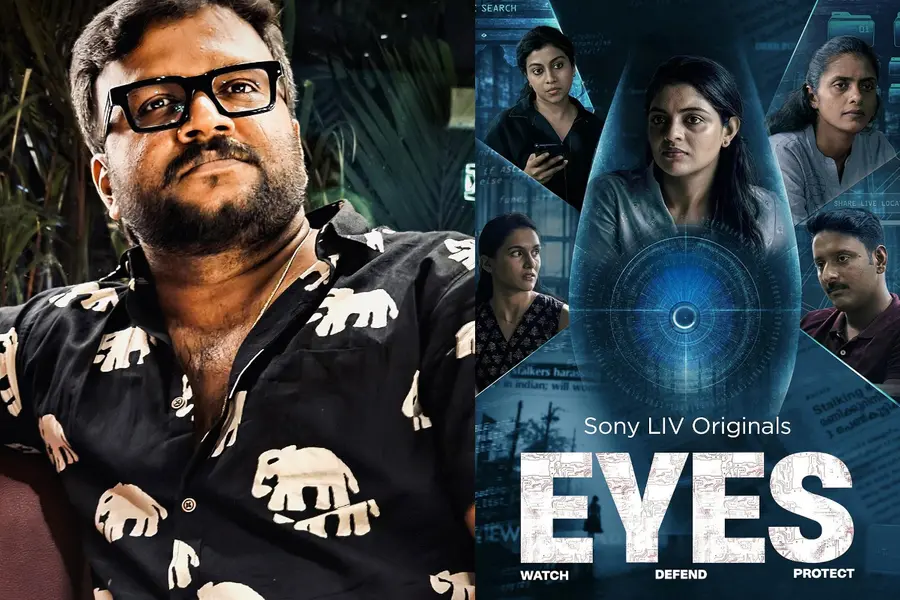
Possessiveness is often mistaken for passion, control is disguised as concern, and stalking is romanticised as love. But when does affection turn into obsession? With his latest Malayalam web series ‘Eyes’, streaming on Sony LIV, filmmaker Manu Ashokan attempts to draw a clear line between love and toxic behaviour. In an exclusive conversation with Mathrubhumi English, the ‘Uyare’ director discusses the need to stop glorifying stalking in cinema, how manipulation and control cut across social classes, and why changing mindsets is key to preventing such behaviour.
Possessiveness is often mistaken for passion, control is disguised as concern, and stalking is romanticised as an expression of love. But where does affection end and obsession begin? With his latest Malayalam web series ‘Eyes’, which is premiering on Sony LIV, filmmaker Manu Ashokan seeks to challenge these blurred boundaries, exploring how toxic behaviour can cut across social classes and relationships, often remaining unrecognised until it escalates.
In a conversation with Mathrubhumi English, the filmmaker discussed the thinking behind the series, the need to stop romanticising stalking in cinema, and why real change must begin with a shift in mindset. Read excerpts:
Q. The biggest strength of ‘Eyes’ is that it captures the fear women experience when someone crosses the line and becomes obsessive with them. So what do you want the audience to understand about this kind of fear through the series?
Manu: Unfortunately, when we talk about the technical aspects or the disturbing realities portrayed in a web series like Eyes, the first reaction is often, ‘This should never have happened.’ I made Uyare, my first film, which was based on an acid attack, and there have been many such incidents since then. Through Eyes, too, we want to create awareness among audiences about what should never happen and what we can do to prevent it.
We can suggest solutions through technology, policing, psychology or systemic reforms. But real change must begin at home and in the environment we grow up in, in how we treat both men and women. Ultimately, it comes down to our mindset. That is the most important message we want to convey through Eyes.
Don't call it love or romanticise it. There is a real danger in such behaviour. But it is not enough to simply identify or label that danger; we must also find ways to address it and prevent it. That is what we are trying to communicate through Eyes. As you pointed out, the trauma is borne by women and other people who are affected. But we also need to address the mindset of those who engage in such behaviour, challenge their understanding of what is right and wrong, and figure out how to prevent these incidents before they happen.
Q. In the series, ‘Eyes’ is basically a task force which tries to identify and intervene with the potential stalkers, even before their behaviour escalates to a deeper extent. Do you think something like this can actually work in real life? And how did you come up with this idea?
Manu: No, there is no such task force in reality. It’s the tangible dream of ‘Eyes’. But if there was a team like this, so many of such incidents could have been prevented.
With this series, we are requesting the system or the concerned authorities, that we don't know whether it is practical to make a software like this, but we should think of something. The ‘Eyes’ taskforce is completely fictional. But it is our wish or request to the system to initiate something like this.
Q. Stalking is often romanticised in cinema. Did you consciously challenge that narrative while creating this series?
Manu: Unfortunately, there are still so many films and shows that glorify this kind of masculinity, portraying possessiveness and toxic behaviour as heroism. Even the women opposite these characters are shown enjoying such behaviour on screen, although, in real life, people understand that this is not the right way to treat someone.
Earlier, these issues were not discussed as openly as they are today. With Gen Z and the changing social landscape, there is greater awareness of what is right and wrong. Yet, possessiveness and toxicity continue to be romanticised in the name of love. We are deliberately challenging that narrative through ‘Eyes’. People need to understand that this is not love. Love is not supposed to be like this.
ALSO READ: ‘Eyes’ Review: A chilling look at stalking, obsession and the fear women live with
After watching ‘Eyes’, I have received messages from several women in the 20–25 age group who have told me that they have experienced similar trauma. Some of them have reflected on their past relationships and realised that what they had experienced was not right, and that they had been mistaken in how they understood certain behaviours. They can relate deeply to ‘Eyes’ because it makes them revisit their own experiences and recognise the mindset they had when they were in those relationships.
That is exactly what we want to challenge through this series.
Q. Sajin’s character, played by Dev Mohan, is one that actually makes you question whether he is the victim or the villain. The way it has been written, it literally blurs the line between concern, possessiveness, and control. What went behind writing such a character, and what behaviour did you want viewers to recognise as a warning sign with such characters?
Manu: The reason we wanted to incorporate this social aspect into ‘Eyes’ was something I noticed while watching a film just two or three days before I spoke about it in an interview. There was a scene in which a girl was walking when a boy approached her, professed his love for her and, when he did not get the response he wanted, poured petrol on her. What struck me was how the boy was portrayed as someone from a so-called slum or an economically disadvantaged, uneducated background, while the girl was presented as beautiful and from a supposedly higher social class.
I felt that this was not the right way to portray such incidents. These things do not happen only among people from economically weaker or less educated backgrounds. They can happen across all sections of society, including among people who occupy influential positions. That is why we deliberately created Dev's character Sajin as a collector. You would not typically expect someone in such a high-profile position to engage in this kind of behaviour, but abuse and manipulation are not confined to any particular social class.
We wanted to explore these issues across different socio-economic backgrounds. Hemant and Varsha belong to a middle-class family, while Shobitha, played by Saniya Iyappan, who portrays Sajin's wife, comes from a well-to-do family. Yet, manipulation, control, obsession and even violence can exist in these relationships, too. Sometimes, the violence is subtle, making it difficult to recognise when a boundary has been crossed.
Ultimately, we have to learn to identify that line for ourselves. There is a dialogue by Shobitha's character in which she initially interprets her husband's behaviour as excessive love or over-involvement. That is where her misunderstanding lies. She fails to recognise when his behaviour begins to cross the line from affection into control. Through her character, we wanted to show that this does not happen only between people who are dating or living separately. It can happen between a husband and wife living under the same roof, even within the confines of a single room. We need to recognise that boundary, irrespective of the relationship.
Unfortunately, women continue to bear a disproportionate share of the consequences of such behaviour, which is why we have placed women at the centre of the victim narratives in 'Eyes’.
As for how we arrived at these characters, we are aware of people who have experienced or displayed such behavioural patterns, though not necessarily through direct personal interactions. We discussed these situations while developing the characters. Sajin, for instance, was not based on any particular collector. We were thinking of a certain kind of person and the position he might occupy in society, rather than portraying a specific individual.
Q. How did you convey the fear and impact of such behaviour without resorting to graphic violence or excessive dramatisation?
Manu: Of the four case files and eight characters in ‘Eyes’, I think the Sajin-Shobitha case might feel slightly less familiar to the mass audience. The other six characters, however, are people we recognise in our everyday lives. Everyone can relate to them in some way. We encounter such people around us, even if they do not openly express what they are going through.
Personally, I know several people within my own film fraternity who deal with these kinds of issues. They may not talk about them openly, but they are struggling with them and are affected by them. These are not necessarily extraordinary or unfamiliar situations; they are realities that exist around us.
That was the approach we wanted to take with 'Eyes'. We did not feel the need to dramatise everything. Instead, we wanted to tell these stories subtly, in a way that feels real and allows audiences to recognise the situations for themselves.
Even the operational space in the series, where the police and the system work through these cases, is not designed like a highly stylised Hollywood procedural. It is simply a room where the authorities deal with the cases and work towards resolving them. We wanted the entire treatment to remain semi-realistic, keeping the characters, their circumstances and the investigation grounded in reality.
Q. Is there a scene from the series that has stayed with you - not technically but emotionally?
Manu: There are many scenes that stand out, but one that particularly resonates with me is the scene where the ‘Eyes’ team has an internal conflict with Vidya (played by Shruti Ramachandran). After returning from Tamil Nadu, the team sits together in a room and discusses the situation. In that scene, Vidya tells Tina, played by Kani Kusruti, that she is not a criminal. That moment is very touching for me.
Although it is an emotional scene, what makes it special goes beyond the emotion itself. When I look at that scene, I see myself as part of that team. We are dealing with an issue that exists in the real world, and we have to figure out how to handle it and resolve it. The question is: who is going to take responsibility for addressing such issues? How do we deal with them when they arise within our own team? That is what makes the scene so meaningful to me.
For now, that is my favourite scene. I don't know whether it will remain my favourite in the future, but at this moment, it is the one that stays with me the most.
Published: 14 Oct 2026, 07:20 pm IST
ABOUT THE AUTHOR

Related Topics
Disclaimer: Kindly avoid objectionable, derogatory, unlawful and lewd comments, while responding to reports. Such comments are punishable under cyber laws. Please keep away from personal attacks. The opinions expressed here are the personal opinions of readers and not that of Mathrubhumi.