
The group’s return comes after a nearly four-year hiatus driven by South Korea’s conscription system, requiring most able-bodied men to serve 18 to 21 months
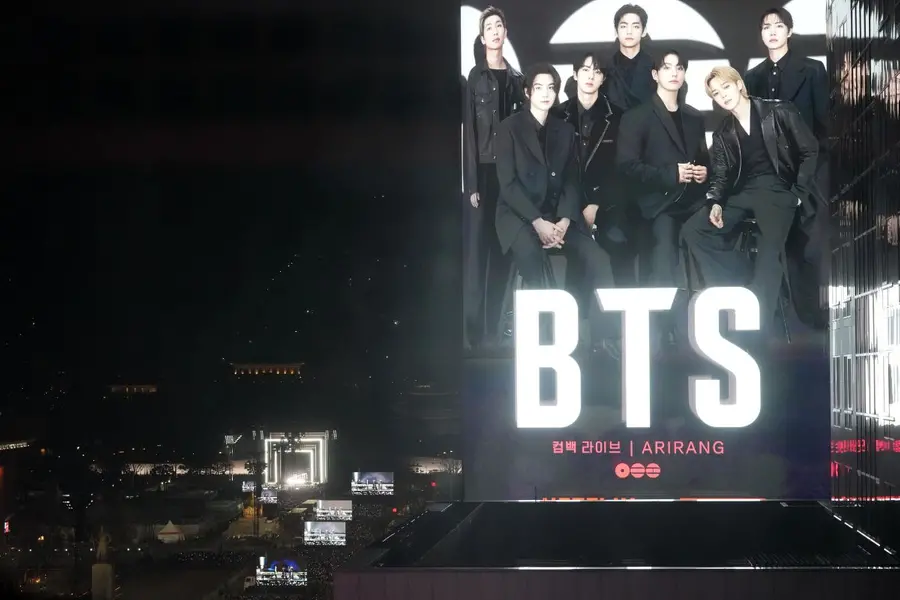
After a four-year break, BTS staged a free comeback concert in Seoul on Saturday, drawing vast crowds as authorities imposed sweeping restrictions across a central district for the Netflix-exclusive event.
All seven members — RM, Jin, Suga, J-Hope, Jimin, V and Jung Kook — have recently completed South Korea’s mandatory military service and are aiming to re-establish their position among the world’s biggest pop acts.
The performance at Gwanghwamun Square marked the start of a global tour spanning dozens of shows across the United States, Europe and Asia. Analysts say the tour could generate hundreds of millions of dollars in revenue per quarter.
Authorities expected more than 200,000 people in the Gwanghwamun area, including 22,000 fans with free seats and others gathering to watch on nearby screens. The concert, which began at 8 p.m., was streamed live on Netflix.
Police and city officials shut roads, museums and public transport links, sealed dozens of buildings and enforced what amounted to a full-day lockdown of the district. Cars were barred from the main road between Gwanghwamun and Seoul City Hall for more than 30 hours.
Security was heightened with anti-terror monitoring, surveillance vehicles and drone-jamming equipment. Shops nearby were forced to close and deliveries halted.
Fans began arriving hours in advance, queuing from midday and passing through security checks and metal detectors. Thousands of police officers maintained a tight perimeter, using fences and buses to channel crowds. Restrictions even led police to transport wedding guests to a nearby venue.
“It will be amazing because it’s been so long that BTS (was) not with us,” said Dallila Di Tullio, a 32-year-old fan from Italy.
“I was hoping to (see) if we can go through some holes or be around. Apparently we cannot because they will be asking people to move,” said Bernice Sanchez, a 52-year-old fan from Switzerland.
The concert followed the release of BTS’s fifth album “ARIRANG” on Friday, which sold nearly 4 million copies on its first day, according to HYBE.
“Annyeonghaseyo! We’re back,” RM said as the group opened with “Body to Body.” HYBE said RM had injured his ankle during rehearsal but performed with modified choreography.
The 14-track album, featuring lead single “SWIM,” was recorded in Los Angeles. Its title references a centuries-old Korean folk song associated with themes of separation and resilience.
The performance unfolded against the historic backdrop of Gwanghwamun and nearby Gyeongbok Palace. Lee Jae Myung expressed hope the event would boost the country’s cultural influence.
The group’s return comes after a nearly four-year hiatus driven by South Korea’s conscription system, requiring most able-bodied men to serve 18 to 21 months. Members began enlistment in 2022, with Suga the last to complete service in June 2025.
Crowd safety measures have been tightened since a 2022 Halloween surge that killed nearly 160 people. However, critics argued the restrictions for the concert went too far and undermined the symbolism of performing at Gwanghwamun, widely seen as Seoul’s central civic space.
The area has hosted large gatherings in recent years, including protests and vigils. About a year ago, demonstrators filled the district calling for the ouster of Yoon Suk Yeol over his brief imposition of martial law in December 2024. Those rallies, marked by music and K-pop imagery, concluded without major safety incidents.
From struggling rookies to global force
To understand the scale of BTS’s return, analysts point to the group’s early struggles within a K-pop industry shaped by government-backed expansion in the 1990s.
Unlike many acts formed under tightly controlled “idol systems”, BTS debuted in 2013 with limited resources, operating more like a small startup. Their first two albums failed commercially, leading to financial hardship and public criticism at a time when the industry was dominated by three major companies.
The group’s leader even questioned whether they would ever perform in a major stadium.
Momentum shifted in 2014 during a Los Angeles cultural festival, which helped expand their international fanbase. By 2017, BTS were winning major American awards and surpassing artists such as Justin Bieber in social media popularity.
They went on to match records set by The Beatles and Jackson 5, building a global following of around 100 million fans.
They also became the first K-pop act to top the Billboard Hot 100 in 2020 with the all-English single “Dynamite”.
Analysts say the group’s appeal lies in its focus on deeper themes, including mental health, social issues and self-identity, rather than conventional pop lyrics.
This extends beyond music. BTS have delivered speeches at the United Nations on climate change and youth empowerment, and donated to causes including Black Lives Matter and pandemic relief efforts.
For many younger fans, the group is seen as “authentic and genuine”, supported by a more flexible management approach from HYBE that allows members to express personal struggles.
BTS also departed from traditional K-pop promotion by engaging directly with fans through social media, sharing personal moments and building a sense of connection.
Their management created the Weverse platform, enabling direct interaction, exclusive content and merchandise sales within a dedicated community. This helped transform their fanbase, known as the “Army”, into an organised global force.
Fans have demonstrated unusual levels of loyalty, from buying advertising slots on television shows to sending flowers to radio stations in support of the group.
During the global pandemic, BTS adopted new technologies such as AR, VR and high-quality live streaming to stage large-scale online concerts.
One event in 2020 became the world’s largest paid online concert, attracting viewers from nearly 200 countries.
By combining traditional K-pop strategies with digital storytelling, including a fictional “BTS Universe”, the group maintained global relevance even without in-person performances.
Published: 21 Mar 2026, 05:45 pm IST
Related Topics
Disclaimer: Kindly avoid objectionable, derogatory, unlawful and lewd comments, while responding to reports. Such comments are punishable under cyber laws. Please keep away from personal attacks. The opinions expressed here are the personal opinions of readers and not that of Mathrubhumi.
