
Scientists are uncovering why mosquitoes prefer some people over others, from body odour and carbon dioxide to beer consumption and skin chemistry.
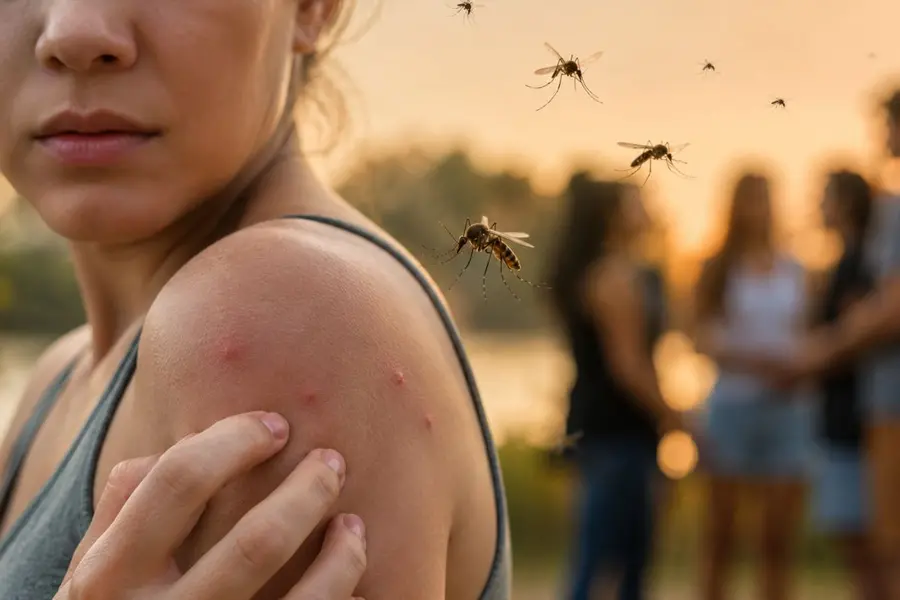
Ever wondered why mosquitoes seem determined to bite you while leaving everyone else alone? Scientists say the phenomenon is real, but the reasons are more complicated than many popular theories suggest.
Researchers studying mosquito behaviour have found that these insects rely on a combination of chemical signals, body heat and exhaled carbon dioxide when selecting their next meal. While some people consistently appear more attractive to mosquitoes, experts say this preference can also vary over time.
"It's not a misconception, mosquitoes are attracted to some people more than others," said Frederic Simard of France's Institute of Research for Development.
"But we are not all magnets all the time," the medical entomologist added.
How mosquitoes find their targets
Female mosquitoes, which are the only mosquitoes that bite humans, use highly sensitive receptors to detect potential hosts. Their search begins from a distance, long before they can see a person.
"We have known for over 100 years that mosquitoes are attracted by the carbon dioxide that we exhale, this is the first signal that triggers their behaviour" when they are dozens of metres away, Swedish scientist Rickard Ignell said.
Once they move closer, additional cues come into play.
Within around 10 metres, mosquitoes begin detecting a person's scent alongside the carbon dioxide they breathe out. This combination strengthens the insects' attraction and helps them identify a suitable host.
As they approach even nearer, body warmth and moisture released through the skin provide further signals that can make certain individuals particularly appealing.
The role of body odour
Scientists increasingly believe that the chemical compounds produced on human skin are among the most important factors influencing mosquito preference.
According to Simard, the microbes that naturally live on human skin create a complex mixture of odours. Some of these scents appear highly attractive to mosquitoes, while others are less so.
"A soup of molecules produced by our microbiota is more, or less, appealing to mosquitoes," Simard explained.
Research suggests people emit hundreds of different volatile compounds through their skin, ranging from roughly 300 to 1,000 distinct molecules. However, scientists are still working to identify exactly which ones play the biggest role in attracting mosquitoes.
What the latest research found
In a recent laboratory study led by Ignell, researchers examined how Aedes aegypti mosquitoes, known carriers of dengue and yellow fever, responded to 42 women.
The scientists identified 27 odorous compounds that mosquitoes appeared able to detect from the much larger pool of chemicals produced by the human body.
"We have shown that mosquitoes use a blend of odorous compounds (we identified 27 that the mosquitoes will detect, out of the possible 1,000) for their attraction to us," Ignell said.
The women who attracted the greatest number of mosquitoes, including several who were in the second trimester of pregnancy, produced higher levels of a compound linked to the breakdown of sebum, the oily substance naturally present on the skin.
Researchers found that even a relatively small increase in this compound, known as 1-octen-3-ol or mushroom alcohol, appeared to significantly influence mosquito attraction.
"That even a small increase of this compound, called "1-octen-3-ol", or mushroom alcohol, made a difference came as a surprise," Ignell said.
"Mosquitoes are fascinating creatures," he added.
Myths that do not stand up to scrutiny
Despite widespread beliefs, scientists say there is little evidence supporting several common mosquito-bite theories.
One persistent claim is that mosquitoes favour people with particular blood groups. Experts argue that current research does not provide convincing proof of this.
"The idea that mosquitoes prefer particular blood types "has no scientific basis," Simard said.
"There have been some studies, but only involving very few people," he said. "Nor is it related to skin, eye or hair colour," he added.
Why beer may increase your chances of being bitten
Alcohol consumption, particularly beer, has repeatedly been associated with increased mosquito attraction.
Researchers believe this may be because drinking beer can raise body temperature, alter skin odour and increase the amount of carbon dioxide released through breathing.
In one controlled study in Burkina Faso, volunteers alternated between drinking beer and water on different occasions. Researchers found that Anopheles mosquitoes, which can transmit malaria, were more attracted to those who had consumed beer.
Another study conducted in the Netherlands in 2023 involved 465 volunteers placing their arms inside cages containing female Anopheles mosquitoes. Participants who had consumed beer during the previous 24 hours were found to be 1.35 times more attractive to the insects.
A growing concern as mosquitoes spread
Understanding mosquito preferences is becoming increasingly important as warming temperatures allow disease-carrying species to expand into new regions.
The tiger mosquito, which can transmit chikungunya, has been spreading into areas where it was previously uncommon. In France, cases of chikungunya reached the Alsace region for the first time last year.
"This risk is affecting more and more people," Simard said.
How to reduce the risk of bites
While scientists continue investigating why mosquitoes favour certain people, experts recommend practical measures to reduce exposure.
Simard advises wearing loose-fitting clothing that covers as much skin as possible, using mosquito repellents and sleeping under mosquito nets where necessary.
"Try to eat light meals, and go easy on the alcohol," he added.
(With AFP inputs)
Published: 16 Jun 2026, 11:06 am IST
Disclaimer: Kindly avoid objectionable, derogatory, unlawful and lewd comments, while responding to reports. Such comments are punishable under cyber laws. Please keep away from personal attacks. The opinions expressed here are the personal opinions of readers and not that of Mathrubhumi.
