
Samantha Ruth Prabhu shared details of a Srividya ritual called Kalaa Aavarana
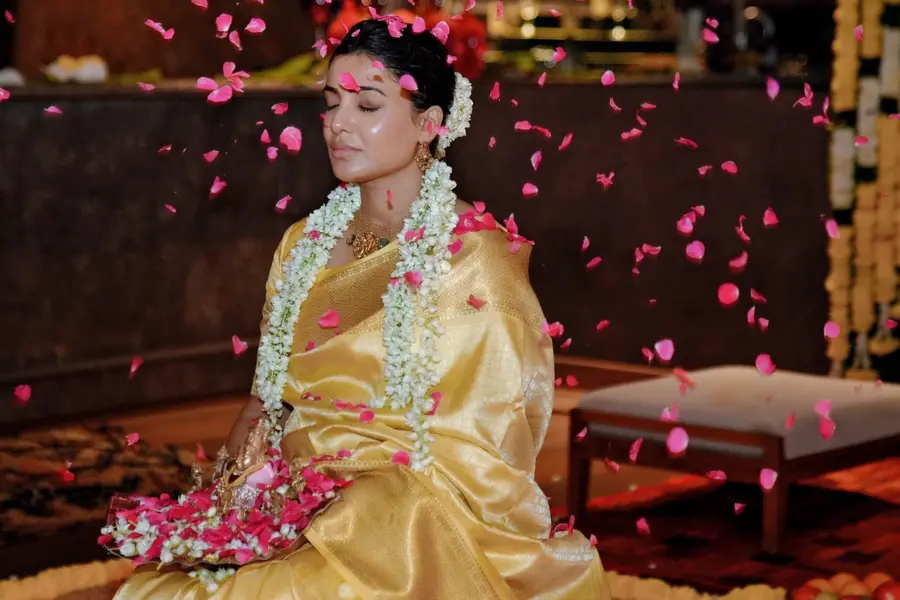
If you've been anywhere near Instagram lately, you've probably seen Samantha Ruth Prabhu's latest post doing the rounds. The mom-to-be, who's expecting her first child with husband Raj Nidimoru this December, shared a deeply personal update about a ceremony she went through and honestly, most of us had never heard the term before: Kalaa Aavarana.
Samantha didn't just casually drop the name of a ritual and move on. She wrote at length about it, and it's clear the experience stayed with her. She started by talking about how she's always felt pulled toward tradition, even without fully understanding it. In her words, she's always carried a deep respect for our traditions and specifically, she talked about believing there's something at work beyond just the surface of a ritual; in the mantras, the chanting, the way these practices have survived generations.
Also Read

What's interesting is she's upfront about not knowing all the meanings going in. It was only once the priest, described as a Srividya Upaasaka, someone trained specifically in this particular tantric-devotional lineage, started walking her through each step that things clicked for her. She talks about realising every single mantra, offering, and step had a specific purpose behind it. Nothing was random.
Also Read: Samantha’s pregnancy puts myositis in focus: Is healthy pregnancy with autoimmune disease possible?
What is Kalaa Aavarana?
Per Samantha's own description, it's also known as Sri Kalpam, and it comes from the Srividya tradition, which, for context, is one of the oldest and most intricate branches of Shakta worship in Hinduism, centred around the goddess in her form as Lalita Tripurasundari. The word "kalaa" roughly translates to a divine quality or attribute, and the ritual is built around the idea that the goddess possesses 94 such kalas, essentially 94 distinct facets or powers of the divine feminine.
The ceremony channels these through the seven chakras (energy centres) of the expectant mother's body. Priests use sacred water and specific mantras to cleanse and "energise" these centres, the intention, as Samantha put it, is inviting a kind of living consciousness to flow through the mother.
What really seemed to land for her, though, wasn't the technical mechanics of the ritual, it was the framing.
During Kalaa Aavarana, the pregnant woman isn't just a bystander at her own ceremony. She's treated as Devi herself, honoured as the one through whom new life is being created. Samantha described this beautifully, saying it felt like a blessing not only for the baby but for the woman "being born into a new version of herself."
The Sri Chakra part is where it gets really symbolic
After the abhishekam (the ritual bathing/anointing portion), the mother-to-be is seated right at the centre of a Sri Chakra Yantram, a geometric diagram that's central to Srividya worship. If you've ever seen one, it's made of interlocking triangles arranged into nine enclosures, called aavaranas, which are said to represent different stages on a spiritual journey inward. Right at the very centre sits the bindu, a single point symbolising the origin point of all creation, and, in this tradition, the seat of the goddess Lalita Tripurasundari herself.
Also Read: Samantha Ruth Prabhu shares her pregnancy workout and a message for other moms-to-be
While the mother sits there, priests recite something called the Devi Khadgamala, a long, layered chant that calls out the names of deities and divine energies tied to each of those nine enclosures. The chanting deliberately moves from the outermost layer toward the centre, symbolically drawing the mind inward, toward stillness, toward protection.
The belief, as Samantha explained it, is that all this chanting creates a kind of protective field around both mother and baby, and that the child receives a samskaara, a spiritual imprint, even before it's born.
Why she says she's grateful for it
Samantha was candid that she walked into this knowing almost nothing about what it involved. But she came out of it, by her own account, feeling deeply blessed and protected. She credited her friend Shilpa Reddy, for giving her the opportunity to go through it, and thanked what she called "the hands and hearts that created this sacred space", along with the ancient wisdom behind it all. She ended her post reflecting on the mother she's becoming and the "little life entrusted to" her.
A big part of why this post travelled so fast probably isn't just because it's Samantha. It's because pregnancy rituals like this rarely get discussed openly, especially by public figures who could easily keep their spiritual practices private.
Garbhasanskar-style traditions, the rituals meant to spiritually and energetically prepare a baby even in the womb, exist across Hindu practice in various forms, but something as specific and Srividya-rooted as Kalaa Aavarana isn't exactly common knowledge, even among people who grew up around similar customs.
It's also worth pointing out that Samantha wasn't claiming to be an expert or trying to "explain" Hindu philosophy to anyone. She was pretty clear that she went in without deep prior understanding, and that the priest guided her through it step by step.
Published: 15 Sept 2026, 05:01 pm IST
ABOUT THE AUTHOR
Disclaimer: Kindly avoid objectionable, derogatory, unlawful and lewd comments, while responding to reports. Such comments are punishable under cyber laws. Please keep away from personal attacks. The opinions expressed here are the personal opinions of readers and not that of Mathrubhumi.